
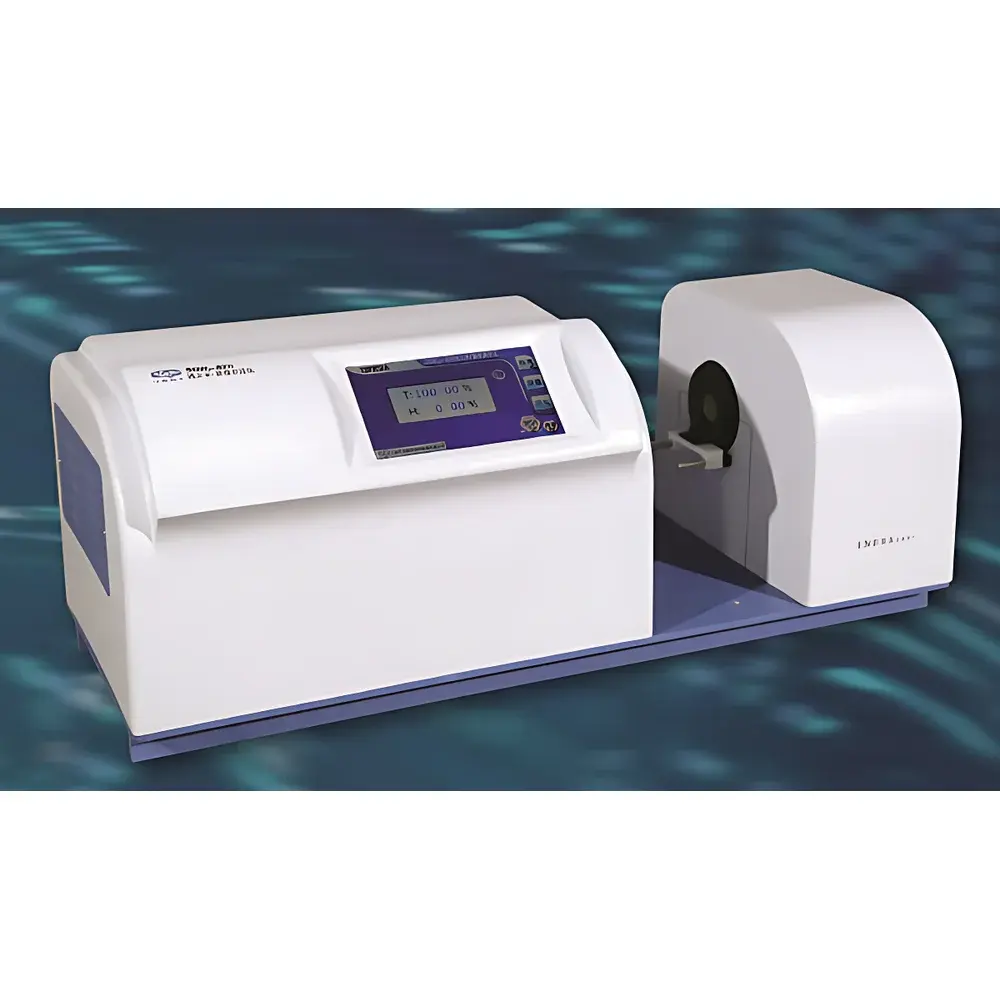
GBPI SGW-810A Automatic Haze and Luminous Transmittance Tester
| Brand | GBPI |
|---|---|
| Origin | Guangdong, China |
| Manufacturer Type | Direct Manufacturer |
| Origin Category | Domestic (China) |
| Model | SGW-810A |
| Product Type | Fully Automatic |
| Haze Range | 0–30.00% |
| Transmittance Range | 0–100.0% |
| Haze Repeatability | ±0.05% (for haze ≤0.5%), ±0.1% (for haze >0.5%) |
| Transmittance Repeatability | ±0.5% |
Overview
The GBPI SGW-810A Automatic Haze and Luminous Transmittance Tester is an ISO/ASTM-compliant optical measurement instrument engineered for precise quantification of light transmission and scattering characteristics in planar transparent and translucent materials. It operates on the principle of collimated beam illumination combined with a 4π solid-angle integrating sphere detection system—fully compliant with the geometric and photometric requirements of ASTM D1003, GB/T 2410, and JIS K7105-81. The instrument employs C-illumination (6774 K) and A-illumination (2856 K) selectable light sources to accommodate both daylight-simulated and incandescent-spectrum evaluation conditions, ensuring metrological traceability across diverse application contexts. Designed for laboratory and production-line quality control environments, the SGW-810A delivers high reproducibility in haze and transmittance measurements without requiring darkroom installation, thanks to its built-in optical modulation architecture that actively suppresses ambient light interference.
Key Features
- Fully automatic operation via embedded microprocessor control—no manual knobs or analog adjustments required
- High-resolution digital display: transmittance to 0.01%, haze to 0.01%
- Dual-standard light source selection (C- and A-illuminants) with stable spectral output and thermal management
- Integrating sphere receiver with silicon photodiode detector, optimized for diffuse + direct component separation per ASTM D1003 Annex A2
- Integrated 7-inch capacitive touchscreen interface with intuitive menu navigation and real-time data preview
- Onboard storage capacity for up to 800 test records; USB port enables direct data export to PC or external USB flash drive
- Dedicated sample handling accessories: magnetic film holder (for rigid/flexible sheets up to 2 mm thickness), liquid cuvette adapter (for turbidity assessment of aqueous solutions), and certified reference haze standard plate (non-cleanable—air-blow only)
- 30-minute warm-up stabilization protocol ensures thermal equilibrium of optical path and detector response
Sample Compatibility & Compliance
The SGW-810A accommodates flat, parallel-faced specimens including polymer films (PET, PP, PE), rigid plastic plates (acrylic, polycarbonate), coated glass substrates, lacquered metal foils, and optically clear packaging materials. Liquid samples—including purified water, pharmaceutical injectables, beverage formulations, and solvent-based coatings—are measured using the supplied quartz cuvette assembly under standardized pathlength (10 mm). All measurement protocols align with internationally recognized standards: ASTM D1003 (Standard Test Method for Haze and Luminous Transmittance of Transparent Plastics), GB/T 2410 (Chinese national standard for transmittance and haze of transparent plastics), and JIS K7105-81 (Japanese Industrial Standard for haze of plastics). Instrument calibration verification follows documented procedures traceable to NIM (National Institute of Metrology, China) reference standards. Optional GLP-compliant audit trail logging can be enabled via firmware update for regulated environments.
Software & Data Management
The embedded operating system supports structured data capture with timestamp, operator ID (optional), sample ID, illumination mode, and environmental condition tags (temperature/humidity input fields). Exported CSV files are compatible with LIMS platforms and statistical process control (SPC) software such as Minitab and JMP. USB connectivity enables seamless integration into enterprise QA/QC workflows. Firmware updates are delivered via secure encrypted USB media, maintaining version control and change documentation per ISO/IEC 17025 clause 5.9. No proprietary drivers or cloud dependencies are required—full local autonomy is preserved for data integrity and cybersecurity compliance.
Applications
- Quality assurance of optical films used in display laminates, solar panel encapsulants, and anti-glare overlays
- Batch release testing of medical packaging films (e.g., blister foil, Tyvek® lids) per ISO 11607
- Turbidity screening of parenteral solutions in pharmaceutical manufacturing (aligned with USP particulate matter guidance)
- R&D evaluation of anti-fog coatings, nanostructured diffusers, and UV-stabilized polymeric optics
- Regulatory submission support for FDA 510(k) dossiers involving transparency-critical Class II devices
- Process validation of extrusion, casting, and coating lines where haze drift indicates additive segregation or moisture ingress
FAQ
What standards does the SGW-810A comply with for regulatory submissions?
It fully satisfies the optical measurement requirements of ASTM D1003, GB/T 2410, and JIS K7105-81—and supports IQ/OQ documentation packages for GMP-aligned installations.
Can the instrument measure curved or non-planar samples?
No. The optical design assumes parallel, flat surfaces with minimal surface deviation (<0.1 mm flatness tolerance); curved, textured, or frosted samples require alternative methods (e.g., goniophotometry).
Is the reference haze standard plate NIST-traceable?
The supplied verification plate is calibrated against GBPI’s primary standard, which is periodically validated against NIM-certified artifacts; full traceability documentation is provided upon request.
Does the device support 21 CFR Part 11 compliance?
Out-of-the-box electronic records meet ALCOA+ principles; Part 11 compliance requires optional audit trail module activation and site-specific validation protocol execution.
What maintenance is required beyond daily air-blowing of the reference plate?
Annual optical alignment verification and photodiode responsivity recalibration by authorized service engineers are recommended; no user-serviceable optical components exist inside the integrating sphere housing.





