
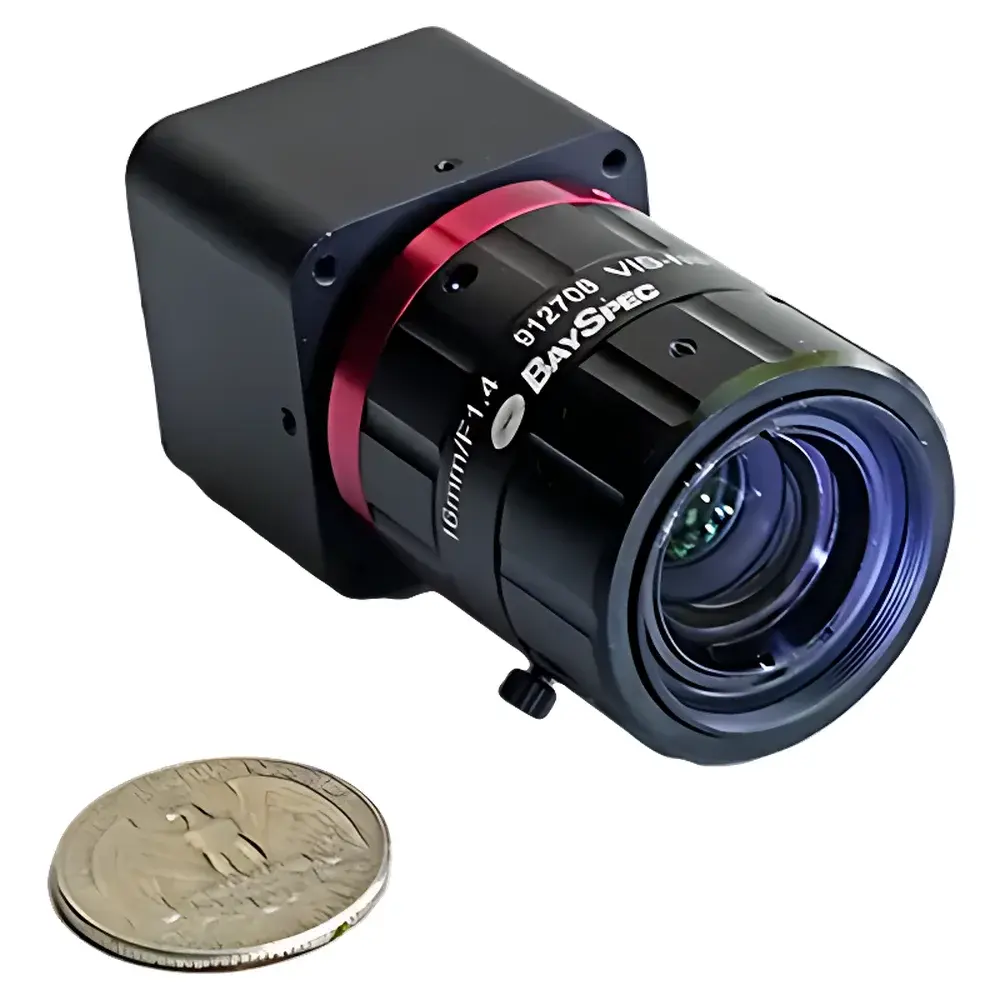
BaySpec OCI-M Compact Pushbroom Multispectral Imaging Camera
| Brand | BaySpec |
|---|---|
| Origin | USA |
| Manufacturer Type | Original Equipment Manufacturer (OEM) |
| Import Status | Imported |
| Model | OCI-M |
| Operating Principle | Pushbroom Scanning |
| Imaging Modality | 3D Hyperspectral Data Cube Acquisition |
| Deployment Platform | Ground-based and Airborne Compatible |
| Spectral Range | 400–1000 nm |
| Spectral Resolution | 5 nm (FWHM) |
| Spatial Resolution | 1000 pixels across track × L pixels along track |
| Total Field of View (TFOV) | 18° |
| Frame Rate | 120 fps |
| Interface | USB 3.0 |
| Dimensions | 30 mm × 30 mm × 75 mm |
| Weight | 117 g |
| Real-time Preview | Yes |
| Scan Time per Cube | ≤5 s |
| Data Cube Generation Time | ≤10 s |
Overview
The BaySpec OCI-M is a compact, OEM-grade pushbroom multispectral imaging camera engineered for high-fidelity spectral-spatial data acquisition in resource-constrained environments. Unlike conventional scanning systems reliant on mechanical translation stages or gimbal stabilization, the OCI-M implements a true pushbroom architecture—capturing full spectral profiles line-by-line as the sensor moves relative to the scene. This principle leverages precise optical dispersion via transmission gratings and linear CMOS detection to generate calibrated 3D hyperspectral data cubes (x, y, λ) with native spectral sampling at 5 nm resolution across the visible-to-near-infrared (VIS-NIR) band (400–1000 nm). Its core design philosophy centers on minimizing moving parts while maximizing robustness, making it suitable for integration into unmanned aerial vehicles (UAVs), handheld survey platforms, laboratory conveyors, and field-deployable ground stations. The device operates without internal motors or rotating optics—eliminating wear mechanisms and thermal drift sources common in whiskbroom or tunable-filter-based systems.
Key Features
- Ultra-compact form factor (30 × 30 × 75 mm) and low mass (117 g), enabling integration into weight-sensitive airborne payloads and portable inspection tools.
- True pushbroom scanning architecture: no moving optical components—data acquisition occurs inherently through relative motion between camera and target, supporting arbitrary scan velocities including manual panning.
- High-speed USB 3.0 interface ensures real-time data streaming up to 120 fps, with onboard buffering for uninterrupted capture during dynamic motion.
- Native spatial resolution of 1000 pixels across-track, optimized for high signal-to-noise ratio (SNR) under ambient illumination conditions typical in outdoor VIS-NIR applications.
- Integrated real-time preview engine allows immediate visual validation of spectral alignment, focus, and illumination uniformity prior to full-cube acquisition.
- Seamless hardware-software co-design reduces system-level calibration overhead; factory spectral response characterization is embedded in firmware for consistent radiometric reproducibility.
Sample Compatibility & Compliance
The OCI-M supports non-contact, standoff spectral imaging of heterogeneous surfaces—including vegetation canopies, mineral outcrops, painted substrates, biological tissues, and forensic trace evidence—without sample preparation. Its 18° total field of view enables flexible working distances from 0.3 m (macro mode) to >100 m (aerial mapping), with spatial sampling scalable via geometric projection modeling. The instrument complies with IEC 61000-6-3 (EMC emission standards) and meets RoHS Directive 2011/65/EU for hazardous substance restrictions. While not certified as medical or safety-critical equipment, its radiometric stability and traceable spectral calibration support method development aligned with ASTM E1777 (Standard Practice for Spectral Bandwidth Characterization) and ISO 15739:2013 (Imaging system noise measurement). For regulated environments, raw data output formats (e.g., ENVI-compatible BIL/BIP) facilitate downstream validation under GLP or GMP-aligned workflows.
Software & Data Management
The OCI-M ships with BaySpec’s OCI Studio—a cross-platform application (Windows/macOS/Linux) supporting live preview, automated dark/light reference capture, spectral library matching (via NIST SRD databases), and export to industry-standard formats including HDF5, GeoTIFF (with optional geotagging), and MATLAB .mat. All acquired data cubes retain embedded metadata: timestamp, GPS coordinates (when synchronized with external GNSS), exposure parameters, and temperature-compensated wavelength calibration coefficients. Audit-trail functionality logs user actions, configuration changes, and processing steps—supporting compliance with FDA 21 CFR Part 11 requirements when deployed in quality-controlled analytical settings. SDKs (C/C++, Python, LabVIEW) enable custom pipeline integration for machine learning preprocessing, real-time anomaly detection, or embedded edge inference.
Applications
- Precision Agriculture: Quantitative assessment of chlorophyll content, water stress indices (NDVI, NDRE), and nutrient deficiency mapping at sub-meter resolution from UAV platforms.
- Environmental Remote Sensing: Discrimination of invasive species, soil organic carbon estimation, and wetland boundary delineation using spectrally distinct absorption features between 650–950 nm.
- Forensic Science: Non-destructive differentiation of ink formulations, blood residue detection under ambient light, and latent fingerprint enhancement via spectral unmixing.
- Industrial Quality Control: Coating thickness verification, polymer blend homogeneity analysis, and counterfeit pharmaceutical tablet identification based on NIR spectral fingerprints.
- Academic Research: Hyperspectral dataset generation for training convolutional neural networks (CNNs) in material classification, with open-access spectral libraries available via BaySpec’s developer portal.
FAQ
Is the OCI-M compatible with third-party flight controllers or autopilot systems?
Yes—the USB 3.0 interface and standardized vendor-agnostic command protocol allow integration with Pixhawk, ArduPilot, and DJI SDK-enabled platforms via middleware such as ROS 2 or MAVLink adapters.
Does the system require external lighting for outdoor operation?
No—its quantum efficiency (>65% at 550 nm) and low read noise (<15 e⁻ RMS) enable daylight operation without supplemental illumination; however, consistent solar zenith angle improves spectral consistency across time-series acquisitions.
Can spectral calibration be performed in-field?
Yes—OCI Studio includes guided routines for white/dark reference capture using portable PTFE panels and thermoelectrically stabilized blackbody sources; factory calibration remains valid for ≥12 months under stable thermal conditions.
What is the maximum usable scan length (L) in the along-track dimension?
Limited only by host storage bandwidth and buffer memory—tested deployments exceed 10,000 lines per cube at full 120 fps, yielding data cubes >2 GB uncompressed.
Is radiometric accuracy traceable to NIST standards?
Yes—each unit undergoes end-of-line calibration against NIST-traceable tungsten-halogen and deuterium lamps; certificate of calibration is provided with serial-number-matched spectral responsivity curves.





