
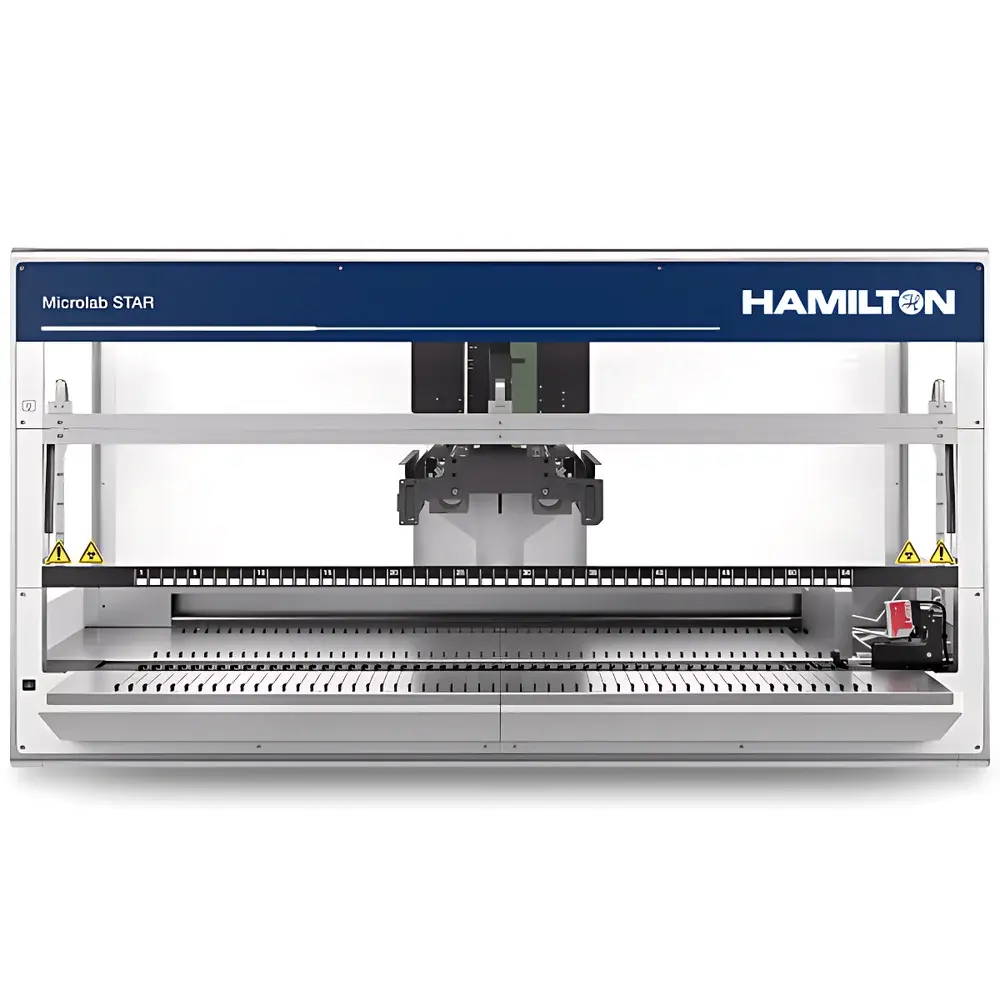
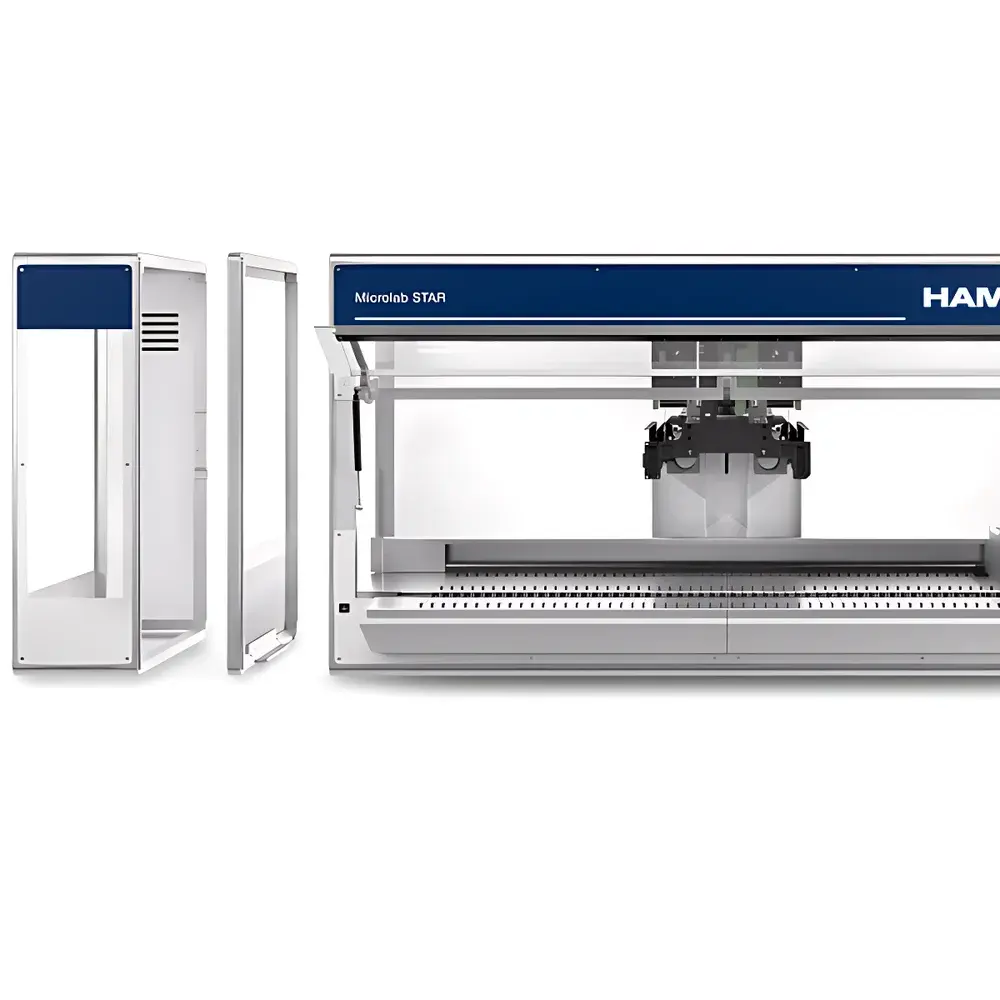
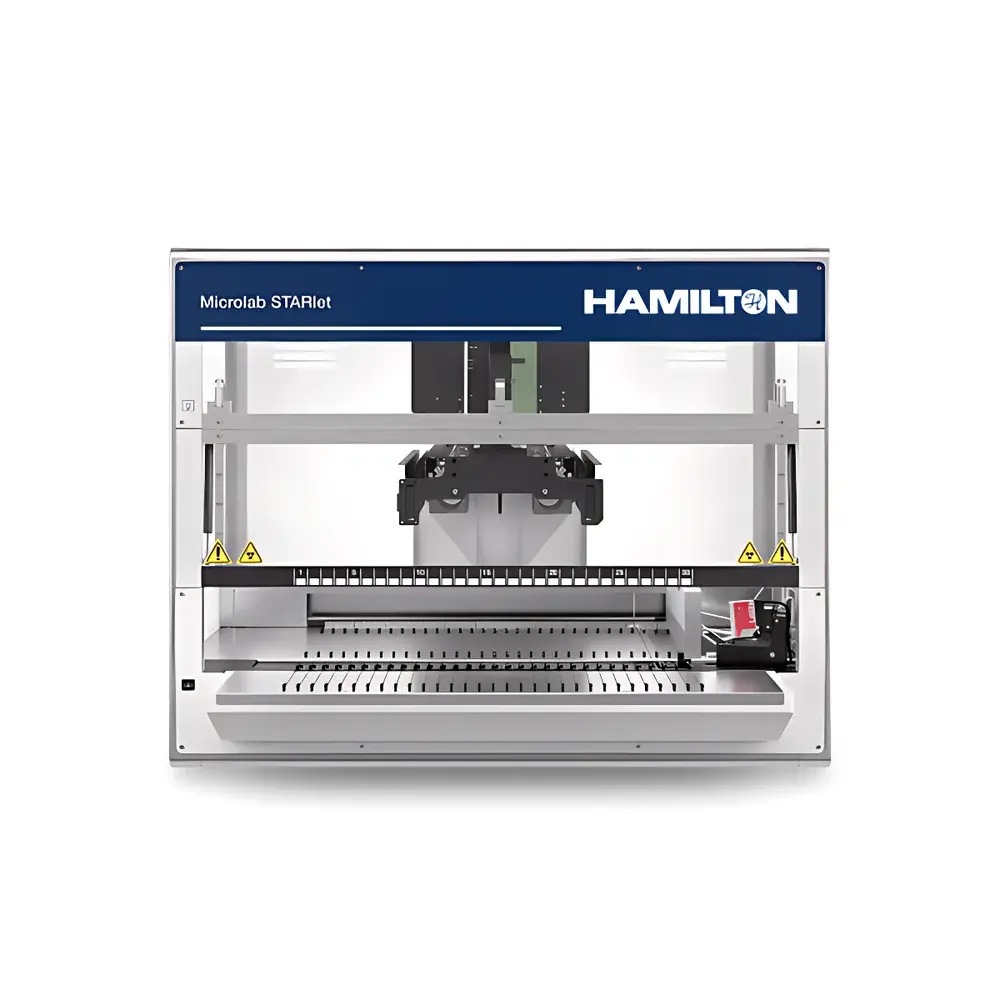
Hamilton Microlab STAR Series Automated Liquid Handling Workstation
| Brand | Hamilton |
|---|---|
| Origin | Switzerland |
| Manufacturer Type | Original Equipment Manufacturer (OEM) |
| Origin Category | Imported |
| Model | Microlab STAR |
| Plate Capacity | 25–55 SLAS/ANSI-compliant deck positions |
| Pipetting Accuracy | ±1% to ±8% (volume-dependent, per ISO 8655-6) |
| Pipetting Range | 1–1000 µL |
| Sample Throughput | Up to 384 samples per run |
| Dimensions (W × D × H) | 1664 × 795 × 903 mm |
Overview
The Hamilton Microlab STAR Series is a modular, benchtop automated liquid handling workstation engineered for precision, flexibility, and traceability in high-mix, low-to-medium throughput laboratory environments. Built upon Hamilton’s proprietary air displacement pipetting principle — validated per ISO 8655-6 for gravimetric performance assessment — the system delivers reproducible volumetric transfer across its full operational range (1–1000 µL). Its core innovation lies in the CO-RE (Combinable, Reusable, Exchangeable) pipetting architecture: a unified mechanical and software framework enabling seamless interchange of single-channel, 8-channel, 96-channel, and 384-channel pipetting tools on the same deck without hardware reconfiguration. Unlike positive-displacement systems, air displacement ensures minimal carryover, reduced maintenance frequency, and compatibility with standard polypropylene tips — all critical for assay integrity in genomics, compound management, ELISA development, and QC sample preparation.
Key Features
- CO-RE modular pipetting system supporting simultaneous use of single-, 8-, 96-, and 384-channel tools on one platform
- Real-time pipetting monitoring with anti-drip control, dual-level liquid detection (capacitive + optical), and dynamic liquid classification for non-ideal fluids (e.g., viscous, volatile, or foaming samples)
- Integrated STARwatch diagnostic suite for automated calibration verification, tip recognition via CCD imaging, and steel-pin-based tip ejection validation
- Full deck automation: 1D and 2D barcode scanning for plate, tube, and tip rack identification; robotic arm-assisted sample loading/unloading
- SLAS/ANSI-standardized deck layout accommodating 25–55 positions, optimized for integration with third-party modules (e.g., incubators, readers, centrifuges)
- Intuitive method programming environment with drag-and-drop workflow builder and built-in error-handling logic (e.g., volume mismatch alerts, tip clog detection, collision avoidance)
Sample Compatibility & Compliance
The Microlab STAR supports open-format consumables including SBS-standard microplates (96-, 384-, 1536-well), tubes (1.5–50 mL), deep-well plates, and custom labware. Its liquid handling fidelity has been verified for aqueous buffers, serum, cell lysates, DMSO solutions, and low-surface-tension solvents — provided appropriate tip selection and aspiration/dispense parameters are applied. The system complies with ISO/IEC 17025 requirements for method validation documentation and supports audit-ready operation under GLP and GMP frameworks. Optional 21 CFR Part 11-compliant software modules provide electronic signatures, role-based access control, and immutable audit trails for instrument usage, calibration events, and protocol execution logs.
Software & Data Management
VANTAGE software serves as the central control interface, offering both graphical workflow design and Python scripting capability for advanced automation logic. All protocols are stored as version-controlled XML files, enabling traceability from method creation to execution. Integrated data export supports CSV, Excel, and LIMS-compatible formats (e.g., ASTM E1384, HL7). Instrument diagnostics, calibration history, and consumable lot tracking are centrally logged and exportable for internal quality reviews. Remote monitoring via secure HTTPS connection allows real-time status checks and alert notifications without compromising network security policies.
Applications
- High-fidelity serial dilution and concentration gradient generation for dose-response assays
- Automated nucleic acid normalization and library preparation for NGS workflows
- Compound reformatting and cherry-picking from master plates into assay-ready plates
- Cell-based assay setup including co-culture seeding, cytokine addition, and media exchange
- QC/QA testing of raw materials and finished products across pharmaceutical, biotech, and clinical research settings
- Method development and validation studies requiring full parameter documentation and repeatability assessment
FAQ
What pipetting technologies does the Microlab STAR support?
It exclusively uses air displacement pipetting, optimized through Hamilton’s CO-RE mechanism for consistent plunger travel, temperature-stable air column dynamics, and minimized evaporation effects.
Can the same tip be used across different CO-RE modules?
Yes — standardized tip geometry enables identical tips to be deployed on single-channel, 96-channel, and 384-channel CO-RE heads, reducing consumable inventory and cross-contamination risk.
Is the system compatible with third-party instruments?
Yes — the deck supports SLAS/ANSI footprint standards and includes I/O ports (RS-232, Ethernet, TTL) for hardware handshake with readers, shakers, sealers, and storage modules.
How is pipetting accuracy validated?
Accuracy is verified gravimetrically per ISO 8655-6 using certified weights and Class A distilled water at 20 °C; routine checks are performed via STARwatch’s integrated calibration routines.
Does the system support audit trail generation for regulated environments?
With optional VANTAGE Part 11 software, it provides time-stamped, user-attributed, tamper-evident records of all critical operations, meeting FDA and EMA expectations for electronic records.



