
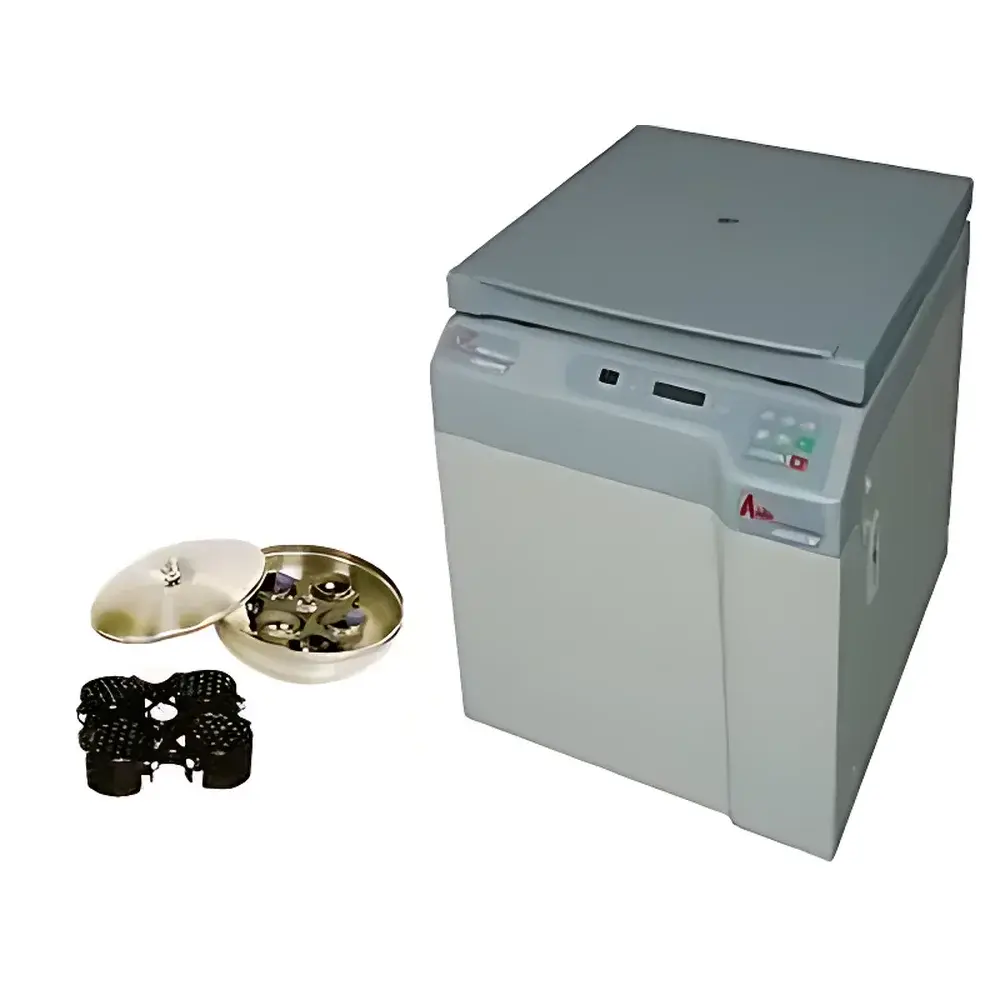
AnTing TDL-5C Benchtop Low-Speed High-Capacity Centrifuge
| Brand | AnTing |
|---|---|
| Origin | Shanghai, China |
| Manufacturer | Anting Scientific Instrument Factory |
| Model | TDL-5C |
| Max Speed | 5000 rpm |
| Max RCF | 4500 × g |
| Drive Type | Frequency-Controlled Brushless Motor |
| Control System | Microprocessor-Based Digital Control |
| Rotor Configurations | Horizontal Fixed-Angle & Swinging-Bucket Options |
| Capacity Options | 250 mL × 4, 50 mL × 8, 10 mL × 36, 15 mL × 16, 7 mL × 36, 5 mL × 36, 6 mL × 96 (RIA), 192-well Microtiter Plate (Mold Assay) |
| Safety Certification | CE-compliant design per IEC 61010-1, IP20 enclosure rating |
| Operating Ambient | 5–40 °C, ≤80% RH non-condensing |
Overview
The AnTing TDL-5C Benchtop Low-Speed High-Capacity Centrifuge is engineered for reproducible, low-shear separation of biological suspensions, clinical specimens, and bulk laboratory samples requiring gentle yet high-volume processing. Utilizing a brushless frequency-controlled motor and microprocessor-based digital control architecture, the system delivers precise speed regulation (±10 rpm accuracy across 300–5000 rpm range), real-time RCF calculation, and programmable acceleration/deceleration profiles. Its mechanical design prioritizes thermal stability and vibration damping—critical for extended runs with large-volume rotors—while maintaining compliance with IEC 61010-1 safety standards for laboratory electrical equipment. The TDL-5C is routinely deployed in hospital immunology labs, clinical diagnostic centers, and academic research facilities where consistent sedimentation of whole blood, serum, plasma, cell pellets, and immunoassay plates is required without compromising sample integrity.
Key Features
- Microprocessor-controlled operation with LCD display showing real-time rpm, RCF, time remaining, and error codes
- Brushless DC motor delivering high torque at low speeds, minimizing heat generation and extending service life
- Double-locking rotor lid mechanism with automatic imbalance detection and immediate deceleration upon threshold exceedance
- Three pre-programmed rotor configurations: Standard horizontal bucket rotor (max 250 mL × 4), RIA-specific 96-position tube carrier (6 mL × 96), and 192-well microtiter plate adapter for fungal or serological assays
- Programmable run parameters including speed (rpm), time (1 s–99 min 59 s), and acceleration/deceleration ramp rates (soft stop option available)
- Stainless-steel chamber interior and corrosion-resistant aluminum rotor bodies compatible with common disinfectants and aqueous reagents
Sample Compatibility & Compliance
The TDL-5C accommodates a broad spectrum of primary and secondary containment formats used in clinical and life science workflows—including polypropylene conical tubes (5–250 mL), glass test tubes, RIA vials, and standardized microtiter plates. Its maximum payload capacity of 1700 g per run supports batch processing of up to 36 × 10 mL samples or 96 × 6 mL immunoassay tubes in a single cycle. All rotor assemblies are dynamically balanced and certified to ISO 15195:2019 (requirements for centrifuge calibration and verification). The instrument meets essential requirements of the EU Medical Device Regulation (MDR) Annex I for Class I non-invasive devices when used with CE-marked rotors, and supports GLP-compliant documentation via optional RS-232 serial output for audit trail recording.
Software & Data Management
While the TDL-5C operates as a standalone unit with embedded firmware, its RS-232 interface enables integration into centralized lab management systems. Users may export run logs—including date/time stamp, set parameters, actual achieved RCF, and fault history—to external databases or LIMS platforms. Firmware updates are delivered via USB flash drive (not included), ensuring long-term maintainability without hardware modification. No proprietary software installation is required; data exchange follows standard ASCII protocol with configurable delimiter settings. For regulatory environments operating under FDA 21 CFR Part 11, the device supports user-defined password protection for parameter editing and maintains immutable session logs when connected to compliant external logging hardware.
Applications
- Clinical diagnostics: Separation of serum and plasma from whole blood prior to ELISA, RIA, or chemiluminescent immunoassays
- Hematology labs: Preparation of packed red blood cells and buffy coat layers from anticoagulated specimens
- Microbiology: Pellet recovery of fungal spores or yeast cultures from liquid media using the 192-well plate rotor
- Blood bank operations: Large-batch processing of donor units for component fractionation under controlled g-force conditions
- Pharmaceutical QC: Clarification of suspension-based formulations prior to filtration or analytical testing
- Academic teaching labs: Demonstrating sedimentation kinetics and density gradient principles with scalable volume handling
FAQ
What safety certifications does the TDL-5C hold?
The unit complies with IEC 61010-1:2010 for electrical safety and carries CE marking under the Low Voltage Directive. Rotor assemblies are independently validated per ISO 15195:2019.
Can the TDL-5C be used for radioactive samples?
Yes—the sealed rotor chamber and optional lead-lined rotor shields (sold separately) support safe handling of low-activity radiolabeled immunoassay samples per IAEA SSG-46 guidelines.
Is rotor calibration traceable to national standards?
Each rotor includes a factory-issued calibration certificate referencing NIM (National Institute of Metrology, China) traceable torque and rotational inertia measurements.
Does the centrifuge support temperature control?
No—the TDL-5C is a non-refrigerated model designed for ambient-temperature separations. For thermosensitive applications, pre-chill samples and use short-duration protocols.
How often should maintenance be performed?
Visual inspection and cleaning every 3 months; full mechanical service—including bearing assessment and motor calibration—is recommended annually or after 1000 operational hours, whichever occurs first.
Related Products



