
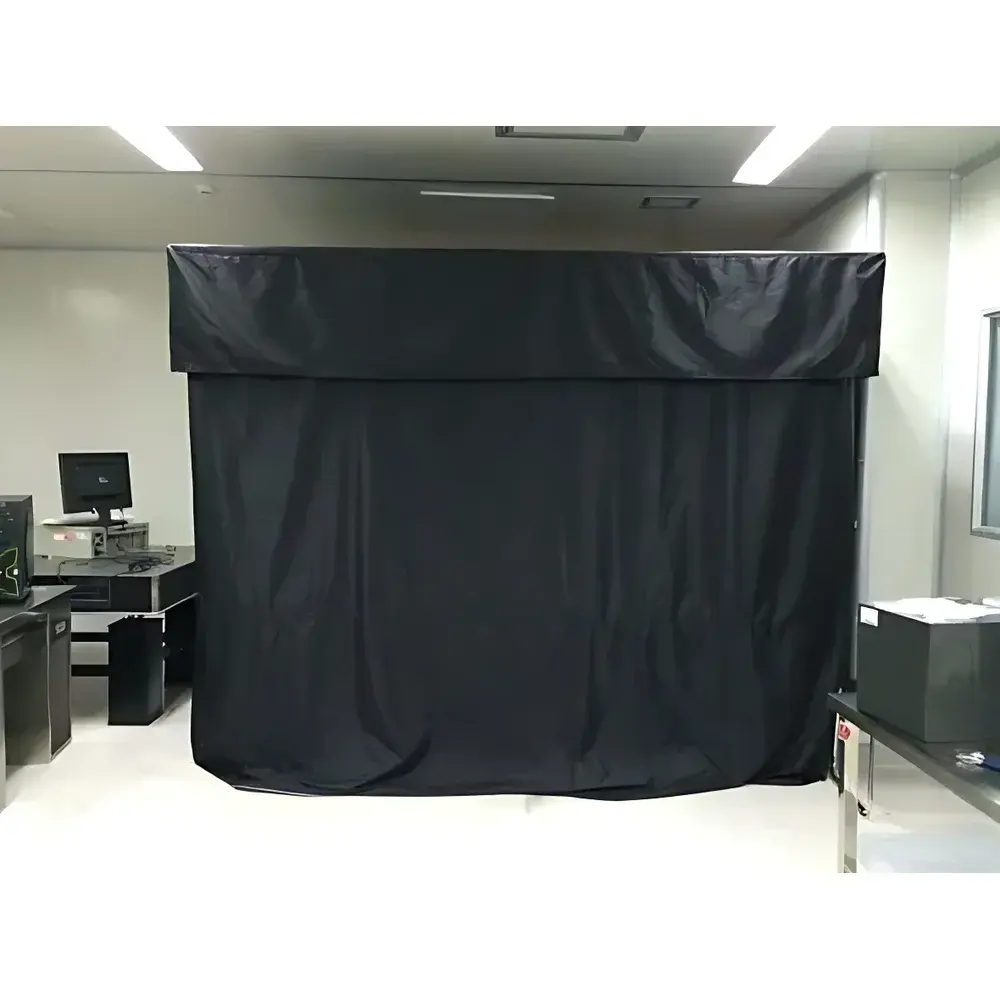
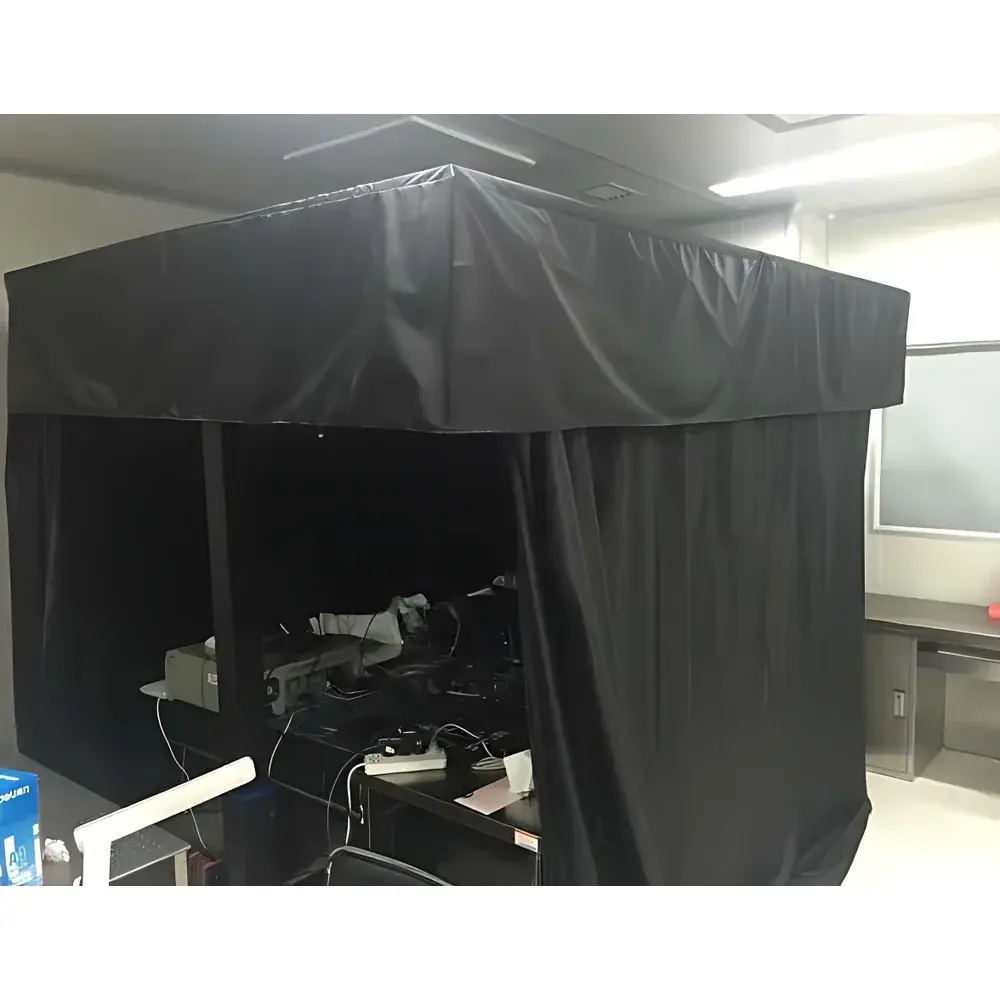
SPL-ZG Series Optical Darkroom
| Brand | SPL |
|---|---|
| Origin | Zhejiang, China |
| Manufacturer Type | Authorized Distributor |
| Country of Origin | China |
| Model Variants | SPL-ZG-30 (3000 mm), SPL-ZG-24 (2400 mm) |
| Price Range | USD 700 – 1,400 (FOB Zhejiang) |
| Frame Material | Powder-Coated Steel Tubing |
| Light-Tight Enclosure | Triple-Layer Blackout Fabric with Overlap Seams |
| Door Mechanism | Manual Pull-Track Blackout Curtain |
| Platform Integration | Modular Interface for Standard Optical Tables (e.g., 3000 × 1200 mm or 2400 × 1200 mm) |
| Customization | Available for non-standard platform lengths and height-adjustable configurations |
Overview
The SPL-ZG Series Optical Darkroom is a purpose-engineered light-tight enclosure designed to eliminate ambient illumination in precision optical experiments. Constructed around a rigid, powder-coated steel tubular frame, it forms a geometrically stable volume that integrates seamlessly with standard optical tables—specifically engineered for compatibility with 2400 mm and 3000 mm linear platforms. Its core function is to suppress stray light below detectable thresholds (< 0.01 lux interior under 500 lux ambient conditions), enabling reliable operation of high-sensitivity photodetectors, low-light imaging sensors, and interferometric setups. Unlike passive enclosures relying solely on opaque curtains, the SPL-ZG employs triple-layer blackout fabric with overlapping seams and compression-fit perimeter gaskets at the optical table interface—minimizing photon leakage at structural junctions. This architecture addresses critical noise sources in quantitative optical metrology: detector saturation in high-gain CCD/CMOS systems, baseline drift in photometric calibration, and spurious modulation artifacts in ellipsometry and polarimetry where background light couples into polarization-sensitive detection paths.
Key Features
- Rigid steel frame with corrosion-resistant powder coating ensures long-term dimensional stability and vibration damping when mounted on optical tables.
- Triple-layer blackout fabric (polyester-cotton blend with carbon-black impregnation) provides >99.99% visible-light attenuation (400–700 nm) and effective suppression of near-UV (350 nm) and NIR (1000 nm) transmission.
- Manual pull-track curtain system enables rapid, repeatable door actuation without motorized components—eliminating electromagnetic interference (EMI) risks near sensitive electronics.
- Modular optical table interface features adjustable clamping brackets and silicone-sealed edge channels, accommodating both metric and imperial platform mounting hole patterns (M6/M8).
- Fully disassemblable design allows transport in standard cargo pallets and reconfiguration across laboratory spaces without permanent installation.
- Optional accessories include internal cable management sleeves, grounding straps for ESD-sensitive applications, and removable floor mats compatible with cleanroom Class 1000 protocols.
Sample Compatibility & Compliance
The SPL-ZG Series supports diverse experimental configurations including laser alignment stations, spectrometer calibration benches, photomask inspection rigs, and UV-curable resin characterization setups. It complies with ISO 14644-1 Class 8 (100,000) air cleanliness requirements when used with optional HEPA-filtered air exchange modules. For regulated environments, the enclosure’s static-dissipative fabric meets IEC 61340-5-1 surface resistivity standards (10⁶–10⁹ Ω/sq). While not certified to FDA 21 CFR Part 11, its mechanical design supports integration into GLP/GMP workflows through traceable assembly logs and configurable access control (e.g., lockable curtain latches for audit trails). No electrical certification (UL/CE) applies, as the unit contains no powered components.
Software & Data Management
As a passive optical infrastructure component, the SPL-ZG requires no embedded firmware or proprietary software. Its operational integrity is verified via standardized photometric validation: users deploy calibrated lux meters (e.g., Konica Minolta T-10A) at predefined grid points (per ASTM E2917-20 Annex A1) to document spatial uniformity of darkness. Measurement logs may be imported into LIMS platforms via CSV export from handheld meters. The modular frame permits retrofitting with third-party environmental monitoring nodes (temperature/humidity/light leakage) compatible with Modbus RTU or MQTT protocols—enabling centralized data aggregation in industrial QA laboratories.
Applications
- Quantitative imaging metrology: MTF measurement of lenses, resolution target analysis under controlled dark-field conditions.
- Laser safety testing: Alignment and power profiling of Class 3B/4 lasers per ANSI Z136.1-2022 requirements.
- Photolithography R&D: Mask alignment verification and exposure dose mapping in UV-A (365 nm) and DUV (248 nm) wavelength bands.
- Polarimetric ellipsometry: Reduction of polarization crosstalk caused by ambient light scattering in thin-film thickness characterization.
- Low-light detector calibration: Dark current and read-noise measurement for scientific CMOS and EMCCD cameras per ISO 15739:2013.
- X-ray fluorescence (XRF) sample chamber shielding: Supplementary attenuation layer for scatter reduction in benchtop EDXRF systems.
FAQ
What optical table sizes does the SPL-ZG-30 support?
The SPL-ZG-30 is dimensioned for direct integration with 3000 mm × 1200 mm optical tables using standardized M6 mounting patterns; custom bracket sets are available for 3000 mm × 900 mm or asymmetric configurations.
Can the darkroom be used in cleanroom environments?
Yes—the triple-layer fabric is non-shedding and compatible with ISO Class 1000 protocols; optional anti-static floor mats and HEPA air filtration kits extend suitability to ISO Class 10,000 environments.
Is light leakage tested during manufacturing?
Each unit undergoes factory photometric validation using NIST-traceable lux meters at 12 spatial points; test reports are included with shipment.
Does the enclosure provide EMI/RFI shielding?
No—it offers optical isolation only; for electromagnetic shielding, users must integrate separate conductive gasketing or Faraday cage overlays.
How is thermal stability maintained inside the darkroom?
Passive thermal equilibrium is achieved via fabric breathability and frame thermal mass; active HVAC integration is supported through pre-drilled ports (Ø50 mm) on rear panels.





