
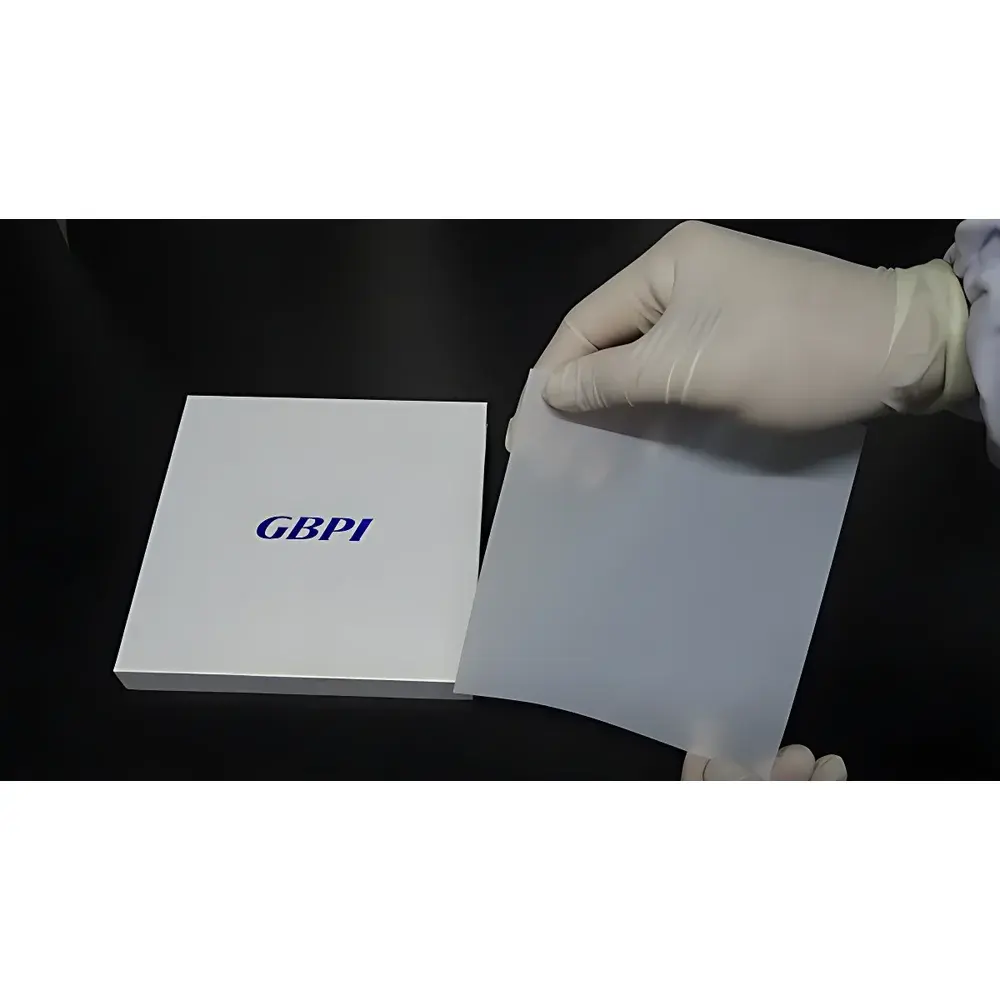
GBPI 125μm Polyester Film Standard Reference Material for Gas Permeability Calibration
| Brand | GBPI |
|---|---|
| Thickness | 125 μm |
| Material | Biaxially Oriented Polyethylene Terephthalate (BOPET) |
| Certified Reference Material (CRM) Designation | GBW(E)130541 |
| Compliance | GB/T 1038–2000 (Differential Pressure Method) |
| Certification Level | China National Secondary Standard Substance |
| Origin | Guangdong, China |
| Manufacturer | Guangzhou GBPI Instrument Co., Ltd. |
Overview
The GBPI 125μm Polyester Film Standard Reference Material (SRM) is a certified reference material specifically engineered for the calibration, verification, and metrological validation of gas permeability testing instruments used in packaging quality control laboratories. Designed in strict accordance with the principles of differential pressure-based gas transmission measurement per GB/T 1038–2000, this SRM provides a stable, homogeneous, and traceable permeation rate for nitrogen or air under controlled temperature (23 °C) and relative humidity (0% RH) conditions. As a nationally accredited secondary standard substance (GBW(E)130541), it serves as a primary metrological anchor for laboratories seeking compliance with ISO/IEC 17025 accreditation requirements, GLP practices, and regulatory validation protocols in food, pharmaceutical, and medical device packaging sectors.
Key Features
- Certified gas permeability value with documented uncertainty budget and long-term stability data (shelf life ≥24 months when stored at 23 ± 2 °C, <40% RH, protected from UV exposure)
- Manufactured from biaxially oriented polyethylene terephthalate (BOPET) film with precisely controlled thickness (125 ± 1.5 μm), surface roughness (<0.05 μm Ra), and dimensional uniformity (±0.5% across 100 mm × 100 mm sample area)
- Traceable to China National Institute of Metrology (NIM) via interlaboratory comparison and gravimetric reference methods
- Supplied with Certificate of Analysis (CoA) including certified permeability value (cm³·m⁻²·24h⁻¹·0.1MPa⁻¹), expanded uncertainty (k=2), homogeneity test results, and storage instructions
- Validated for use across all differential-pressure gas permeability testers compliant with GB/T 1038–2000, ASTM D1434, and ISO 2556
Sample Compatibility & Compliance
This SRM is exclusively intended for instrument calibration—not for routine sample testing. It is compatible with all gas permeability analyzers utilizing the constant-pressure/varying-volume or constant-volume/varying-pressure configurations defined in GB/T 1038–2000. Each batch undergoes rigorous homogeneity assessment per JJF 1342–2012 (Technical Guidelines for Certification of Reference Materials) and is certified against national metrological standards. The material meets requirements for audit readiness under FDA 21 CFR Part 11 (when used in conjunction with compliant software systems), EU Annex 11, and ICH Q5C stability guidelines for reference standards. It is not suitable for water vapor transmission rate (WVTR) or oxygen transmission rate (OTR) calibration—separate SRMs (GBW(E)130543 and GBW(E)130498) are designated for those applications.
Software & Data Management
While the SRM itself is a physical artifact, its integration into laboratory data workflows follows internationally recognized reference material management practices. Laboratories are advised to log usage in electronic lab notebooks (ELN) or LIMS with mandatory fields: SRM lot number, certificate expiry date, instrument ID, calibration date, operator ID, and environmental conditions during use. When paired with GBPI’s proprietary permeability analysis software (e.g., GBT-PermeaSuite v4.2+), the SRM’s certified value can be preloaded into calibration templates, enabling automated pass/fail evaluation against user-defined acceptance criteria (e.g., ±3% deviation from certified value). All calibration events generate timestamped, audit-trail-enabled records compliant with ALCOA+ principles (Attributable, Legible, Contemporaneous, Original, Accurate, Complete, Consistent, Enduring, Available).
Applications
- Periodic calibration verification of gas permeability testers prior to routine packaging film qualification (e.g., PET, PE, PP, AlOx-coated substrates)
- Performance qualification (PQ) and operational qualification (OQ) of new or reinstalled permeability instrumentation
- Inter-laboratory proficiency testing and round-robin studies coordinated by CNAS-accredited reference labs
- Supporting method validation documentation required for regulatory submissions (e.g., FDA Drug Master Files, EU CPMP/Q5C dossiers)
- Training analysts on proper film mounting technique, seal integrity verification, and baseline drift assessment using a known-permeability reference
FAQ
What is the certified gas permeability value for this SRM?
The certified value is provided on the accompanying Certificate of Analysis and is valid only under the specified test conditions (23 °C, 0% RH, 0.1 MPa differential pressure). Exact values vary by batch and are traceable to NIM.
Can this SRM be reused after initial calibration?
Yes—provided it remains physically intact, free from scratches, folds, or contamination, and is stored per CoA instructions. Reuse requires re-verification of seal integrity and baseline stability before each use.
Is this SRM compatible with ISO 15105-1 or ASTM F2622 instruments?
No. This SRM is validated exclusively for differential-pressure methods per GB/T 1038–2000 and ASTM D1434. Instruments based on infrared sensor detection (e.g., ISO 15105-1) or coulometric sensors (e.g., ASTM F2622) require SRMs with traceability to their respective measurement principles.
Does the certificate include uncertainty components breakdown?
Yes—the CoA reports combined standard uncertainty and expanded uncertainty (k=2) with contributions from homogeneity, stability, characterization method, and reference measurement system.
How often should calibration with this SRM be performed?
Per ISO/IEC 17025:2017 Clause 6.6.2, calibration frequency must be risk-based: typically daily pre-analysis verification for high-throughput QC labs, or prior to each analytical run in regulated environments where critical quality attributes depend on permeability data.




