
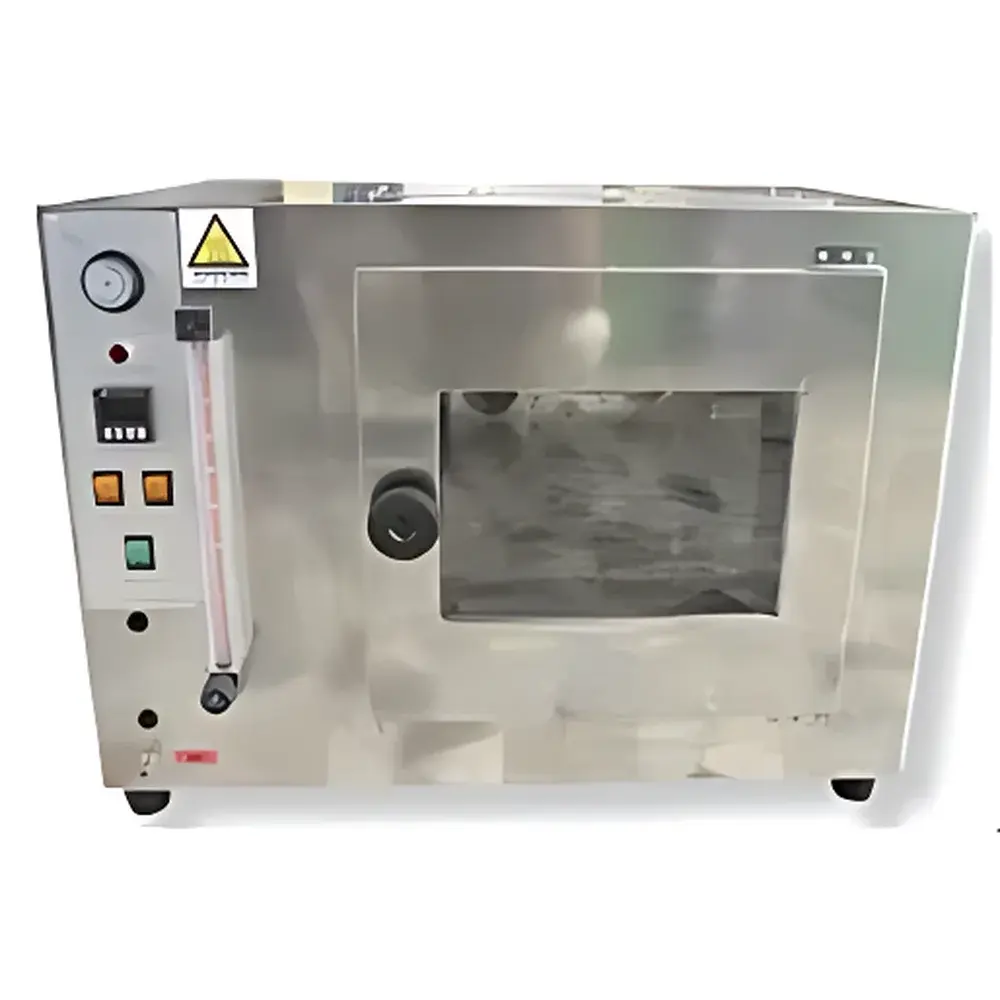
SDM D2872 Rotating Film Oven (RFO) for Asphalt Aging Testing
| Brand | SDM |
|---|---|
| Origin | Italy |
| Model | D2872 |
| Temperature Range | Ambient to 170°C (±0.5°C stability) |
| Rotational Speed | 15 rpm |
| Chamber Airflow | Adjustable via calibrated flowmeter with control valve |
| Heating System | Copper coil heater with precision air nozzles |
| Temperature Control | PID digital controller with PT100 sensor |
| Construction | Full stainless steel chamber |
| Turntable | Aluminum, vertical circular design with eight 34-mL glass sample holder positions |
| Fan Motor | 1725 rpm |
| Door | Dual-wall insulated door with reinforced tempered glass viewport |
| Power Supply | 220 V, 50 Hz |
| Rated Power | 1500 W |
| Compliance | ASTM D2872, EN 12607-1 |
Overview
The SDM D2872 Rotating Film Oven (RFO) is a precision-engineered thermal aging apparatus designed to simulate oxidative aging of asphalt binders under controlled conditions of elevated temperature, forced airflow, and rotational shear. Based on the fundamental principle of thin-film oxidation—where a defined volume of asphalt is spread as a uniform film inside a rotating glass container exposed to preheated, conditioned air—the D2872 replicates the short-term aging effects experienced during hot-mix asphalt (HMA) production and laydown. Its operation adheres strictly to the gravimetric and procedural requirements of ASTM D2872 (“Standard Test Method for Effect of Heat and Air on a Moving Film of Asphaltic Material”) and EN 12607-1 (“Petroleum and related products — Determination of the effect of heat and air on bituminous binders — Part 1: Rotating film oven test”), making it an indispensable tool for asphalt formulation development, quality assurance in refinery and paving material laboratories, and regulatory compliance testing.
Key Features
- Stainless steel construction throughout the heating chamber, turntable support structure, and external housing ensures long-term corrosion resistance and thermal stability under repeated high-temperature cycling.
- Vertically oriented aluminum turntable rotates at a precisely maintained 15 ± 0.2 rpm, accommodating eight standardized 34-mL glass sample containers (ASTM D2872-compliant) in symmetrical arrangement to guarantee uniform thermal exposure and film shear history across all specimens.
- Integrated high-efficiency axial fan, driven by a 1725 rpm induction motor, generates consistent, laminar airflow across the rotating sample array; airflow rate is continuously adjustable and quantified via a calibrated rotameter with fine-control needle valve.
- Preheated air delivery system employs a copper coil heater with distributed nozzle outlets positioned to direct heated air tangentially across the outer surface of each rotating vial—maximizing convective heat transfer while minimizing localized overheating or stagnation zones.
- PID-based digital temperature controller utilizes a Class A PT100 platinum resistance thermometer mounted within the chamber’s thermal mass center, delivering ±0.5°C temperature stability over the full operating range (ambient to 170°C).
- Dual-wall insulated access door features a thick, safety-rated tempered glass viewport and positive-latching mechanism, enabling real-time visual monitoring without compromising thermal integrity or operator safety.
Sample Compatibility & Compliance
The D2872 is validated exclusively for use with standard 34-mL borosilicate glass bottles conforming to ASTM D2872 geometry and wall thickness specifications. It supports both unaged binder characterization and post-aging residue recovery for subsequent rheological (e.g., DSR per AASHTO TP101), chemical (FTIR), or physical property analysis (penetration, softening point). The system meets essential regulatory and accreditation criteria: it is routinely employed in ISO/IEC 17025-accredited laboratories for asphalt binder certification, satisfies ASTM D2872 procedural fidelity requirements, and supports GLP documentation workflows through traceable temperature logging (when paired with optional external data acquisition systems). While not inherently 21 CFR Part 11 compliant, its stable analog control architecture and mechanical repeatability make it suitable for GMP-aligned QC environments where audit-ready calibration records and maintenance logs are maintained.
Software & Data Management
The D2872 operates as a standalone benchtop instrument with embedded digital temperature regulation and manual airflow adjustment—no proprietary software or PC interface is required for core functionality. All operational parameters (setpoint, actual chamber temperature, elapsed time) are displayed on the front-panel LED interface. For laboratories requiring electronic recordkeeping, the unit’s PT100 output signal (0–10 V or 4–20 mA, configurable upon request) can be integrated into third-party data loggers or LIMS platforms supporting analog input channels. Calibration certificates—including as-found/as-left temperature uniformity mapping across the turntable plane—are provided with each unit and recommended annually per ASTM E74 and ISO/IEC 17025 Clause 6.5.
Applications
- Short-term aging simulation of paving-grade asphalts (PG binders) prior to dynamic shear rheometer (DSR) or bending beam rheometer (BBR) testing per AASHTO M320 and M323.
- Quality control screening of polymer-modified binders (PMBs) to assess thermal oxidative stability and compatibility retention after simulated HMA production.
- Research into antioxidant efficacy and aging inhibition mechanisms in novel asphalt formulations.
- Validation of reclaimed asphalt pavement (RAP) binder blending efficiency and aged binder rejuvenation kinetics.
- Interlaboratory round-robin studies requiring high inter-unit reproducibility in aging severity (mass loss, viscosity increase, carbonyl index shift).
FAQ
What standards does the D2872 fully satisfy?
ASTM D2872 and EN 12607-1 are fully supported through mechanical design, thermal performance, and procedural fidelity—including turntable geometry, airflow delivery method, and temperature control accuracy.
Is the unit supplied with sample bottles?
No. ASTM D2872-compliant 34-mL borosilicate glass bottles must be sourced separately and verified for dimensional conformity prior to use.
Can the D2872 be operated at temperatures above 170°C?
No. The maximum rated operating temperature is 170°C; exceeding this limit voids warranty and compromises thermal sensor accuracy and structural integrity.
Does the system include temperature uniformity validation data?
Yes. Each unit ships with a factory-generated temperature mapping report covering nine spatial points across the turntable plane at 163°C, demonstrating compliance with ASTM D2872’s ±1.0°C uniformity requirement.
What maintenance is required for long-term reliability?
Quarterly inspection of fan motor bearings, annual recalibration of the PT100 sensor and PID controller, and biannual cleaning of copper coil nozzles and chamber interior using non-abrasive stainless steel cleaners.
Related Products





