
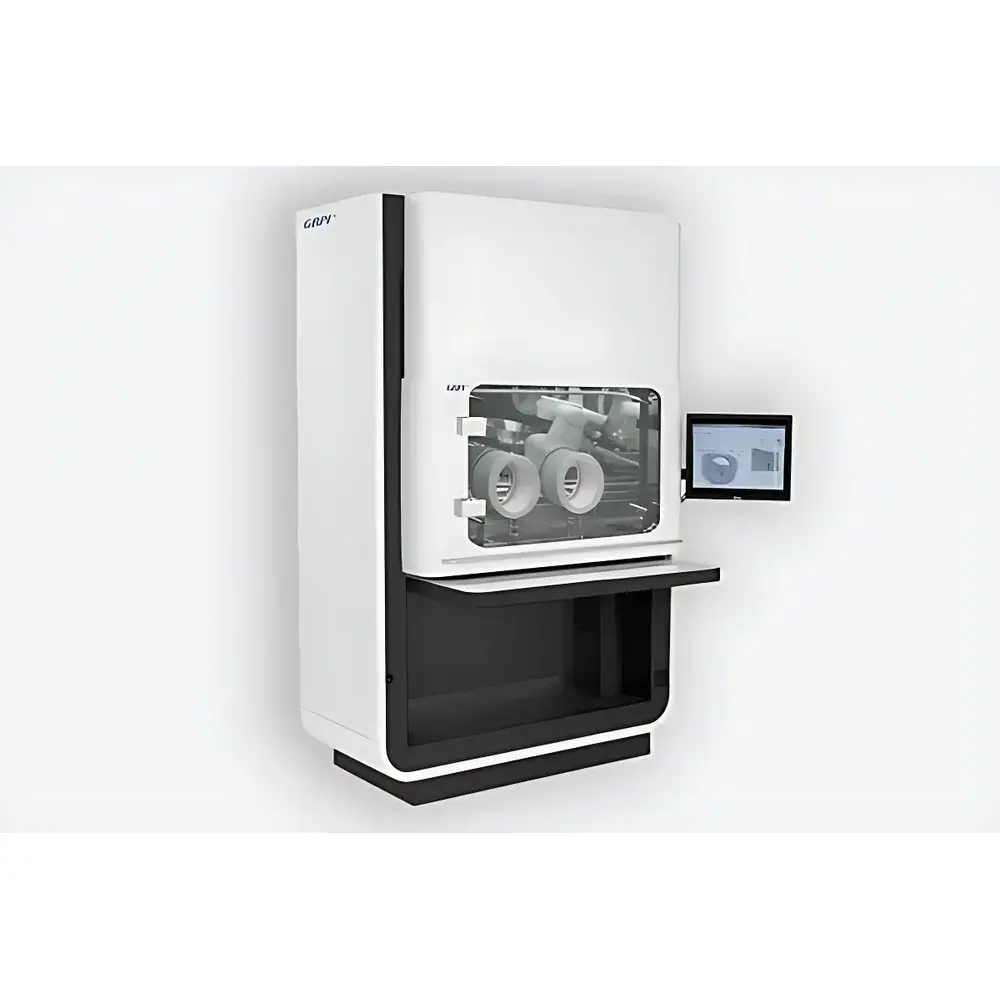
GBPI GB-XF1000 Bacterial Filtration Efficiency (BFE) Tester for Medical Face Masks
| Brand | GBPI (Guangzhou Biaoji) |
|---|---|
| Origin | Guangdong, China |
| Manufacturer Type | Direct Manufacturer |
| Model | GB-XF1000 |
| Sampling Flow Rate (A/B) | 28.3 L/min ±2.5% |
| Aerosol Generation Flow Rate | (8–10) L/min ±2.5% |
| Peristaltic Pump Flow Range | (0.006–3.0) mL/min ±2.5% |
| Pressure Measurement Accuracy | ±2.5% (except aerosol chamber vacuum: ±2.0%) |
| Aerosol Particle Size | MMAD = 3.0 ± 0.3 µm, GSD ≤ 1.5 |
| Andersen Cascade Impactor Stages | 6-stage (I: >7 µm |
| II | 4.7–7 µm |
| III | 3.3–4.7 µm |
| IV | 2.1–3.3 µm |
| V | 1.1–2.1 µm |
| VI | 0.6–1.1 µm) |
| Aerosol Chamber Dimensions | 60 cm (L) × 8.5 cm (Ø) × 3 cm (T) |
| Cabinet Vacuum Range | −50 to −200 Pa |
| Aerosol Chamber Vacuum | −90 to −120 Pa |
| HEPA Filter Efficiency | ≥99.99% for particles ≥0.3 µm |
| Data Storage Capacity | >100,000 test records |
| Display | 10.4″ industrial-grade capacitive touchscreen |
| Power Supply | AC 220 V ±10%, 50 Hz |
| Power Consumption | <1500 W |
| Noise Level | <65 dB(A) |
| Net Weight | ~150 kg |
Overview
The GBPI GB-XF1000 Bacterial Filtration Efficiency (BFE) Tester is a fully integrated, negative-pressure-controlled laboratory instrument engineered for standardized quantitative assessment of bacterial particle retention performance in medical face masks and respirator materials. It operates on the principle of controlled aerosol challenge using viable Staphylococcus aureus (ATCC 6538) bioaerosols, followed by dual-pathway impaction sampling onto nutrient agar plates via a six-stage Andersen cascade impactor. The system implements simultaneous A/B channel sampling—each with independent flow control, real-time pressure monitoring, and calibrated volumetric flow measurement—to eliminate inter-channel bias and ensure statistical robustness in colony-forming unit (CFU) enumeration. Designed in strict alignment with regulatory test protocols, the GB-XF1000 delivers traceable, repeatable, and auditable BFE results essential for quality assurance, regulatory submission, and ISO 13485-compliant production environments.
Key Features
- Negative-pressure containment cabinet (−50 to −200 Pa) with laminar airflow design and integrated HEPA filtration (≥99.99% @ 0.3 µm), ensuring operator biosafety per WHO and CDC biosafety level 2 (BSL-2) guidance;
- Dual independent sampling pathways (A & B), each equipped with a precision mass flow controller (28.3 L/min, ±2.5% accuracy), upstream pressure transducers, and dedicated six-stage Andersen impactors;
- Integrated microbial aerosol generator delivering monodisperse S. aureus bioaerosols with mass median aerodynamic diameter (MMAD) of 3.0 ± 0.3 µm and geometric standard deviation (GSD) ≤ 1.5—validated per ASTM F2101 and ISO 18184;
- Programmable peristaltic pump (0.006–3.0 mL/min, resolution 0.001 mL/min) enabling precise control of bacterial suspension feed rate into the nebulizer;
- Embedded high-performance industrial microcomputer with 10.4″ capacitive touchscreen interface, supporting real-time parameter visualization, alarm logging, and multi-user access control;
- Comprehensive environmental monitoring: ambient temperature (−40 to 99 °C), aerosol chamber vacuum (−90 to −120 Pa), and spray line pressure (0–300 kPa), all with ≤±2.5% measurement uncertainty;
- Modular mechanical architecture featuring height-adjustable support frame (±10 cm), lockable dual-mode casters (support/mobility), and quick-release impactor trays for GLP-aligned cleaning and calibration;
- Full electrical safety compliance: built-in RCD (residual-current device), fire-retardant insulation between inner/outer cabinets, and front-mounted tempered glass observation window with gas-tight sealing.
Sample Compatibility & Compliance
The GB-XF1000 accommodates flat mask material specimens up to 100 mm × 100 mm, secured within standardized sample holders compatible with ASTM F2101, YY/T 0969–2013, YY 0469–2004, EN 14683:2019, and ISO 22609 test fixtures. All fluidic components contacting biological agents are constructed from autoclavable 316 stainless steel or medical-grade PTFE. The instrument’s firmware supports audit trail generation—including user ID, timestamp, parameter set, and raw CFU counts—for FDA 21 CFR Part 11 and EU Annex 11 readiness. Calibration certificates for flow meters, pressure sensors, and temperature probes are issued traceable to NIM (China National Institute of Metrology) or equivalent national standards bodies.
Software & Data Management
Proprietary embedded software provides guided test sequencing, automatic calculation of BFE (%) per ISO 22609 formula: BFE = [(Ccontrol − Ctest) / Ccontrol] × 100, where C denotes mean CFU recovered. Raw data—including flow profiles, pressure logs, ambient conditions, and plate colony images (via optional USB-connected microscope camera)—are stored in encrypted binary format with SHA-256 integrity hashing. Export options include CSV, PDF reports (with configurable header/footer and digital signature fields), and direct USB flash drive transfer. Data retention exceeds 100,000 complete test records with automatic overwrite protection for critical validation runs.
Applications
- QC/QA release testing of surgical masks, procedure masks, and community face coverings per YY/T 0969–2013 and ASTM F2100 Level 1–3;
- Pre-submission validation for NMPA Class II/III medical device registration in China;
- Comparative evaluation of novel filter media (e.g., electret nonwovens, nanofiber composites, antimicrobial-coated layers);
- Accelerated aging studies assessing BFE stability after simulated shelf life (e.g., 40 °C/75% RH, 90 days);
- Method verification and equipment qualification under ISO/IEC 17025 accredited laboratory scope;
- Training and proficiency testing for metrology institutes and third-party testing laboratories.
FAQ
What biological agent is required for BFE testing on the GB-XF1000?
Staphylococcus aureus ATCC 6538 is the standard challenge organism specified in YY/T 0969–2013, ASTM F2101, and EN 14683. Users must prepare suspensions in tryptic soy broth (TSB) at concentrations yielding 1.0×10⁶–2.0×10⁶ CFU/mL pre-nebulization.
Does the system support automated colony counting?
The GB-XF1000 does not include integrated image-based colony enumeration hardware. However, its data export protocol is compatible with third-party colony counters (e.g., Synbiosis ProtoCOL, Scan® 3.0) via standardized CSV output.
How frequently must flow meters be recalibrated?
Per ISO/IEC 17025 requirements, primary flow sensors should undergo annual calibration against a certified reference standard, with intermediate verification performed before each test batch using a dry calibrator traceable to national standards.
Can the instrument operate under ISO Class 5 cleanroom conditions?
Yes—the cabinet’s negative-pressure operation, HEPA-filtered exhaust, and sealed construction enable safe deployment in ISO 14644-1 Class 5 environments when installed with appropriate utility interfaces (e.g., dedicated exhaust ducting, stable power conditioning).
Is remote diagnostics or firmware update capability available?
Firmware updates are delivered via authenticated USB media only; no network connectivity or cloud-based telemetry is implemented, preserving data sovereignty and aligning with IEC 62304 Class C software safety requirements for medical device test equipment.
Related Products






