
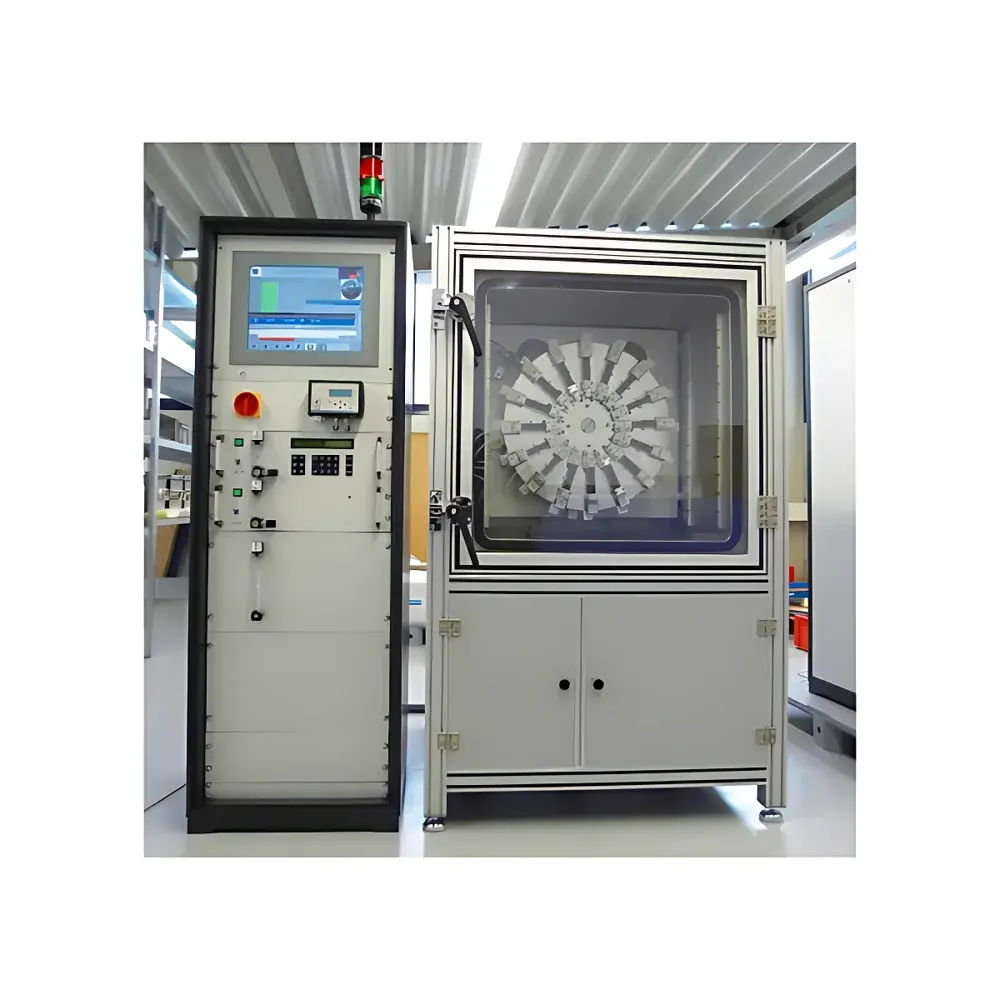
GBPI CYLLX Ozone Aging Test Chamber
| Brand | GBPI |
|---|---|
| Origin | Guangdong, China |
| Manufacturer Type | Manufacturer |
| Country of Origin | Domestic (China) |
| Model | CYLLX |
| Pricing | Upon Request |
Overview
The GBPI CYLLX Ozone Aging Test Chamber is an engineered environmental simulation system designed for accelerated evaluation of ozone-induced degradation in elastomeric materials. It operates on the principle of controlled atmospheric exposure—maintaining precise, stable concentrations of ozone (O3) within a sealed test chamber under regulated temperature and humidity conditions. This methodology replicates real-world oxidative stress mechanisms where ozone selectively attacks carbon–carbon double bonds in unsaturated rubbers (e.g., natural rubber, SBR, NBR), initiating surface microcracking—particularly under static or dynamic tensile strain. The chamber enables standardized assessment of material resistance to ozone aging per internationally recognized test protocols, supporting reliability forecasting for critical components such as automotive seals, power cables, tire sidewalls, and aerospace gaskets.
Key Features
- Programmable PLC-based control system with real-time monitoring of ozone concentration (pphm), temperature (±0.5 °C), and relative humidity (±3% RH)
- Dual-mode operation: static strain testing (fixed elongation fixtures) and dynamic fatigue testing (optional motorized extension mechanism)
- High-stability ozone generation via silent corona discharge with electrochemical sensor feedback loop for continuous concentration calibration
- Stainless steel 316L inner chamber construction with non-reactive sealing gaskets and UV-blocking tempered glass viewing window
- Integrated safety interlocks including ozone destruct catalyst, exhaust scrubber, and emergency ventilation override
- Compliance-ready architecture supporting audit trails, user access levels, and parameter lockout functions for GLP/GMP environments
Sample Compatibility & Compliance
The CYLLX accommodates standard test specimens per ISO 1431-1 (dumbbell, ring, or strip geometries), ASTM D1149-compliant mounting fixtures, and custom jigs for automotive harness assemblies or extruded cable jackets. Its operational envelope supports specimen widths up to 150 mm and lengths accommodating ≥200% elongation. The system is validated against over 70 international standards—including ASTM D1149, ISO 1431-1/2/3, GB/T 7762–2003, EN 27326, IEC 60811-2-1, VDE 0282, JIS K 6254, and SAE J1401—ensuring technical alignment with OEM specifications from Volkswagen (VW 2.8.1), Ford (BP101-01), Toyota (TSE 50), and Daimler (MS-EA122). All calibration procedures follow traceable NIST-equivalent reference methods, and chamber performance verification reports are generated per ISO/IEC 17025 requirements.
Software & Data Management
Control and data acquisition are managed through GBPI’s proprietary OzoneTest Suite v4.2—a Windows-based application compliant with FDA 21 CFR Part 11 Annex 11 requirements. The software provides configurable test profiles, automated logging of ozone concentration drift, temperature/humidity deviation alerts, and timestamped digital signatures for operator actions. Raw sensor outputs (ozone pphm, chamber temp, RH%) are stored in encrypted .CSV and SQL database formats with optional cloud backup. Audit trail functionality records all parameter modifications, user logins, and report exports, enabling full traceability during regulatory inspections. Export modules support direct integration with LIMS platforms via OPC UA or RESTful API interfaces.
Applications
- Evaluation of crack initiation and propagation kinetics in vulcanized and thermoplastic elastomers
- Qualification testing of rubber compounds used in high-voltage cable insulation systems per IEC 60502-1
- OEM validation of sealing solutions for electric vehicle battery enclosures exposed to urban ozone-rich atmospheres
- Comparative lifecycle analysis of halogen-free flame-retardant (HFFR) cable sheathing materials
- Research into antioxidant efficacy in synthetic rubber formulations under multi-stress aging (ozone + thermal cycling)
- Supporting ISO 1431-3-compliant dynamic flex-cracking tests for conveyor belt splices and hose couplings
FAQ
What ozone concentration range does the CYLLX support?
The chamber delivers stable ozone concentrations from 25 to 1000 pphm (parts per hundred million), adjustable in 1 pphm increments, with long-term stability ≤±2% of setpoint over 72-hour continuous operation.
Is the system suitable for dynamic fatigue testing?
Yes—optional servo-driven tensile actuators enable programmable cyclic strain (0.5–10 Hz) synchronized with ozone exposure, meeting ASTM D3395-99 and ISO 1431-2 requirements.
How is ozone concentration verified and calibrated?
Calibration uses dual-reference methodology: primary verification via NIST-traceable UV photometric analyzer (254 nm absorption), secondary validation using potassium iodide (KI) chemical titration per ASTM D1149 Annex A1.
Does the chamber meet requirements for pharmaceutical packaging validation?
While primarily intended for elastomer testing, its ISO 14644-1 Class 7 cleanroom-compatible design and Part 11-compliant software allow adaptation for ozone-sensitive polymer barrier studies under ICH Q5C guidelines.
What maintenance intervals are recommended?
Ozone generator electrodes require cleaning every 500 operating hours; UV sensor recalibration is advised quarterly; full system performance verification per ISO/IEC 17025 is recommended annually or after major component replacement.




