
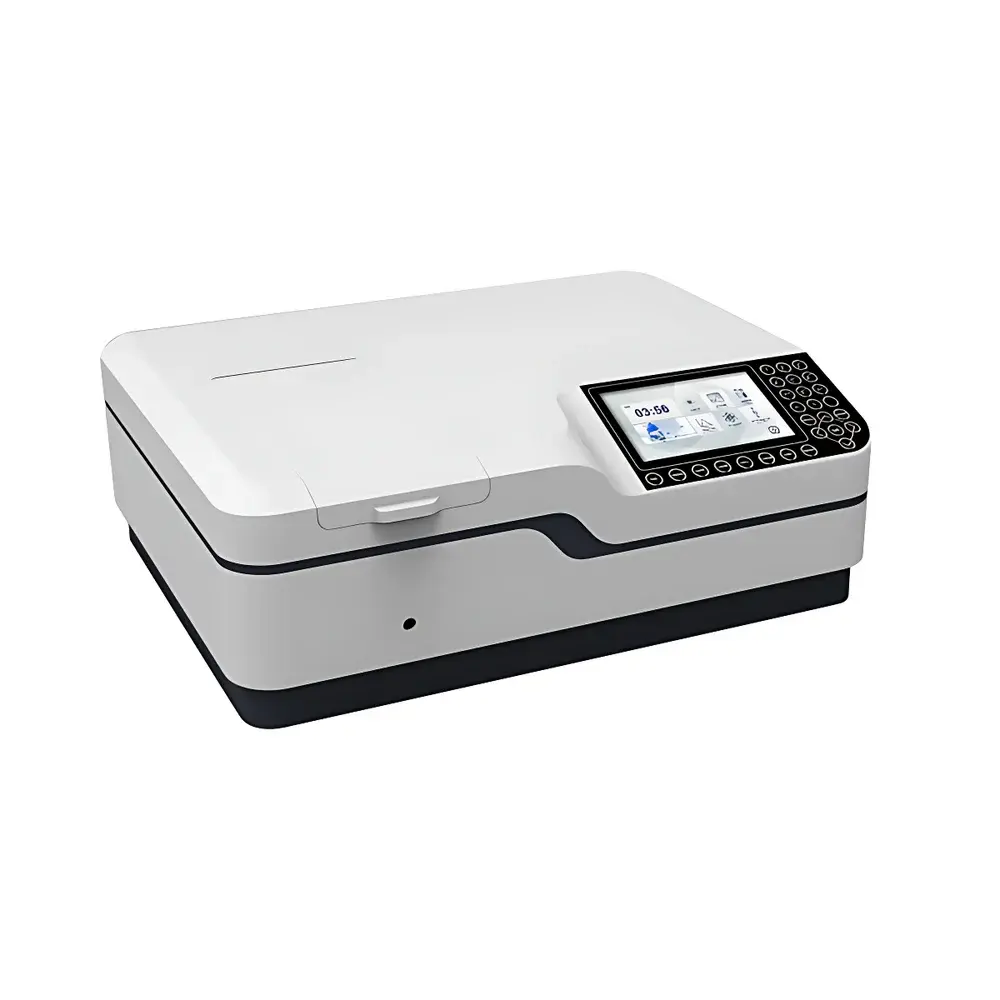
Yoke Omron-Tactile UV-Vis Spectrophotometer T2600
| Brand | Yoke |
|---|---|
| Origin | Shanghai, China |
| Manufacturer Type | Direct Manufacturer |
| Instrument Architecture | Pseudo-Double-Beam |
| Detector | Photodiode Array (PDA) |
| Wavelength Range | 190–1100 nm |
| Wavelength Scanning | Motorized Auto-Scanning |
| Spectral Bandwidth | 2 nm |
| Wavelength Accuracy | ±0.3 nm (full range), ±0.1 nm at 656.1 nm |
| Stray Light | ≤0.05% at 220 nm |
| Transmittance Accuracy | ±0.3% T |
| Wavelength Repeatability | ±0.1 nm |
| Display | 7″ TFT LCD (1024 × 600) |
| Keypad | Omron® Long-Life Tactile Switches |
| Internal Storage | 16 GB flash memory (supports ≥2000 spectra or 500 calibration curves) |
| Data Interfaces | RS-232C, USB Device (for PC connection), USB Host (for U-disk) |
| Output Formats | CSV, QUA, TXT, BMP |
| Optional Accessories | 8-position Rotating Cuvette Holder (patented centering design), Integrated Flow Cell Module |
Overview
The Yoke Omron-Tactile UV-Vis Spectrophotometer T2600 is a precision laboratory-grade spectrophotometer engineered for routine and research-level quantitative and qualitative analysis in the ultraviolet, visible, and near-infrared spectral regions (190–1100 nm). Based on a pseudo-double-beam optical architecture with CT (Czerny–Turner) monochromator design, the instrument delivers high photometric stability and minimized baseline drift during extended measurements. Its core optical path employs imported deuterium and tungsten-halogen lamps as dual broadband sources, coupled with a high-sensitivity photodiode array detector—ensuring consistent signal-to-noise performance across the full wavelength range. The T2600 implements advanced signal processing via an ARM11 embedded processor, enabling real-time spectral acquisition, internal curve fitting, and on-device data reduction without external computing hardware. Designed for compliance with fundamental spectroscopic measurement standards—including ISO 6425, ASTM E275, and USP —the system supports traceable absorbance, transmittance, concentration, and energy mode quantification under controlled environmental conditions.
Key Features
- 7-inch high-resolution TFT color display (1024 × 600) with intuitive graphical interface for direct spectrum visualization, kinetic plot rendering, and multi-curve overlay—eliminating dependency on external PCs for basic operation.
- Omron® certified tactile keypads rated for >1 million actuations, offering precise haptic feedback and mechanical reliability in high-throughput lab environments.
- Suspended optical bench architecture with reinforced aluminum baseplate to isolate the monochromator and detector from mechanical vibration and thermal deformation—critical for long-term wavelength reproducibility (±0.1 nm).
- Patented ZL 2010 2 0562320.3 optoelectronic detection module, minimizing electronic noise and enhancing signal fidelity, particularly at low absorbance levels (<0.1 A).
- Dual-layer internal layout physically separates optical and electronic subsystems, suppressing electromagnetic interference and improving photometric linearity (R² > 0.9999 over 0–3.0 A range).
- Onboard 16 GB non-volatile storage enables autonomous logging of up to 2000 full-spectrum scans or 500 user-defined calibration curves—including multi-point standard addition and polynomial regression models.
Sample Compatibility & Compliance
The T2600 accommodates standard 10 mm square cuvettes (quartz, glass, or plastic), as well as optional accessories including an 8-position rotating cuvette holder with patented optical centering alignment—ensuring consistent beam positioning across all cells and reducing inter-cell variability to <0.15% RSD in replicate measurements. For liquid stream analysis, a factory-integrated flow cell module (optional) supports continuous monitoring with programmable flow rates (0.1–5 mL/min) and auto-zero referencing. All firmware and data handling protocols are designed to support GLP-compliant workflows: audit trails for method changes, user authentication logs, and timestamped metadata embedding in exported files (CSV, QUA, BMP). While not pre-certified for FDA 21 CFR Part 11, the system provides configurable security settings—including password-protected method editing and read-only export modes—to facilitate internal validation against regulatory requirements.
Software & Data Management
Data acquisition and post-processing occur natively on the instrument’s embedded Linux-based OS. Measurement results are exportable via USB host port directly to FAT32-formatted USB drives in four interoperable formats: CSV (compatible with Excel, Origin, and Python pandas), QUA (native Yoke spectral format), TXT (ASCII tabular), and BMP (publication-ready grayscale images). No proprietary software installation is required for data retrieval or report generation. RS-232C serial output supports integration with LIMS or custom SCADA systems using standard ASCII command protocols (e.g., “READ ABS” returns current absorbance value). Internal memory retains full spectral metadata—including lamp usage hours, calibration timestamps, and environmental sensor readings (ambient temperature, humidity)—enabling retrospective QA/QC assessment.
Applications
The T2600 is routinely deployed in pharmaceutical QC labs for assay validation per USP , in environmental testing for nitrate/nitrite quantification (EPA Method 353.2), in food science for pigment stability studies (e.g., anthocyanin degradation kinetics), and in academic research for enzyme kinetics (NADH/NADPH monitoring at 340 nm) and nanoparticle characterization (plasmon resonance profiling). Its 2 nm spectral bandwidth meets resolution requirements for most small-molecule UV-Vis applications, while the ±0.3 nm wavelength accuracy ensures reliable identification of characteristic absorption maxima in complex matrices. The system supports both single-wavelength and full-spectrum scanning modes, kinetic time-course acquisition (up to 100 points/sec), and multi-component analysis using built-in least-squares algorithms.
FAQ
What is the difference between pseudo-double-beam and true double-beam architectures?
Pseudo-double-beam instruments use a single optical path with rapid alternating reference/sample beam routing via a mechanical chopper—reducing cost and complexity while maintaining sufficient stability for most routine applications. True double-beam systems employ two parallel paths and are typically reserved for ultra-high-stability applications requiring sub-0.05% drift over hours.
Can the T2600 be validated for GMP environments?
Yes—the instrument supports IQ/OQ documentation templates, configurable user access levels, and tamper-evident data export. Full 21 CFR Part 11 compliance requires additional infrastructure (e.g., electronic signatures, networked audit servers), which can be implemented externally.
Is the 8-position cuvette holder compatible with all T2600 variants?
Yes—the rotating holder is mechanically and electrically standardized across the T2600, T2601, and T2600S models, with automatic position recognition and error-checking logic embedded in firmware.
Does the instrument support spectral subtraction or derivative spectroscopy?
Yes—onboard processing includes first- and second-order derivative calculation, baseline correction (Rubberband, Straight Line), and spectral subtraction (A – B) with real-time preview.
What maintenance is required for the deuterium and tungsten lamps?
Lamp lifetime is rated at ≥2000 hours; the system tracks cumulative on-time and alerts users at 90% end-of-life. Replacement is tool-free and takes <3 minutes, with automatic intensity recalibration initiated post-installation.




