
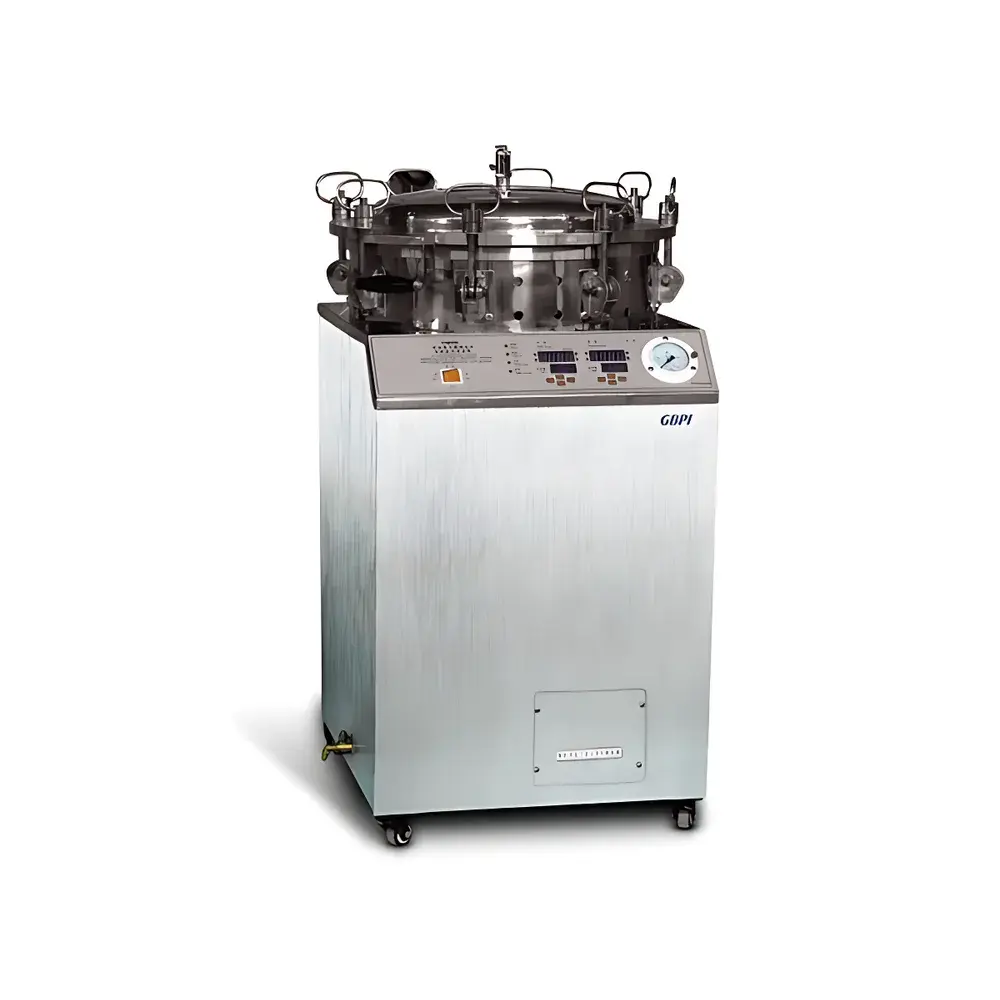
GBPI ZM-100C Vertical High-Pressure Steam Sterilizer
| Brand | GBPI |
|---|---|
| Origin | Guangdong, China |
| Manufacturer Type | Direct Manufacturer |
| Equipment Type | Vertical Sterilizer |
| Model | ZM-100C |
| Max Temperature | 135 °C |
| Max Pressure | 0–0.22 MPa (saturated steam) |
| Chamber Dimensions | Ø400 mm × 500 mm (H) |
| External Dimensions | Ø500 mm × 560 mm (H) |
| Chamber Volume | 50 L |
| Safety Relief Pressure | 0.23 MPa |
| Counter-Pressure Range | 0.14–0.165 MPa |
| Timing Range | 1–99.59 min |
| Power Supply | AC 220 V, 50 Hz |
| Rated Power | 4.5 kW ±10% |
| Compliance | GB 150.1–2011, GB/T 10004–2008, GB 4793.4–2001, YY 1007–2010 |
Overview
The GBPI ZM-100C Vertical High-Pressure Steam Sterilizer is an engineered solution for thermal sterilization and retort-type resistance testing of heat-sensitive packaged materials and biomedical products. Operating on the principle of saturated steam under controlled pressure, it delivers precise, repeatable thermal exposure across a defined temperature range (100–135 °C) and pressure envelope (0–0.22 MPa), enabling compliance with internationally recognized sterilization validation protocols. Unlike horizontal autoclaves designed primarily for laboratory glassware or culture media, the ZM-100C integrates counter-pressure functionality—critical for evaluating package integrity during thermal processing of flexible packaging, pouches, and sealed containers. Its vertical architecture optimizes floor space while maintaining full ASME-equivalent pressure vessel integrity per GB 150.1–2011, with dual safety mechanisms including a certified 0.23 MPa relief valve and real-time overtemperature/low-water interlocks.
Key Features
- Full-cycle automation: Integrated PLC-based control system manages heating ramp, sterilization hold, pressure equalization, cooling (via dual-mode air-cooling or spray-water cooling), and drain sequencing without manual intervention.
- Real-time process monitoring: Backlit LCD interface displays chamber temperature, elapsed time, setpoint deviation, and pressure status with ±0.5 °C and ±0.01 MPa resolution.
- Robust pressure containment: 50 L stainless-steel chamber (AISI 304 grade) with elliptical dished head conforming to GB 150.1–2011 pressure vessel design standards; safety factor ≥3.0 at maximum working pressure.
- Mobility and stability: Four swivel casters with locking brakes enable repositioning within ISO-classified cleanrooms or QC labs while maintaining operational rigidity.
- Redundant safety architecture: Independent high-limit thermostat, water-level sensor, pressure transducer, and emergency power cutoff ensure fail-safe shutdown during abnormal conditions.
- Counter-pressure capability: Programmable back-pressure application (0.14–0.165 MPa) prevents package deformation or seal failure during rapid cooling—essential for ASTM F2054-compliant retort simulation.
Sample Compatibility & Compliance
The ZM-100C accommodates a broad spectrum of sample formats—including pre-filled IV bags, Tyvek-sealed instrument trays, laminated pouches, pharmaceutical vials, microbiological culture media, and adhesive-coated substrates—without requiring custom fixtures. Its chamber geometry supports uniform steam penetration verified per ISO 17665-1:2017 for moist heat sterilization validation. Regulatory alignment includes YY 1007–2010 (Chinese medical device sterilization equipment standard), GB 4793.4–2001 (safety requirements for laboratory equipment), and GB/T 10004–2008 (plastic composite film retort performance testing). While not FDA 510(k)-cleared, its design principles support IQ/OQ/PQ documentation required for GLP/GMP environments and align with foundational elements of ISO 13485:2016 clause 7.5.11 (process validation).
Software & Data Management
The embedded controller logs timestamped temperature, pressure, and cycle phase data at 1-second intervals to internal non-volatile memory (≥1000 cycles retained). Optional RS-485 Modbus RTU output enables integration with LIMS or SCADA systems for centralized audit trail generation. All stored records include operator ID input, cycle ID, and pass/fail flagging based on user-defined acceptance criteria—supporting traceability requirements under 21 CFR Part 11 when paired with validated third-party software platforms. Raw data export is available via USB port in CSV format, preserving metadata such as firmware version and calibration timestamp.
Applications
- Package integrity validation: Simulating commercial retort processes for flexible packaging used in ready-to-eat meals, pet food, and sterile medical devices.
- Bioburden reduction verification: Terminal sterilization of heat-stable pharmaceutical excipients, ointments, and aqueous solutions per USP .
- Quality control of sterilization media: Preparation and validation of agar plates, broth cultures, and enzymatic reagents in microbiology laboratories.
- Material stability assessment: Accelerated aging studies of adhesives, inks, and barrier coatings exposed to cyclic thermal stress.
- Regulatory submission support: Generating reproducible thermal profiles for submissions to NMPA, PMDA, or ANVISA referencing GB/T 10004–2008 or ISO 11607–2:2019 Annex B.
FAQ
What pressure vessel certification does the ZM-100C meet?
It complies with GB 150.1–2011 “Pressure Vessels – Part 1: General Requirements”, including hydrostatic test validation at 1.25× maximum allowable working pressure.
Can this unit be used for depyrogenation?
No—it is optimized for saturated steam sterilization (moist heat), not dry-heat depyrogenation; maximum temperature is insufficient for endotoxin destruction per USP .
Is remote monitoring supported out-of-the-box?
Local display and data logging are standard; Ethernet or Wi-Fi connectivity requires optional hardware add-on and configuration via Modbus TCP gateway.
What maintenance intervals are recommended?
Daily visual inspection of door gasket and drain strainer; quarterly verification of pressure transducer accuracy and annual recalibration of temperature sensors per ISO/IEC 17025 guidelines.
Does the unit include validation documentation?
Factory-assembled IQ/OQ templates are provided; PQ execution and protocol customization must be performed by the end-user’s qualified personnel or third-party validation service.
Related Products



