
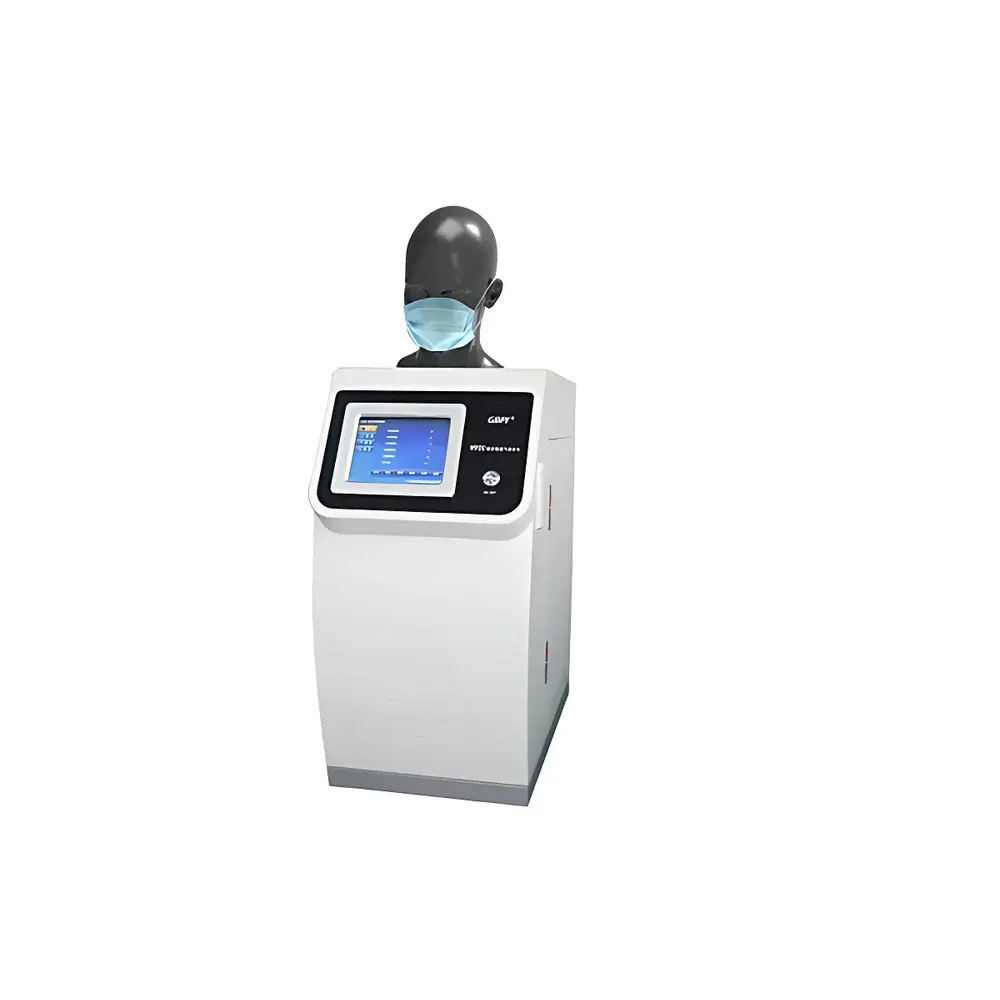
GBPI GBN702 Respiratory Resistance Tester
| Brand | GBPI |
|---|---|
| Origin | Guangdong, China |
| Manufacturer Type | Direct Manufacturer |
| Country of Origin | China |
| Model | GBN702 |
| Price Range | USD 14,000 – 42,000 |
| Air Flow Range | 0–100 L/min |
| Flow Accuracy | ±2% FS |
| Differential Pressure Range | −1000 to +1000 Pa |
| Pressure Resolution | 1 Pa |
| Pump Capacity | ≥100 L/min |
| Test Flow Rate | (85 ± 1) L/min (constant) |
| Dimensions | 380 × 620 × 825 mm |
| Headform Sizes | 30 mm, 25 mm, 20 mm |
| Power Supply | AC 220 V, 50 Hz |
Overview
The GBPI GBN702 Respiratory Resistance Tester is a precision-engineered instrument designed for quantitative evaluation of inhalation and exhalation resistance in respiratory protective devices—including industrial respirators, medical/surgical masks, and daily-use particulate-filtering face coverings. It operates on the principle of controlled airflow generation across a conditioned test specimen mounted on standardized headforms, while simultaneously measuring the resulting differential pressure drop across the material under defined flow conditions. Compliant with key Chinese national standards—namely GB 2626–2006 “Respiratory Protective Devices—Non-powered Air-purifying Particulate Respirators” and GB/T 32610–2016 “Technical Specification for Daily Protective Masks”—the GBN702 provides traceable, repeatable data essential for quality assurance, regulatory submission, and product development in occupational safety and personal protective equipment (PPE) manufacturing.
Key Features
- Integrated dual-path pneumatic architecture enabling seamless switching between inhalation and exhalation resistance measurement without manual reconfiguration.
- High-sensitivity thermal mass flow sensor with no requirement for temperature or pressure compensation—ensuring stable calibration and minimal zero drift over extended operation.
- Multi-sensor chip design delivering extended turndown ratio (up to 100:1), supporting accurate low-flow detection down to sub-L/min levels while maintaining full-scale linearity.
- Dual-range differential pressure transducer (±1000 Pa) with 1 Pa resolution, two-wire output configuration, explosion-proof housing, and field-adjustable zero/span/damping—minimizing maintenance and maximizing long-term stability.
- Embedded data logger featuring a 128 × 64 graphic LCD with intuitive Chinese-language interface, 4 MB internal non-volatile memory for time-stamped pressure and flow records, and real-time graphical display during testing.
- Modular headform system accommodating three standard orifice diameters (20 mm, 25 mm, 30 mm) to support diverse mask geometries and fit configurations per GB/T 32610 and GB 2626 test protocols.
- Constant-flow control system maintaining (85 ± 1) L/min throughout the test cycle—aligned with mandatory airflow requirements for both inspiratory and expiratory resistance assessment.
Sample Compatibility & Compliance
The GBN702 supports flat-panel filter media, cup-style respirators, foldable masks, and molded elastomeric half-masks when properly secured on the designated headform. All test fixtures conform to dimensional specifications outlined in GB 2626–2006 Annex B and GB/T 32610–2016 Clause 6.3. The instrument’s pressure and flow metrology is traceable to national standards via GBPI’s CNAS-accredited calibration laboratory (CNAS No. L7925). While primarily aligned with Chinese regulatory frameworks, its operational parameters are compatible with comparative assessments against ISO 16900-1:2015 (Respiratory protective devices—Methods of test—Part 1: Determination of breathing resistance) and ASTM F2299/F2299M (Standard Test Method for Determining the Initial Efficiency of Materials Used in Medical Face Masks to Penetration by Particulates Using Latex Spheres), particularly where airflow and ΔP correlation is required.
Software & Data Management
Data acquisition and reporting are managed through the embedded microcontroller-based interface; no external PC is required for routine operation. All measurements—including instantaneous flow rate, differential pressure, test duration, and pass/fail status—are stored with timestamped metadata. Export functionality supports USB flash drive transfer of CSV-formatted datasets for post-processing in Excel or statistical analysis platforms. Audit trail capabilities include operator ID entry (optional), test sequence logging, and firmware version stamping—supporting GLP-aligned documentation practices. Though not FDA 21 CFR Part 11-compliant out-of-the-box, the system architecture allows integration with validated third-party LIMS environments where electronic signature and change-control requirements apply.
Applications
- Quality control testing of N95, KN95, FFP2, and equivalent filtration masks during production and incoming inspection.
- Verification of compliance with GB 2626–2006 Class KN90/KN95/KN100 and GB/T 32610–2016 Level A/B/C performance tiers.
- R&D validation of novel filter media, electrostatically charged nonwovens, and multi-layer composite structures under standardized breathing simulation.
- Third-party certification testing at national PPE inspection centers, including those accredited under CNAS and provincial market supervision bureaus.
- Comparative resistance profiling across mask designs to optimize breathability–filtration trade-offs without compromising regulatory thresholds.
FAQ
What standards does the GBN702 explicitly support?
The instrument is engineered to meet the technical requirements of GB 2626–2006 and GB/T 32610–2016 for respiratory resistance measurement, including prescribed airflow rate, pressure range, and headform geometry.
Can the GBN702 be used for testing respirators with exhalation valves?
Yes—its dual-path design accommodates valve-equipped models by isolating exhalation resistance measurement through dedicated tubing and sensor routing, per Clause 6.4.2 of GB 2626–2006.
Is calibration traceable to national metrology institutes?
All pressure and flow sensors are calibrated using GBPI’s CNAS-accredited reference standards (Certificate No. CNAS-CL01:2018), with calibration certificates issued per ISO/IEC 17025 requirements.
Does the instrument require compressed air or external vacuum sources?
No—the integrated high-capacity diaphragm pump (≥100 L/min) generates all necessary airflow; only AC 220 V / 50 Hz power is required for operation.
How is data integrity ensured during long-duration batch testing?
The 4 MB internal memory retains up to 10,000 test records with cyclic overwrite protection; each entry includes date/time stamp, operator ID, model ID, and pass/fail flag per configured limit thresholds.






