
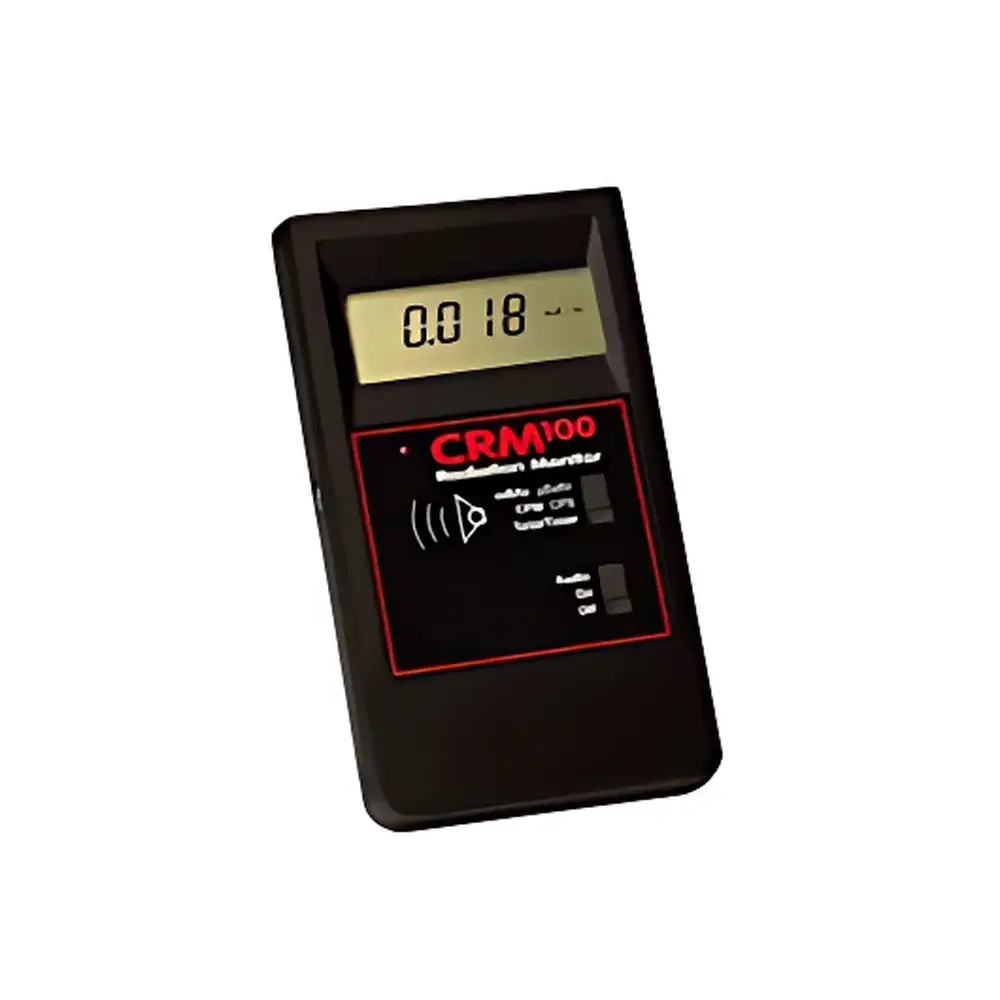
Medcom CRM-100 Geiger-Müller Radiation Survey Meter
| Brand | Medcom |
|---|---|
| Origin | USA |
| Model | CRM-100 |
| Detector Type | Halogen-quenched Geiger-Müller tube with mica end-window (45 mm diameter, 1.5–2.0 mg/cm² density) |
| Radiation Types Detected | Alpha, Beta, Gamma, and X-ray |
| Energy Range | 20 keV – 3 MeV |
| Dose Rate Range | 0.001–110.0 mR/h or 0.01–1100 µSv/h |
| Count Rate Range | 0–3,500 CPS / 0–350,000 CPM |
| Total Count Capacity | Up to 9,999,000 counts |
| Timer Range | Up to 40 hours |
| Sensitivity | ≥1,000 CPM per mR/h (referenced to Cs-137) |
| Accuracy | ±10% typical, ±15% maximum (mR/h and µSv/h modes) |
| Audio Feedback | Click-per-count (user-muteable) |
| Display | 4-digit LCD with mode indicators |
| Output Interface | 3.5 mm mono jack (CMOS-compatible TTL pulse output) |
| Input Interface | 2.5 mm calibration input port |
| Power | One 9 V alkaline battery (typical life: 2,160 hours) |
| Dimensions | 150 × 80 × 30 mm |
| Weight | 225 g (including battery) |
| Certifications | CE, RoHS, WEEE, ISO 9001:2001 & ISO 14001 |
Overview
The Medcom CRM-100 Geiger-Müller Radiation Survey Meter is a portable, general-purpose radiation detection instrument engineered for reliable field measurements in occupational safety, environmental monitoring, educational laboratories, and emergency response scenarios. It employs a halogen-quenched Geiger-Müller (GM) tube with a thin mica end-window—optimized for detection of alpha, beta, gamma, and X-ray radiation across an energy range of 20 keV to 3 MeV. Unlike scintillation or semiconductor-based detectors, the CRM-100 leverages robust GM tube physics: ionizing radiation triggers discrete, quantifiable gas avalanches within the tube, producing uniform electrical pulses that are counted and converted into dose rate (mR/h or µSv/h) and count rate (CPS/CPM) outputs. Its design prioritizes operational simplicity, mechanical durability, and traceable calibration—making it suitable for routine screening where high-resolution spectroscopy is unnecessary but rapid, repeatable exposure assessment is essential.
Key Features
- Halogen-quenched GM detector with 45 mm mica end-window (density 1.5–2.0 mg/cm²), enabling efficient detection of low-penetrating alpha and beta particles alongside gamma/X-ray photons.
- Real-time dual-unit display: 4-digit LCD simultaneously supports conventional (mR/h, CPM) and SI (µSv/h, CPS) units, configurable via front-panel toggle.
- Three-second update interval ensures responsive feedback without compromising statistical stability in low-flux environments.
- Integrated timer (up to 40 hours) and cumulative counter (max 9,999,000 counts) support time-weighted exposure evaluation and long-duration surveys.
- CMOS-compatible 3.5 mm TTL pulse output enables direct connection to data loggers, PC-based acquisition systems, or custom microcontroller interfaces for automated recording and analysis.
- Calibration input port (2.5 mm) permits external reference signal injection during field verification or QA/QC procedures.
- Low-power architecture: single 9 V alkaline battery delivers >2,160 hours of continuous operation under typical background conditions (≤0.1 µSv/h).
Sample Compatibility & Compliance
The CRM-100 is not sample-based in the analytical chemistry sense; rather, it measures ambient or surface-emitted ionizing radiation from environmental media—including air, soil, building materials, and sealed radioactive sources. Its mica window allows direct alpha/beta assessment on unsealed surfaces when used at ≤2 cm distance, while gamma/X-ray sensitivity supports area monitoring in nuclear medicine facilities, decommissioning sites, or post-incident zones. The instrument complies with EU regulatory frameworks: CE marking confirms conformity with the Electromagnetic Compatibility (EMC) Directive 2014/30/EU and the Radio Equipment Directive (RED) 2014/53/EU; RoHS 2011/65/EU and WEEE 2012/19/EU certifications verify restricted substance compliance and end-of-life responsibility. Quality management adheres to ISO 9001:2001 and environmental stewardship to ISO 14001 standards. Though not FDA 21 CFR Part 11 compliant (as it lacks audit-trail-capable software), its hardware-level calibration traceability to Cs-137 reference sources supports GLP-aligned documentation in non-regulated educational or industrial settings.
Software & Data Management
The CRM-100 operates as a standalone hardware meter with no embedded firmware or proprietary software stack. Pulse output via the 3.5 mm jack is TTL-compatible and electrically isolated—enabling integration with third-party platforms such as LabVIEW, MATLAB, Python (via USB-to-serial adapters), or dedicated radiation data loggers. Users may capture raw count timestamps, compute moving averages, or export CSV-formatted logs for trend analysis. No onboard memory or cloud connectivity is provided; all data persistence occurs externally. For calibration verification, the 2.5 mm input accepts standardized test pulses (e.g., from NIST-traceable pulsers), allowing periodic performance checks without returning the unit to a service center. This architecture ensures long-term interoperability and avoids vendor lock-in.
Applications
- Personal radiation safety monitoring for first responders, health physics technicians, and radiopharmaceutical handlers.
- Classroom instruction in nuclear physics, radiation protection principles, and detector fundamentals.
- Environmental baseline surveys near legacy uranium processing sites, NORM-contaminated industrial facilities, or post-Fukushima remediation zones.
- Verification of shielding integrity in radiotherapy rooms or veterinary X-ray suites.
- Screening of imported scrap metal, antiques, or ceramics for inadvertent radioactive contamination.
- Field validation of decontamination efficacy following radiological dispersal device (RDD) mitigation efforts.
FAQ
Does the CRM-100 provide energy discrimination or spectral identification?
No. As a Geiger-Müller counter, it registers all ionizing events above its threshold without energy resolution. It cannot distinguish between radionuclides or quantify isotopic composition.
Can the CRM-100 detect neutrons?
No. The GM tube is insensitive to neutron radiation due to lack of hydrogenous converter material or boron-lined geometry.
Is the mica window fragile? How should it be protected during use?
Yes—the 1.5–2.0 mg/cm² mica window is mechanically delicate. Always use the supplied protective cap when not actively measuring alpha/beta; avoid contact with solvents, abrasives, or excessive pressure.
What is the recommended calibration frequency?
Annual calibration against a traceable Cs-137 source is advised for occupational use. Field verification using check sources (e.g., KCl or uranium ore) should occur before each measurement session.
Does the instrument meet ANSI N42.33 or IEC 60846 standards?
It is not formally certified to ANSI N42.33 (portable radiation detection instrumentation) or IEC 60846 (radiation protection instrumentation), though its performance parameters fall within typical ranges specified by those standards for basic survey meters.







