
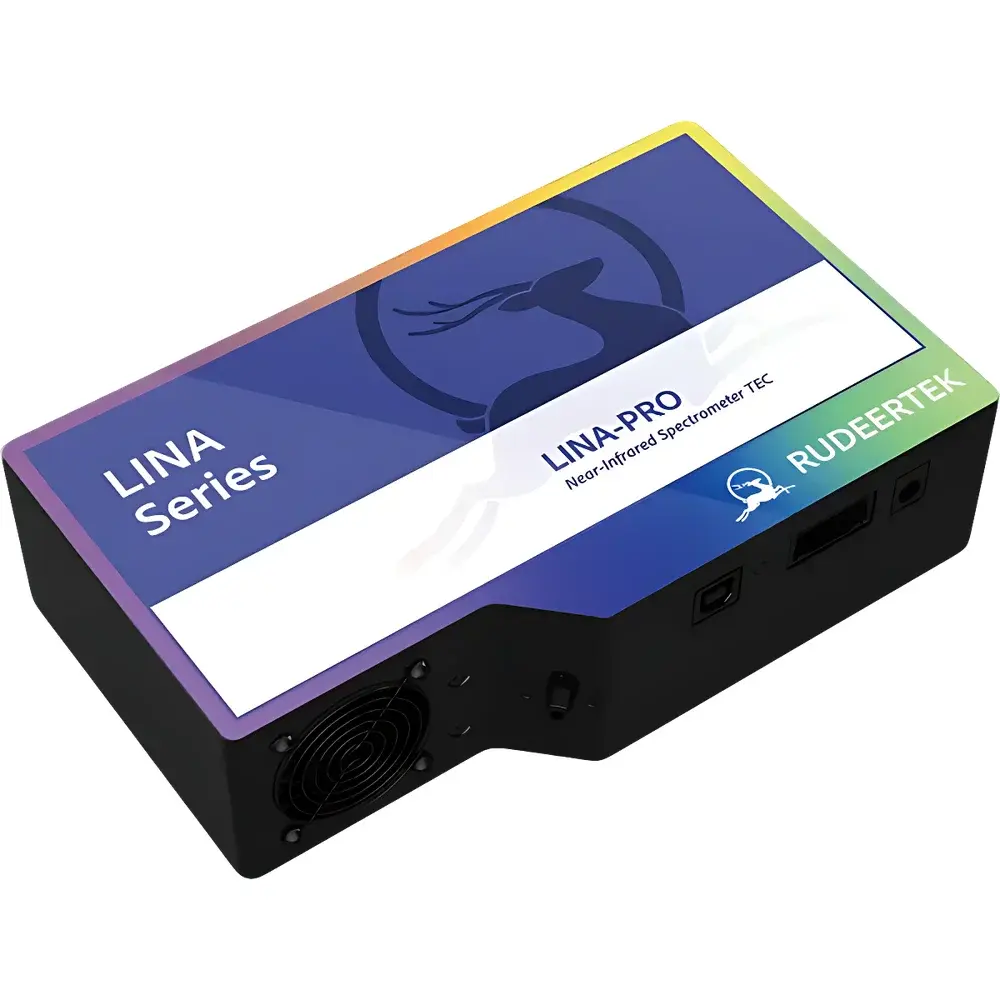
LINA-PRO TEC-Cooled Near-Infrared Fiber Optic Spectrometer
| Brand | LuQi Technology |
|---|---|
| Origin | Anhui, China |
| Manufacturer Type | Direct Manufacturer |
| Spectral Range | 900–1700 nm |
| Detector | TEC-cooled InGaAs linear array (1st-stage cooling) |
| Optical Resolution | ~4.3 nm (with 500 μm slit) |
| Signal-to-Noise Ratio | 5000:1 (full signal) |
| Dynamic Range | 7000:1 (single acquisition) |
| Stray Light | <1% |
| F-number | F/4 |
| Optical Design | Crossed Czerny-Turner |
| Pixel Count | 256 or 512 × 1 pixels |
| Pixel Size | 50/25 μm × 500 μm |
| Integration Time | 1 ms – 10 s |
| Linearity | ≥0.998 |
| A/D Resolution | 16-bit |
| Weight | 1.25 kg |
| Interface | USB 2.0 Type-B, digital I/O, SMA905 fiber port |
| OS Support | 32/64-bit Windows 7/10/11 |
Overview
The LINA-PRO TEC-Cooled Near-Infrared Fiber Optic Spectrometer is a precision-engineered analytical instrument designed for quantitative and qualitative spectral analysis in the 900–1700 nm wavelength region. Based on the crossed Czerny-Turner optical architecture with an F/4 beam path, it delivers high optical throughput and stable spectral fidelity across demanding laboratory and industrial environments. At its core lies a thermoelectrically cooled (TEC) InGaAs linear array detector—operating at a stabilized temperature approximately 30 °C below ambient—enabling substantial suppression of dark current and associated thermal noise. This active cooling architecture ensures consistent performance during extended integration periods and under variable ambient conditions, making the LINA-PRO particularly suitable for applications requiring high reproducibility in low-light or time-resolved NIR measurements.
Key Features
- TEC-based first-stage cooling system for InGaAs detector, maintaining thermal stability within ±0.5 °C for minimized dark current drift
- Optimized optical design with F/4 throughput and interchangeable slit options (10, 25, 50, 75, and 100 μm) to balance resolution and sensitivity
- High linearity (>0.998) and 16-bit analog-to-digital conversion enabling accurate intensity calibration across wide dynamic ranges
- Stray light level <1% — achieved via optimized internal baffling and high-quality coated optics — critical for reliable quantification in complex matrices
- Compact form factor (1.25 kg) with robust aluminum housing, supporting OEM integration and portable field deployment
- Native support for USB 2.0 (Type-B) communication and TTL-compatible digital I/O for external trigger synchronization and hardware control
Sample Compatibility & Compliance
The LINA-PRO interfaces seamlessly with standard SMA905 fiber-optic probes, enabling flexible coupling to transmission cells, reflectance probes, flow cuvettes, and process sampling interfaces. Its spectral response is validated against NIST-traceable tungsten-halogen and deuterium lamp standards, ensuring traceability in routine calibration workflows. While not certified to ISO/IEC 17025 as a standalone metrology device, the instrument’s linearity, repeatability, and thermal stability align with common requirements for method validation under ASTM E1421 (Standard Practice for Describing and Measuring Performance of Near-Infrared (NIR) Spectrometers) and USP (Near-Infrared Spectroscopy). Data acquisition and storage protocols are compatible with GLP-compliant environments when used with audit-trail-enabled third-party software platforms.
Software & Data Management
The LINA-PRO operates via LuQi’s SDK (C/C++, Python, and LabVIEW drivers included), allowing full control over integration time, averaging, hardware triggering, and real-time spectrum streaming. Raw spectral data are output in IEEE 754-compliant floating-point format (32-bit), facilitating direct import into MATLAB, Python (NumPy/Pandas), or chemometric platforms such as Unscrambler X or Pirouette. The driver stack supports timestamped metadata embedding (integration time, temperature, slit width, gain setting), enabling automated batch processing and version-controlled spectral libraries. While the spectrometer itself does not include embedded storage or onboard processing, its USB 2.0 interface sustains sustained data transfer rates up to 30 spectra per second (256-pixel mode), sufficient for kinetic monitoring and inline process analytics.
Applications
- Pharmaceutical raw material identification and blend uniformity assessment (e.g., API-excipient ratio monitoring)
- Food quality control: moisture, fat, protein, and starch content quantification in grains, dairy, and meat products
- Polymer characterization: identification of polyolefins, PET, and bioplastics; degradation state analysis via OH/NH band tracking
- Agricultural product grading: sugar content (Brix) in fruits, nitrogen levels in leaves, and grain protein estimation
- Industrial process monitoring: real-time NIR feedback for drying, granulation, and coating steps in continuous manufacturing
- Research-grade spectroscopy: calibration source characterization, LED/laser diode spectral profiling, and optical filter verification
FAQ
What is the recommended integration time range for optimal SNR in low-light NIR applications?
Integration times from 100 ms to 2 s typically yield the best trade-off between signal accumulation and dark current contribution under TEC-stabilized operation.
Can the LINA-PRO be synchronized with external equipment such as pumps or shutter controllers?
Yes—via its digital I/O port (TTL-level input/output), supporting hardware-triggered acquisition with sub-millisecond latency.
Is the detector cooled to a fixed temperature or dynamically regulated?
The TEC controller maintains a user-selectable setpoint (default: −10 °C), with closed-loop regulation achieving ±0.5 °C stability over ambient fluctuations.
Does the spectrometer support radiometric calibration?
Radiometric response can be established using NIST-traceable halogen and deuterium sources; LuQi provides factory-measured relative spectral responsivity curves upon request.
Are firmware updates available, and how are they deployed?
Firmware upgrades are delivered via USB using LuQi’s dedicated utility; no hardware modification or service visit is required.




