
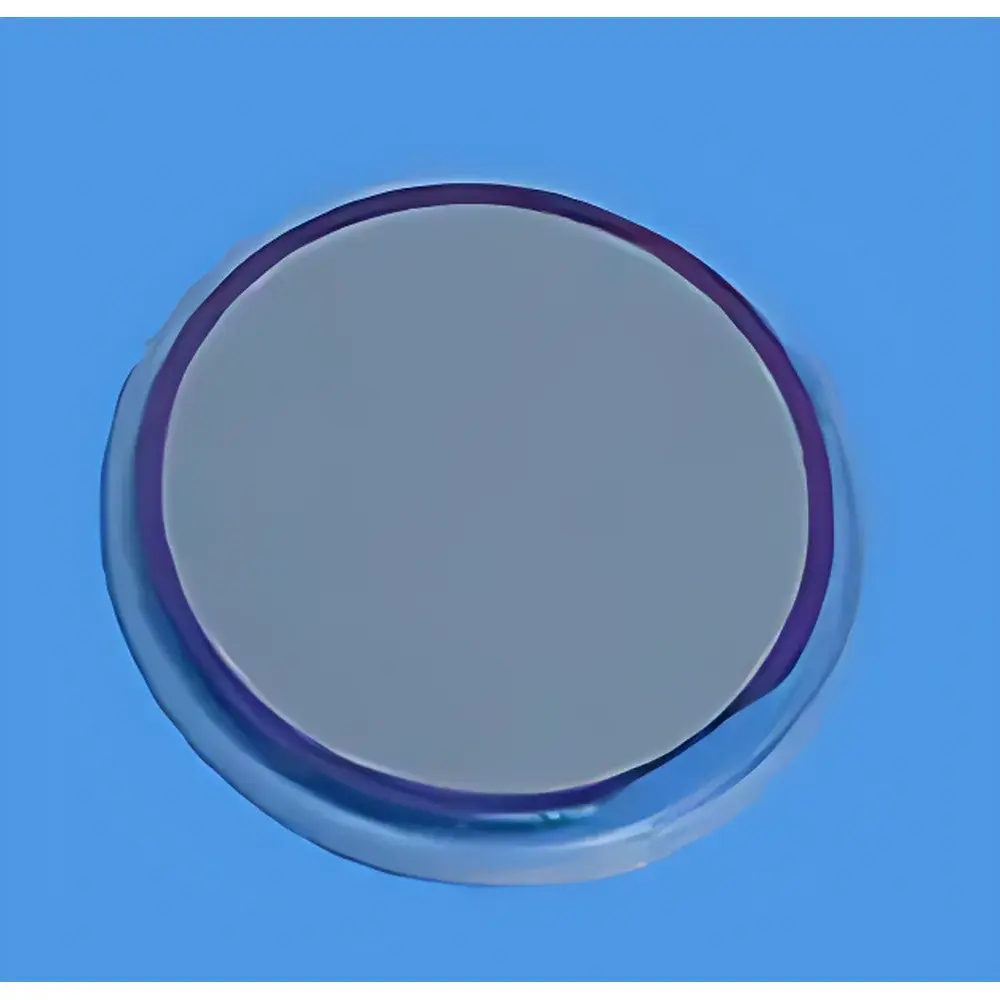
Si+SiO2+Ti+Pt Quartz Crystal Microbalance Sensor Substrate (Domestically Sourced,合肥科晶 Model)
| Brand | Hefei Kejing |
|---|---|
| Origin | Anhui, China |
| Manufacturer Type | Authorized Distributor |
| Origin Classification | Domestic |
| Model | Si+SiO2+Ti+Pt (Domestically Sourced) |
| Pricing | Upon Request |
| Film Thickness | SiO₂ = 500 nm |
| Silicon Substrate | p-type, B-doped, resistivity < 0.005 Ω·cm |
| Standard Dimensions | Ø101.6 mm × 0.5 mm (4" wafers) or 10 mm × 10 mm × 0.5 mm |
| Surface Finish | Single-side polished |
| Packaging | Individual wafers in Class 100 cleanroom bags within Class 1000 cleanroom environment |
Overview
The Si+SiO₂+Ti+Pt Quartz Crystal Microbalance (QCM) sensor substrate is a precision-engineered multilayer thin-film platform designed for high-sensitivity mass sensing in electrochemical, biosensing, and interfacial science applications. Unlike conventional QCM devices that rely solely on AT-cut quartz resonators, this substrate integrates a silicon base wafer with a defined stack of functional dielectric and conductive layers—specifically, a 500 nm thermally grown or deposited SiO₂ insulating layer, followed by a 50 nm titanium adhesion layer and a 200 nm platinum top electrode. The p-type boron-doped silicon substrate (resistivity < 0.005 Ω·cm) provides mechanical rigidity, thermal stability, and compatibility with standard semiconductor handling protocols, while enabling potential integration with complementary microfluidic or CMOS-compatible readout systems.
Key Features
- Engineered multilayer architecture optimized for QCM-D (Quartz Crystal Microbalance with Dissipation monitoring) and electrochemical QCM (EQCM) configurations
- High-purity, low-defect SiO₂ dielectric layer (500 nm) ensuring stable acoustic impedance matching and minimal energy dissipation at fundamental resonance frequencies (typically 5–10 MHz depending on final device geometry)
- Ti adhesion layer (50 nm) guarantees robust interfacial bonding between SiO₂ and Pt, critical for long-term operational reliability under repeated electrochemical cycling or liquid-phase exposure
- Pt working electrode (200 nm) offers excellent electrocatalytic activity, corrosion resistance in acidic/alkaline electrolytes, and low ohmic contact resistance for precise current–mass correlation in EQCM studies
- Single-side polished silicon substrate (Ø101.6 mm × 0.5 mm or 10 × 10 × 0.5 mm) meets SEMI-standard dimensional tolerances and surface flatness requirements (≤0.5 µm total thickness variation)
- Class 100 cleanroom packaging ensures particle-free delivery—each substrate is sealed in individually certified Class 100 polyethylene cleanroom bags within a Class 1000 cleanroom environment
Sample Compatibility & Compliance
This substrate is compatible with standard QCM instrumentation platforms from manufacturers including Q-Sense (Biolin), Stanford Research Systems, and Gamry Instruments. Its layered structure supports both gravimetric and viscoelastic characterization when coupled with dissipation monitoring. The Pt/SiO₂ interface demonstrates reproducible electrochemical behavior across pH 1–13 and temperature ranges from 5 °C to 60 °C. While not certified to ISO 13485 or FDA 21 CFR Part 11 out-of-the-box, the fabrication process adheres to controlled cleanroom protocols consistent with GLP-aligned laboratory practices. Documentation—including lot-specific film thickness verification via ellipsometry and four-point probe sheet resistance data—is available upon request for audit-ready traceability.
Software & Data Management
No proprietary software is bundled with the substrate; however, it is fully interoperable with industry-standard QCM analysis suites such as Q-Tools (Biolin), EC-Lab (BioLogic), and NOVA (Metrohm Autolab). When used in conjunction with time-resolved frequency (Δf) and dissipation (ΔD) acquisition, the substrate enables quantitative modeling of adsorbed mass, hydration state, and shear modulus using Sauerbrey and Voigt-based fitting algorithms. Raw frequency shift data can be exported in CSV or ASCII format for integration into LIMS or custom Python/Matlab analysis pipelines compliant with ASTM E2917-22 (Standard Practice for Validation of Analytical Methods).
Applications
- In situ monitoring of protein adsorption, DNA hybridization, and polymer brush swelling kinetics in liquid environments
- Real-time evaluation of catalyst layer degradation in PEM fuel cell membrane electrode assemblies (MEAs)
- Development and validation of antifouling coatings for biomedical implants and microfluidic channels
- Electrodeposition studies of metal oxides, conducting polymers, and nanocomposites under potentiostatic/galvanostatic control
- Gas-phase sensing of volatile organic compounds (VOCs) using functionalized Pt surfaces in combination with temperature-controlled QCM chambers
FAQ
Is this substrate compatible with QCM-D instruments requiring dual-frequency excitation?
Yes—the SiO₂/Ti/Pt stack maintains consistent acoustic coupling across harmonics (3rd, 5th, 7th overtones), enabling reliable multi-harmonic dissipation analysis.
Can custom patterning or lithography be applied post-delivery?
The Pt surface is compatible with standard photolithography, lift-off, and e-beam processes; however, thermal budget must remain below 200 °C to preserve SiO₂ integrity.
What quality documentation accompanies each shipment?
Each batch includes a Certificate of Conformance listing nominal film thicknesses, substrate resistivity, surface roughness (Ra < 0.3 nm, measured by AFM), and cleanroom packaging certification.
Are smaller or non-standard dimensions available?
Yes—custom cutting (e.g., 5 × 5 mm, 15 × 15 mm) and double-side polishing are offered as value-added services with lead-time adjustment.
How should the substrate be cleaned prior to use?
Recommended protocol: sequential ultrasonication in acetone, isopropanol, and DI water (5 min each), followed by O₂ plasma treatment (100 W, 1 min) to remove organic residues and activate the Pt surface.




