
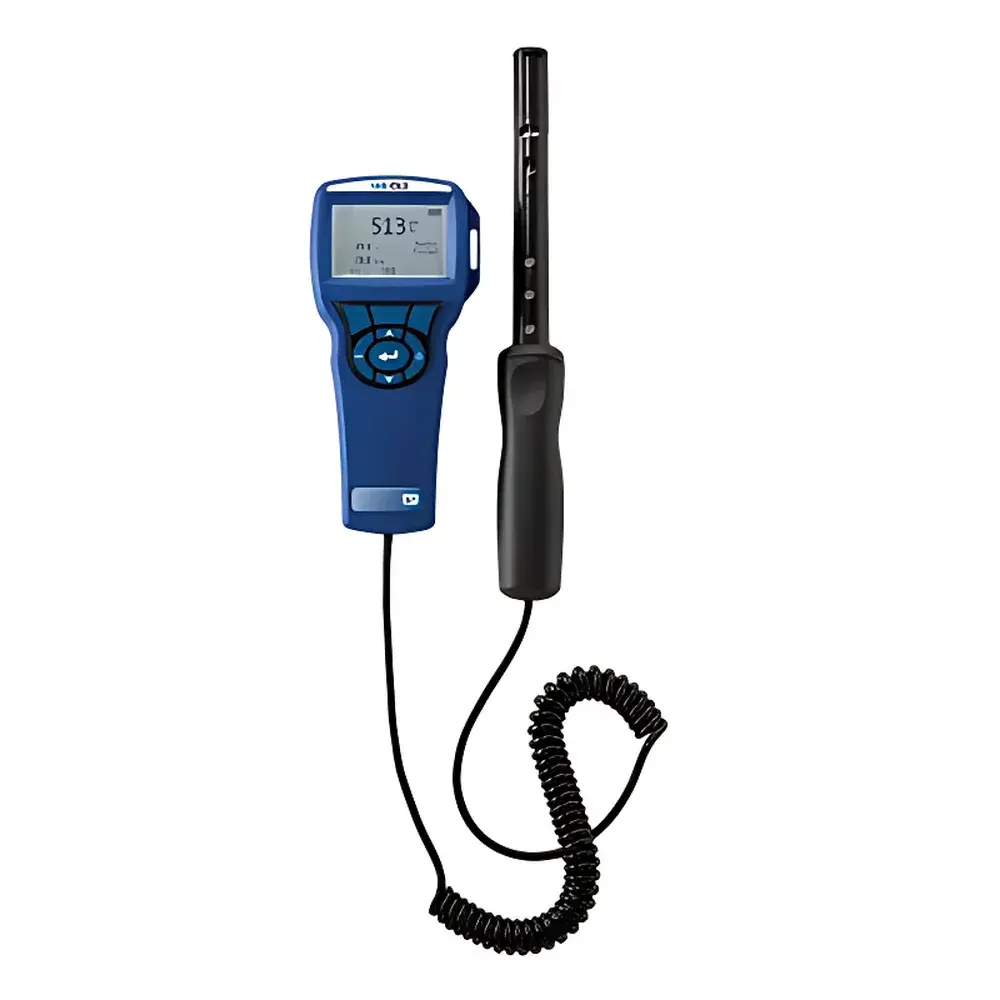
TSI Model 7545 Indoor Air Quality Monitor
| Brand | TSI |
|---|---|
| Origin | USA |
| Model | 7545 |
| Measured Parameters | CO₂, CO, Temperature, Relative Humidity |
| Derived Parameters | Dew Point Temperature, Wet-Bulb Temperature, Outdoor Air Fraction (calculated) |
| Sensor Technology | NDIR (CO₂), Electrochemical (CO), Capacitive (RH), Thermistor (Temperature) |
| Data Logging | Internal memory with timestamped records |
| Interface | USB for data download via TSI LogDat2™ software |
| Compliance | Designed to support ASHRAE 62.1, ISO 16814, and EN 13779 indoor air quality assessment protocols |
Overview
The TSI Model 7545 Indoor Air Quality (IAQ) Monitor is an integrated, handheld instrument engineered for field-deployable, real-time assessment of key environmental parameters in commercial, institutional, and residential buildings. It operates on established physical measurement principles: non-dispersive infrared (NDIR) spectroscopy for carbon dioxide (CO₂) detection, electrochemical cell technology for carbon monoxide (CO) quantification, and high-stability capacitive polymer sensors for relative humidity (RH), paired with precision thermistors for temperature. These core transducers are calibrated traceably to NIST standards and housed within a thermally stabilized enclosure to minimize thermal drift—critical for maintaining measurement integrity during extended monitoring campaigns. The device computes secondary IAQ indices—including dew point temperature, wet-bulb temperature, and estimated outdoor air fraction—using industry-standard psychrometric algorithms compliant with ASHRAE Fundamentals Handbook equations. Its architecture supports both spot-check verification and time-series logging, making it suitable for HVAC commissioning, post-occupancy evaluation, and continuous IAQ baseline studies.
Key Features
- Simultaneous, synchronized measurement of CO₂ (0–5,000 ppm), CO (0–500 ppm), temperature (−10 to 60 °C), and relative humidity (0–95% RH non-condensing)
- Low-drift NDIR CO₂ sensor with automatic baseline correction and <±30 ppm accuracy at 25 °C and 50% RH (per TSI specification sheet)
- Electrochemical CO sensor with cross-sensitivity compensation for H₂ and NO₂, certified to UL 2034 and EN 50291-1 requirements
- On-device statistical engine calculating real-time mean, minimum, maximum, and sample count for each parameter over user-defined intervals
- Ergonomic, one-handed operation with backlit LCD display and intuitive push-button navigation
- Internal flash memory capable of storing up to 32,000 timestamped data points with configurable logging intervals (1 sec to 24 hrs)
Sample Compatibility & Compliance
The Model 7545 is intended for sampling ambient indoor air in mechanically ventilated and naturally ventilated spaces. It is not designed for industrial stack emissions, explosive atmospheres (ATEX/IECEx), or corrosive gas environments. Its measurement range and uncertainty profiles align with the performance criteria outlined in ASTM D6245-22 (“Standard Practice for Using Indoor Air Quality Investigation Instruments”) and ISO 16814:2022 (“Indoor air — Methodology for the assessment of indoor air quality”). When used in conjunction with documented procedures, the instrument supports compliance verification for LEED v4.1 EQ Credit: Indoor Air Quality Assessment, WELL Building Standard v2 Air Concept, and EU Directive 2002/31/EC on workplace exposure limits. Data export functionality enables traceability required under GLP-aligned laboratory practices.
Software & Data Management
Data retrieval and analysis are performed using TSI LogDat2™ software (Windows-compatible, version 3.0+), which provides secure, audit-ready file handling. The software generates CSV and PDF reports with embedded metadata—including instrument serial number, calibration due date, operator ID, and GPS coordinates if enabled via external Bluetooth module. All exported datasets include full audit trails showing timestamp, parameter values, measurement units, and sensor status flags (e.g., “CO sensor warm-up”, “RH saturation warning”). LogDat2™ supports 21 CFR Part 11-compliant user access controls when deployed on validated networked systems, including electronic signatures, role-based permissions, and immutable log archives.
Applications
- HVAC system commissioning and functional performance testing per ASHRAE Guideline 0 and TAB protocols
- Occupant comfort and productivity studies correlating CO₂ levels with cognitive task performance metrics
- Post-remediation verification following mold or VOC mitigation interventions
- Baseline IAQ characterization prior to green building certification (BREEAM, Green Star, DGNB)
- Educational demonstrations of ventilation effectiveness and demand-controlled ventilation logic
- Long-term trend analysis of diurnal and seasonal IAQ variations in schools and office buildings
FAQ
What is the recommended calibration interval for the Model 7545?
TSI recommends annual factory calibration for CO₂ and CO channels; temperature and RH sensors may be verified quarterly using NIST-traceable reference sources.
Can the 7545 measure volatile organic compounds (VOCs)?
No—the Model 7545 does not include photoionization (PID) or metal oxide semiconductor (MOS) VOC sensing capability. It is optimized for CO₂, CO, thermal, and moisture parameters only.
Is the internal data logger password-protected?
The device itself does not support password protection; however, LogDat2™ software allows encrypted project files and Windows-level user authentication when configured in enterprise deployment mode.
Does the instrument meet FDA or EPA regulatory requirements for indoor air monitoring?
While not an EPA-certified ambient monitor, the 7545 satisfies technical criteria referenced in EPA IAQ Tools for Schools Action Kit and FDA guidance on environmental monitoring in pharmaceutical manufacturing facilities (e.g., Annex 1).
How is outdoor air fraction calculated?
Using the measured indoor CO₂ concentration, assumed outdoor CO₂ baseline (typically 400 ppm), and occupant-generated CO₂ generation rate (default 0.005 L/s·person), per the mass balance method described in ASHRAE Standard 62.1.







