
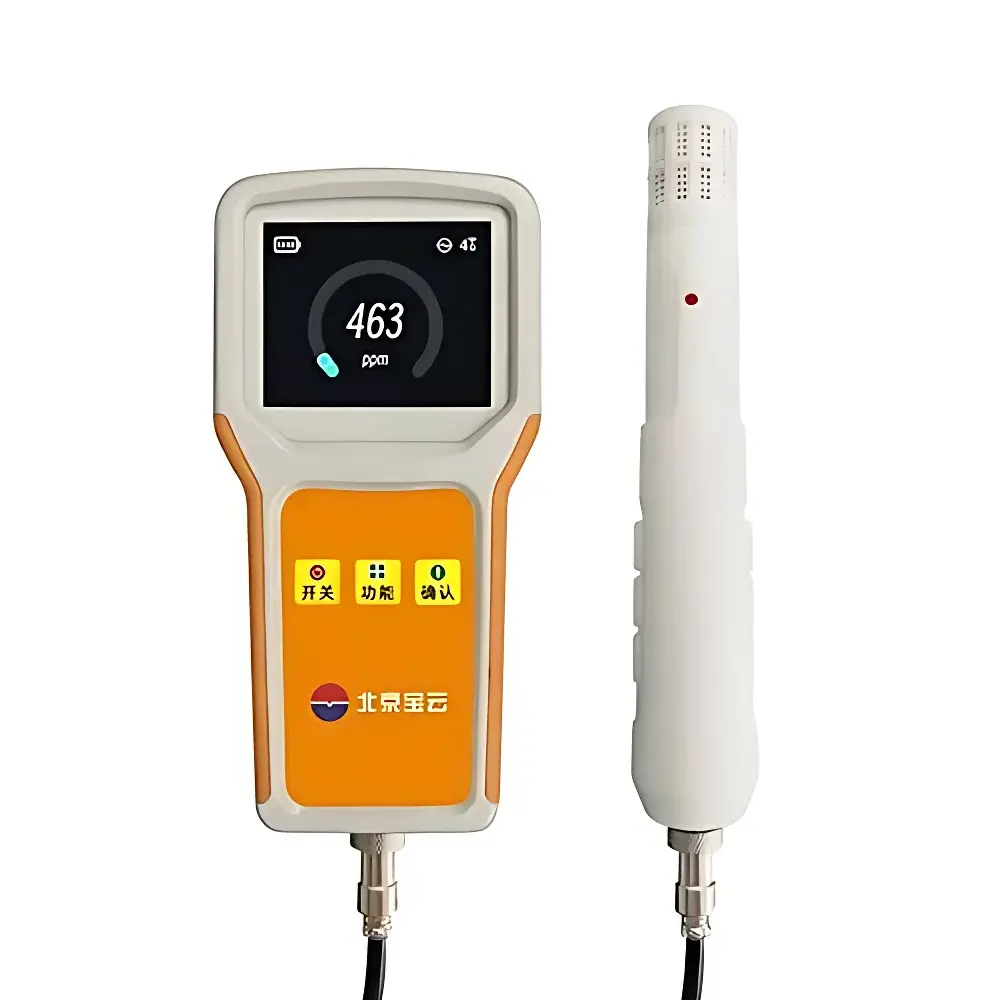
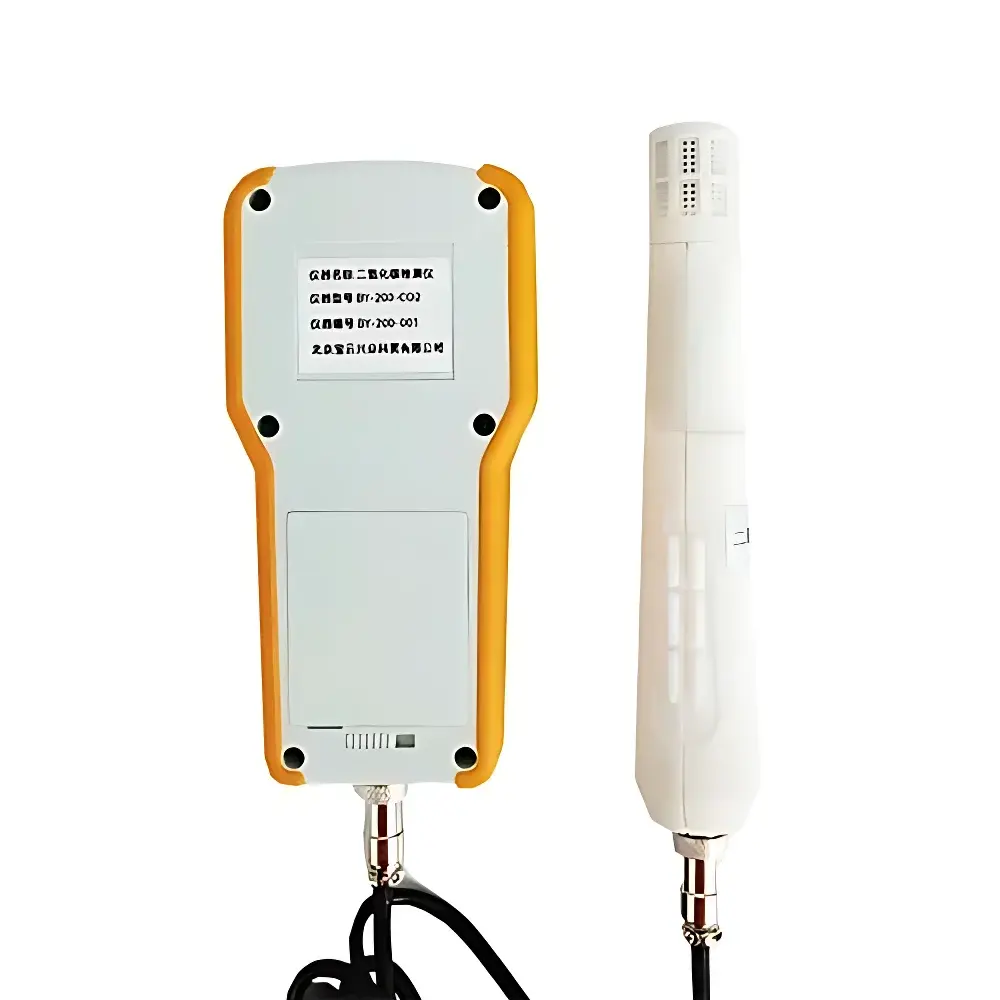
BY-200-CO2 Portable Carbon Dioxide and Formaldehyde Analyzer
| Brand | BJBY (Beijing Baoyun) |
|---|---|
| Model | BY-200-CO2 |
| Type | Portable Gas Analyzer |
| Detection Principle | NDIR for CO₂ |
| CO₂ Range | 0–10,000 ppm |
| CO₂ Resolution | 1 ppm |
| CO₂ Accuracy | ±(40 + 3% of reading) ppm |
| HCHO Range | 0.00–5.00 mg/m³ |
| HCHO Resolution | 0.01 mg/m³ |
| HCHO Accuracy | ±5% |
| Dimensions (Analyzer) | 165 × 80 × 30 mm |
| Sensor Module Size | 123 × 45 × 15 mm |
| Display | Color TFT LCD |
| Power | Replaceable alkaline batteries |
| Data Connectivity | Bluetooth-enabled smartphone app with cloud upload capability |
| Data Logging | Internal storage with query function |
| Compliance | Designed for indoor air quality (IAQ) assessment per ISO 16814, ASHRAE Standard 62.1, and GB/T 18883–2022 (China IAQ guideline) |
Overview
The BY-200-CO2 Portable Carbon Dioxide and Formaldehyde Analyzer is an integrated, field-deployable instrument engineered for real-time monitoring of two critical indoor air quality (IAQ) parameters: carbon dioxide (CO₂) and formaldehyde (HCHO). It employs non-dispersive infrared (NDIR) spectroscopy for CO₂ quantification — a method recognized for its selectivity, long-term stability, and minimal cross-sensitivity to common atmospheric gases. For formaldehyde detection, the device utilizes a calibrated electrochemical or metal-oxide semiconductor sensor (configuration dependent on regional regulatory alignment), optimized for low-concentration measurement in ambient air. Designed for rapid deployment without calibration gas or consumables, the analyzer supports immediate point-of-use assessment in dynamic environments where ventilation efficacy, occupant density, and off-gassing sources must be evaluated objectively. Its compact form factor and battery-powered operation enable continuous logging during walkthrough audits, HVAC commissioning, post-renovation verification, and routine facility health inspections.
Key Features
- Simultaneous dual-parameter measurement: CO₂ (0–10,000 ppm) and HCHO (0.00–5.00 mg/m³) in a single handheld unit
- High-resolution color TFT LCD display with intuitive icon-based navigation and real-time trend visualization
- Modular sensor architecture: External CO₂ and HCHO probe interfaces support flexible deployment configurations, including duct-mounted or remote sampling via extension cables
- Bluetooth 5.0 connectivity enabling secure pairing with iOS/Android companion application for live data streaming, geotagged logging, and customizable alarm thresholds
- On-device data storage (≥10,000 records) with timestamp, location (GPS-assisted), and environmental metadata (temperature/humidity if integrated)
- Low-power design powered by standard AA alkaline batteries (operational life ≥12 hours at 1-min sampling interval)
- Ruggedized ABS housing rated IP54 for dust and splash resistance, suitable for field use in transportation hubs, healthcare facilities, and hospitality venues
Sample Compatibility & Compliance
The BY-200-CO2 is validated for direct sampling of ambient indoor air across temperature ranges of 0–40 °C and relative humidity up to 90% RH (non-condensing). It meets functional requirements outlined in ISO 16814:2008 (Indoor Air Quality – Guidelines for the assessment of indoor air), ASHRAE Standard 62.1–2022 (Ventilation for Acceptable Indoor Air Quality), and China’s GB/T 18883–2022 (Indoor Air Quality Standard). While not certified to IEC 61000-6-3 (EMC) or ATEX for hazardous locations, it conforms to general electromagnetic compatibility expectations for office and public building instrumentation. Sensor modules are factory-calibrated against NIST-traceable reference gases; field recalibration is supported via zero-air and span-gas procedures documented in the user manual.
Software & Data Management
The proprietary mobile application provides end-to-end data governance: real-time visualization, configurable reporting templates (PDF/CSV export), and encrypted cloud synchronization to a secure, role-based web portal. Audit trails record all user actions — including parameter changes, calibration events, and data exports — satisfying basic GLP-aligned documentation needs. The platform supports multi-user account management, site-level tagging, and automated compliance flagging when measured values exceed jurisdictional thresholds (e.g., CO₂ > 1,000 ppm per ASHRAE guidance; HCHO > 0.08 mg/m³ per WHO 2021 recommendations). Data export complies with ISO/IEC 17025 traceability frameworks when used with documented calibration certificates.
Applications
- Air quality surveys in airports, railway stations, and bus terminals to verify demand-controlled ventilation performance
- Occupancy-driven HVAC optimization in hotels, conference centers, and educational institutions
- Post-construction indoor air testing following renovation or furniture installation (per LEED IEQ Credit 3.2)
- Healthcare facility infection control protocols assessing airborne pathogen transmission risk correlates
- Public health inspections in restaurants, karaoke bars, and elderly care homes
- Academic research on building ventilation efficiency, occupant metabolic CO₂ generation, and VOC emission kinetics
FAQ
What is the recommended calibration frequency for the BY-200-CO2?
Annual factory calibration is advised; field zero-checks using certified zero-air can be performed quarterly. Span calibration with 5,000 ppm CO₂ reference gas is recommended before critical assessments.
Does the device meet FDA 21 CFR Part 11 requirements for electronic records?
No — it does not provide full Part 11 compliance (e.g., electronic signatures, audit trail immutability). However, exported CSV reports include timestamps, operator IDs, and device serial numbers for manual QA review.
Can the analyzer operate continuously while charging?
No — it operates exclusively on replaceable alkaline batteries; no internal rechargeable battery or charging circuitry is included.
Is formaldehyde measurement interfered by other aldehydes or VOCs?
Cross-sensitivity to acetaldehyde and benzaldehyde is possible at concentrations >10× typical indoor levels; confirmatory lab analysis (e.g., DNPH-HPLC) is recommended for regulatory submissions.
How is data integrity ensured during Bluetooth transmission?
AES-128 encryption secures all BLE packets between device and app; local storage retains raw sensor values even if connection drops.
Related Products







