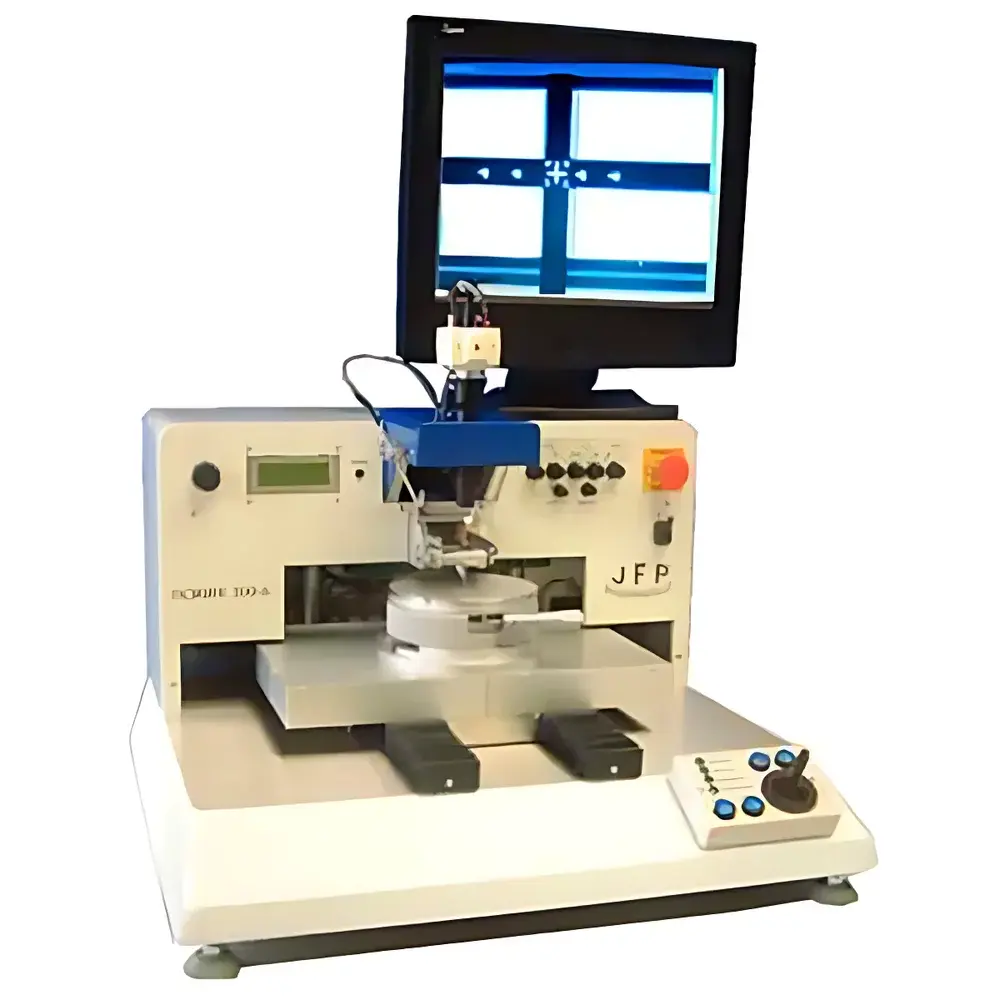
JFP PP7 Semi-Automatic Die Bonder
| Brand | JFP |
|---|---|
| Origin | France |
| Model | PP7 |
| Type | Semi-Automatic Pick-and-Place Die Bonder for Precision Semiconductor Assembly |
| Compliance | Designed for ISO Class 5–7 cleanroom environments |
| Mechanical Architecture | Vibration-isolated granite base with motorized Z-axis and coaxial optical alignment system |
| Imaging | Dual-axis programmable high-magnification telecentric optics with real-time focus tracking |
| Placement Accuracy | ≤ ±1.5 µm (3σ, under controlled environmental conditions) |
| Bond Height Independence | Achieved via dynamic focus-servo loop synchronized with Z-motion control |
| Substrate Compatibility | Wafers (up to 8″), ceramic packages, leadframes, and custom carriers with curvature compensation |
| Tooling Interface | Standard vacuum nozzle exchange (ISO 9409-1-22-6-40) |
| Software Platform | JFP ControlSuite v4.x with audit trail, user-level permissions, and exportable placement logs (CSV/Excel) |
Overview
The JFP PP7 Semi-Automatic Die Bonder is an engineered solution for high-precision die placement in advanced semiconductor packaging, MEMS assembly, and optoelectronic device integration. Built upon a vibration-damped granite platform and driven by a closed-loop motorized Z-axis actuator, the PP7 employs a dual-axis programmable telecentric optical system to achieve bond-height-independent alignment — a critical capability when handling dies on warped substrates, thick ceramic packages, or thermally mismatched carriers. Unlike conventional pick-and-place systems that rely on fixed-focus imaging or mechanical height sensing, the PP7 implements real-time focus-servo synchronization between its coaxial optical path and vertical motion controller. This enables consistent sub-micron registration accuracy across variable bond line thicknesses (BLT), without manual recalibration. The system operates within ISO Class 5–7 cleanroom environments and supports both ambient and nitrogen-purged bonding chambers (optional).
Key Features
- Vibration-isolated mechanical architecture: Monolithic granite base with passive damping mounts minimizes micro-vibrational coupling from floor-borne sources, ensuring stability during fine positioning.
- Coaxial telecentric imaging system: Programmable X/Y/Z-aligned optical train delivers distortion-free magnification up to 200× with depth-of-field compensation across curved surfaces.
- Bond-height independence: Dynamic focus tracking algorithm continuously adjusts focal plane in sync with Z-axis displacement, eliminating height-dependent misregistration.
- Substrate adaptability: Supports wafers (≤200 mm), molded packages, LTCC substrates, and irregular carriers via customizable stage kinematics and curvature mapping routines.
- Tooling flexibility: Interchangeable vacuum nozzles compliant with ISO 9409-1-22-6-40 standard; compatible with low-force dispensing modules and thermal bonding heads (optional).
- Minimal operator dependency: Intuitive graphical interface with guided setup workflows reduces required training time to under two hours for certified technicians.
Sample Compatibility & Compliance
The PP7 accommodates a broad range of die geometries — from <100 µm MEMS sensors to 15 mm × 15 mm infrared detector arrays — while maintaining traceable placement repeatability. It complies with SEMI S2/S8 safety standards and supports GLP/GMP documentation requirements through configurable electronic logbooks. All motion control firmware adheres to IEC 61508 functional safety principles. For regulated medical or aerospace applications, optional 21 CFR Part 11-compliant software validation packages are available, including IQ/OQ documentation templates and change-control records.
Software & Data Management
JFP ControlSuite v4.x provides full parametric control over placement sequence, vision-based fiducial recognition, and real-time process monitoring. Each placement event is timestamped and logged with metadata including stage position, focus error signal, vacuum status, and optical contrast metrics. Audit trails are immutable and exportable in CSV or Excel format for internal quality review or external regulatory submission. User access levels (Operator, Technician, Administrator) enforce role-based parameter locking. Firmware updates are delivered via signed binary packages with SHA-256 verification.
Applications
- Precision die attach for high-value IR imagers and uncooled bolometer arrays
- MEMS packaging requiring angular alignment tolerance <0.1°
- Heterogeneous integration of GaN-on-SiC power devices onto ceramic DBC substrates
- Hybrid optoelectronic assemblies involving VCSELs, photodiodes, and silicon photonics interposers
- Research prototyping of fan-out wafer-level packaging (FOWLP) test vehicles
FAQ
What substrates can the PP7 handle beyond standard wafers?
The PP7 supports ceramic packages (Al₂O₃, AlN), leadframes, flex circuits, and custom carriers with surface curvature up to ±500 µm deviation over 25 mm span — enabled by real-time topography mapping during alignment.
Is nitrogen purge integration supported?
Yes — optional N₂ purge module maintains O₂ <50 ppm inside the bonding chamber, certified for gold-silicon eutectic and thermosonic bonding processes.
Does the system support automated fiducial recognition?
Yes — multi-point fiducial detection using grayscale correlation algorithms with sub-pixel interpolation; supports asymmetric and rotated reference patterns.
Can placement data be exported for SPC analysis?
All positional residuals, focus error traces, and vacuum pressure logs are exportable in standardized formats compatible with JMP, Minitab, and Python-based statistical process control frameworks.
What maintenance intervals are recommended?
Optical calibration every 6 months; vacuum nozzle inspection after 5,000 cycles; granite base leveling verification annually — all procedures documented in the included Preventive Maintenance Manual.