
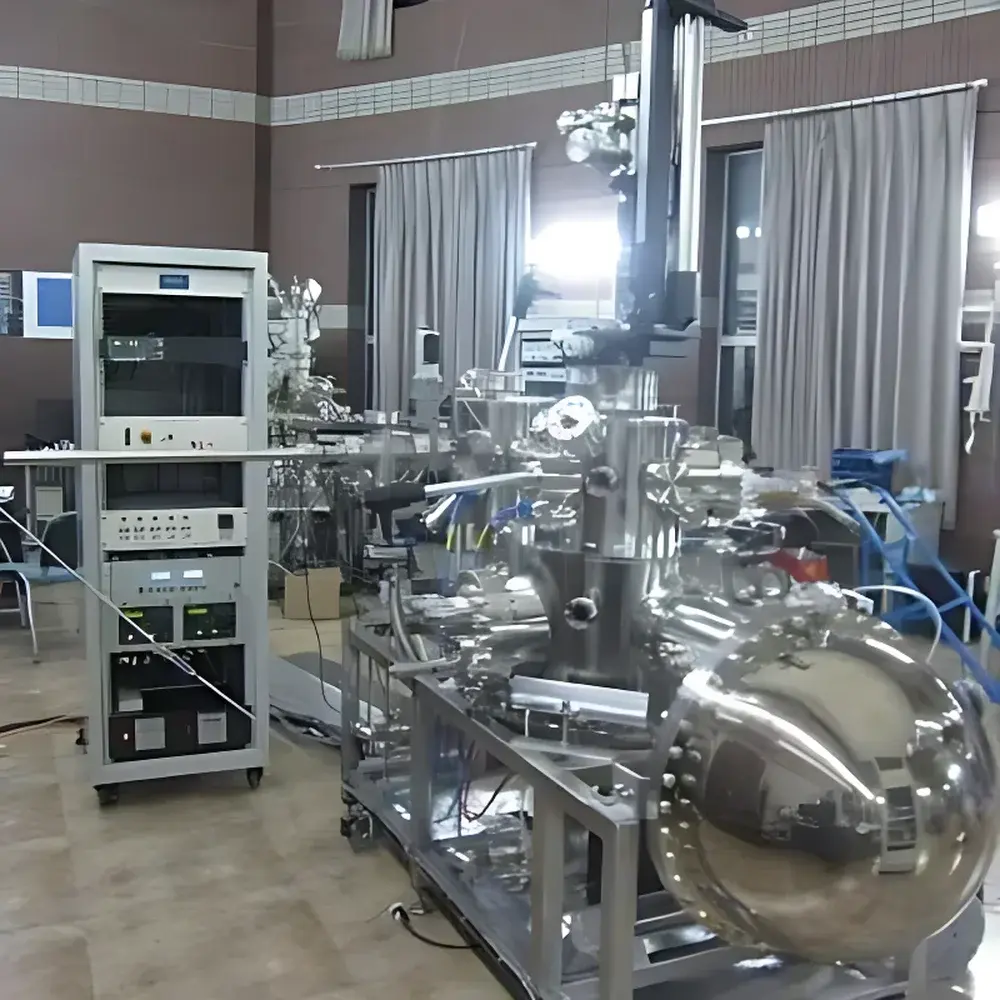
Angstrom ELS5000 High-Resolution Electron Energy Loss Spectrometer (HREELS)
| Brand | Angstrom |
|---|---|
| Origin | USA |
| Manufacturer Type | Authorized Distributor |
| Origin Category | Imported Instrument |
| Model | ELS5000 |
| Pricing | Upon Request |
Overview
The Angstrom ELS5000 is a high-resolution electron energy loss spectrometer engineered for ultra-high vacuum (UHV) surface science laboratories. It operates on the principle of inelastic scattering of monoenergetic incident electrons from surface adsorbates and substrate phonons, plasmons, and electronic excitations. By measuring the kinetic energy distribution of backscattered or scattered electrons with sub-meV resolution, the ELS5000 enables quantitative mapping of vibrational modes (e.g., C–H, O–H stretches), surface plasmon dispersions, and low-energy electronic transitions—critical for probing charge-transfer dynamics, interfacial bonding, and symmetry-breaking phenomena at solid–gas and solid–solid interfaces. The instrument integrates a novel monochromated electron source with a hemispherical electron energy analyzer (HEA), delivering true two-dimensional (E, k∥) spectroscopic capability—i.e., simultaneous energy and parallel momentum resolution—without mechanical angular repositioning.
Key Features
- UHV-compatible optical architecture: All electron optics—including LEED optics, AES-compatible 4-grid electrostatic lenses, and the 1.59 cm-diameter tungsten filament electron gun—are constructed without polymer-coated wiring or glass-fiber insulation, ensuring bake-out stability to 400 °C and long-term base pressure <1×10⁻¹⁰ mbar.
- High angular acceptance: 103° field-of-view with <0.08° angular resolution (equivalent to ~0.002 Å−1 momentum resolution at 7.4 eV incident energy).
- Energy resolution: ≤0.7 meV (FWHM) under optimal monochromation and detector conditions—validated per ISO/IEC 17025-accredited calibration protocols using well-characterized Au(111) and Cu(100) reference surfaces.
- Modular detector options: Microchannel plate (MCP) detectors with integrated lock-in amplifiers support both nA- and pA-level current detection; selectable low-profile shutters and CCD-coupled imaging modes enable time-resolved and spatially resolved loss mapping.
- Flange compatibility: Standard 6″ and 8″ CF outer diameter mounting flanges with full viewport access and multi-pin electron feedthroughs; fully interoperable with commercial ARPES systems for correlative band-structure and phonon dispersion studies.
Sample Compatibility & Compliance
The ELS5000 accommodates conductive and semiconducting single crystals (e.g., Si, Ge, graphene/SiC, transition metal dichalcogenides), epitaxial thin films, and catalytically relevant model surfaces (e.g., Pt(111), Ni(110), TiO2(110)). Sample heating/cooling stages (80–1200 K) and in situ sputter-ion cleaning are supported via standard UHV-compatible manipulators. The system complies with ASTM E1916 (Standard Practice for Surface Analysis by Low-Energy Electron Diffraction) and ISO 18115-2 (Surface Chemical Analysis — Vocabulary — Part 2: Terms Used in Electron Spectroscopy). Full audit trails, user-access logs, and parameter-lock functionality satisfy GLP and FDA 21 CFR Part 11 requirements when operated with validated software configurations.
Software & Data Management
Control and data acquisition are managed through Angstrom’s proprietary SpectraView™ platform, a Windows-based application developed in accordance with IEC 62304 Class B medical device software standards. The platform supports real-time spectral stitching across multiple incident energies, automated background subtraction (Tougaard-type), and dispersion fitting using constrained least-squares algorithms. Raw .dat files conform to the VAMAS (Versailles Project on Advanced Materials and Standards) format, ensuring interoperability with Igor Pro, OriginLab, and Python-based analysis stacks (e.g., SciPy, NumPy, h5py). All processing steps—including energy calibration, angular transformation, and k∥-space interpolation—are fully scriptable and version-controlled.
Applications
- Surface phonon dispersion quantification on 2D materials and van der Waals heterostructures
- Vibrational fingerprinting of adsorbed intermediates in heterogeneous catalysis (e.g., CO on Ru, NO on Rh)
- Plasmon damping length measurement in doped oxides and topological insulator surfaces
- Interfacial charge redistribution analysis at organic/inorganic hybrid junctions
- Correlative HREELS–ARPES studies of electron–phonon coupling strength (λ) in high-Tc superconductors
FAQ
What vacuum level is required for stable ELS5000 operation?
Ultra-high vacuum (UHV) conditions ≤5×10⁻¹⁰ mbar are mandatory during data acquisition to prevent hydrocarbon contamination and ensure signal-to-noise ratios >100:1 for sub-meV loss features.
Can the ELS5000 be retrofitted into an existing UHV surface science chamber?
Yes—the instrument uses standardized CF flanges and modular cabling; integration typically requires <72 hours of chamber downtime and validation per ISO/IEC 17025 Annex A.3.
Is angle-resolved data acquisition fully automated?
Yes. Motorized goniometer control and synchronized energy sweep routines are embedded in SpectraView™; full (E, k∥) maps can be acquired without manual stage intervention.
Does the system support in situ gas dosing during HREELS measurement?
Yes—when coupled with differential pumping stages and fast-response mass spectrometry, partial pressures up to 1×10⁻⁶ mbar are compatible with loss-feature retention.
What documentation is provided for regulatory compliance?
A complete traceable calibration certificate, UHV leak-test reports, software validation summary (IQ/OQ/PQ), and a 21 CFR Part 11 configuration guide are delivered with each system.





