
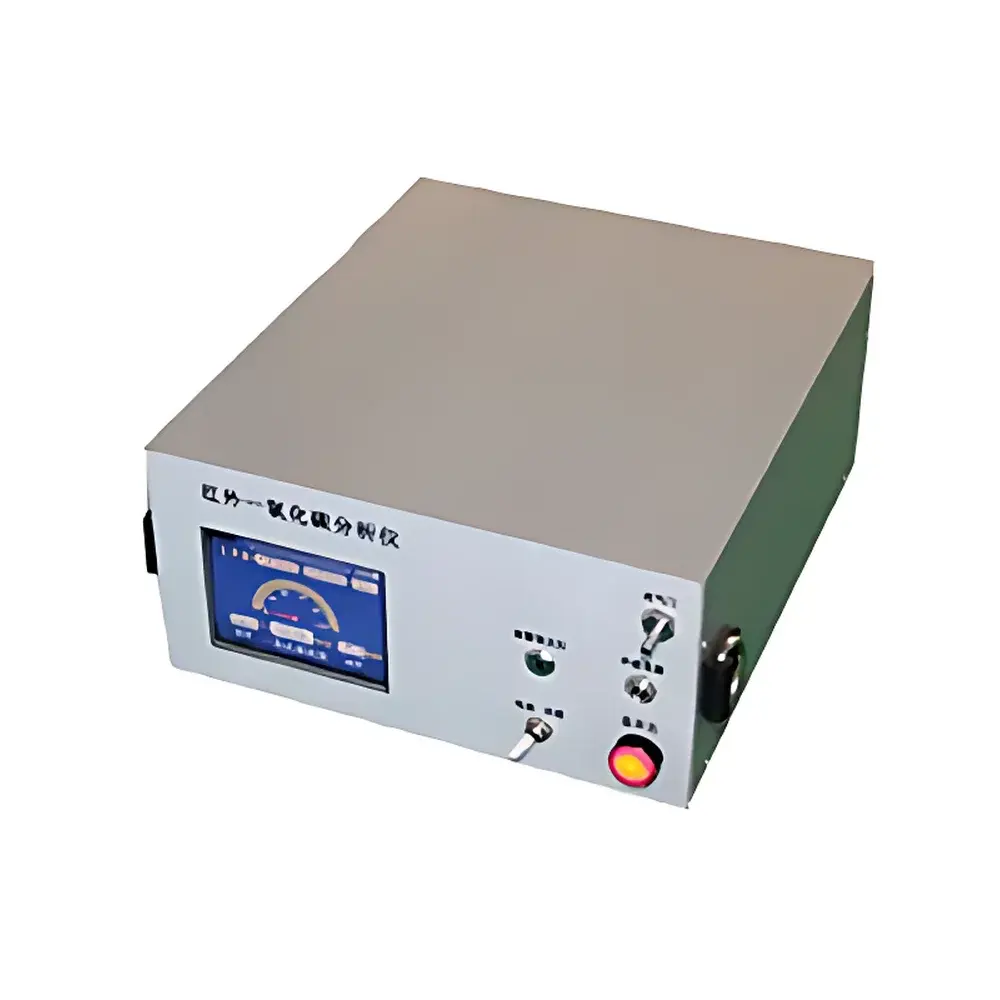
BJBY HX-1500 Intelligent NDIR Carbon Monoxide Analyzer
| Brand | BJBY |
|---|---|
| Origin | Beijing, China |
| Model | HX-1500 |
| Instrument Type | Portable |
| Detection Principle | Non-Dispersive Infrared (NDIR) |
| Target Gas | Carbon Monoxide (CO) |
| Measurement Ranges | CO: 0.0–50 ppm (also configurable to 200 ppm or 1000 ppm) |
| Temperature | −20–60 °C |
| Relative Humidity | 10–95 %RH |
| Resolution | 0.1 ppm |
| Repeatability | ≤1.0 %FS |
| Linearity Error | ≤±2 %FS |
| Zero Drift | Auto-zero compensation |
| Span Drift | ≤±2 %FS / 3 h |
| Response Time (T90) | ≤60 s |
| Warm-up Time | 30 min |
| Flow Rate | 0.5–2.0 L/min |
| Power Supply | AC 220 V (±10 %) or rechargeable internal battery |
| Data Interface | RS-485 |
| Data Storage | 500 records |
| Display | Color touchscreen LCD |
Overview
The BJBY HX-1500 Intelligent NDIR Carbon Monoxide Analyzer is a portable, field-deployable gas monitoring instrument engineered for precise, real-time quantification of carbon monoxide (CO) in ambient air and indoor environments. It employs the well-established non-dispersive infrared (NDIR) absorption spectroscopy principle—where CO molecules selectively absorb infrared radiation at characteristic wavelengths (typically near 4.6 µm)—enabling selective, interference-resistant detection without chemical reagents or consumables. Unlike electrochemical or metal-oxide semiconductor sensors, the NDIR optical path design ensures long-term stability, minimal cross-sensitivity to common atmospheric gases (e.g., CO₂, CH₄, NO₂), and immunity to sensor poisoning. The analyzer simultaneously acquires and displays CO concentration (in ppm and mg/m³, with automatic unit conversion), ambient temperature (−20 to 60 °C), and relative humidity (10–95 %RH), providing contextual environmental metadata essential for regulatory compliance reporting and exposure assessment.
Key Features
- True NDIR optical detection core with dual-wavelength reference compensation for enhanced baseline stability and drift resistance
- Integrated sampling pump enabling active draw-through measurement up to 30 meters via external sampling line (flow rate adjustable between 0.5–2.0 L/min)
- Auto-zero calibration algorithm that dynamically compensates for optical window contamination and thermal drift during operation
- High-resolution color touchscreen interface (≥3.5″) supporting intuitive menu navigation, real-time trend plotting, and on-device configuration
- Onboard data logging capacity for 500 timestamped measurement records, each including CO value, temperature, humidity, date/time, and instrument status flags
- Dual power architecture: operates continuously from AC mains (220 V ±10 %) or autonomously for ≥4 hours using sealed rechargeable Li-ion battery
- RS-485 serial interface compliant with Modbus RTU protocol for integration into SCADA systems, building management platforms, or centralized environmental monitoring networks
Sample Compatibility & Compliance
The HX-1500 is validated for direct analysis of ambient air samples across diverse operational settings—including indoor air quality (IAQ) surveys, occupational hygiene assessments, combustion appliance safety inspections, parking garage ventilation audits, and post-remediation verification testing. Its NDIR methodology conforms to internationally recognized standard test protocols: GB/T 18204.23–2000 (Determination of CO in public place air), GB/T 9801–1988 (Air quality — Determination of carbon monoxide — NDIR method), and JJG 635–2011 (Verification regulation for CO/CO₂ infrared gas analyzers). While not certified to ISO 16000-22 or EN 14662 for formal accreditation, its performance specifications align with the metrological requirements for Class II portable CO monitors under OSHA PEL and WHO air quality guidelines. All firmware and calibration procedures support traceable documentation suitable for GLP-compliant field studies.
Software & Data Management
Data export is supported via USB mass storage mode or RS-485 Modbus communication, enabling seamless transfer to third-party software (e.g., LabVIEW, MATLAB, or custom Python-based dashboards). The embedded firmware maintains full audit trail functionality—including timestamps for all zero/span calibrations, system diagnostics, and parameter changes—facilitating internal QA review and preparation for regulatory inspections. Although the device does not implement FDA 21 CFR Part 11 electronic signature controls (as it lacks user role-based access), its immutable log structure and CRC-verified data integrity meet minimum ALCOA+ (Attributable, Legible, Contemporaneous, Original, Accurate) expectations for field instrumentation used in environmental compliance workflows.
Applications
- Indoor air quality (IAQ) monitoring in offices, schools, hospitals, and residential buildings per ASHRAE Standard 62.1
- Occupational exposure assessment in industrial facilities with combustion processes (e.g., boiler rooms, welding bays, generator enclosures)
- Post-construction indoor air testing following HVAC commissioning or remediation of incomplete combustion sources
- Field validation of CO alarm system performance and placement efficacy
- Educational laboratory use for teaching gas sensing fundamentals, Beer–Lambert law applications, and environmental metrology principles
- Mobile emissions screening in urban microenvironments, traffic corridors, and underground parking structures
FAQ
What detection principle does the HX-1500 use, and why is it preferred for CO monitoring?
It uses non-dispersive infrared (NDIR) absorption at 4.6 µm, offering superior selectivity, long-term stability, and minimal maintenance compared to electrochemical sensors.
Can the instrument measure CO in high-humidity environments without condensation errors?
Yes—the integrated humidity sensor enables real-time compensation algorithms, and the optical cell is thermally stabilized to prevent dew formation within the specified 10–95 %RH operating range.
Is factory calibration traceable to national standards?
Calibration is performed using NIST-traceable CO standard gases (±2 % uncertainty), with certificate-of-calibration provided per unit shipment.
Does the device support remote firmware updates or cloud connectivity?
No—firmware updates require local USB connection and proprietary configuration utility; no built-in Wi-Fi, Bluetooth, or cellular module is included.
What is the recommended calibration interval for routine field use?
Biannual zero/span verification is advised under normal operating conditions; more frequent checks are required after exposure to extreme temperatures, high particulate loads, or mechanical shock.







