
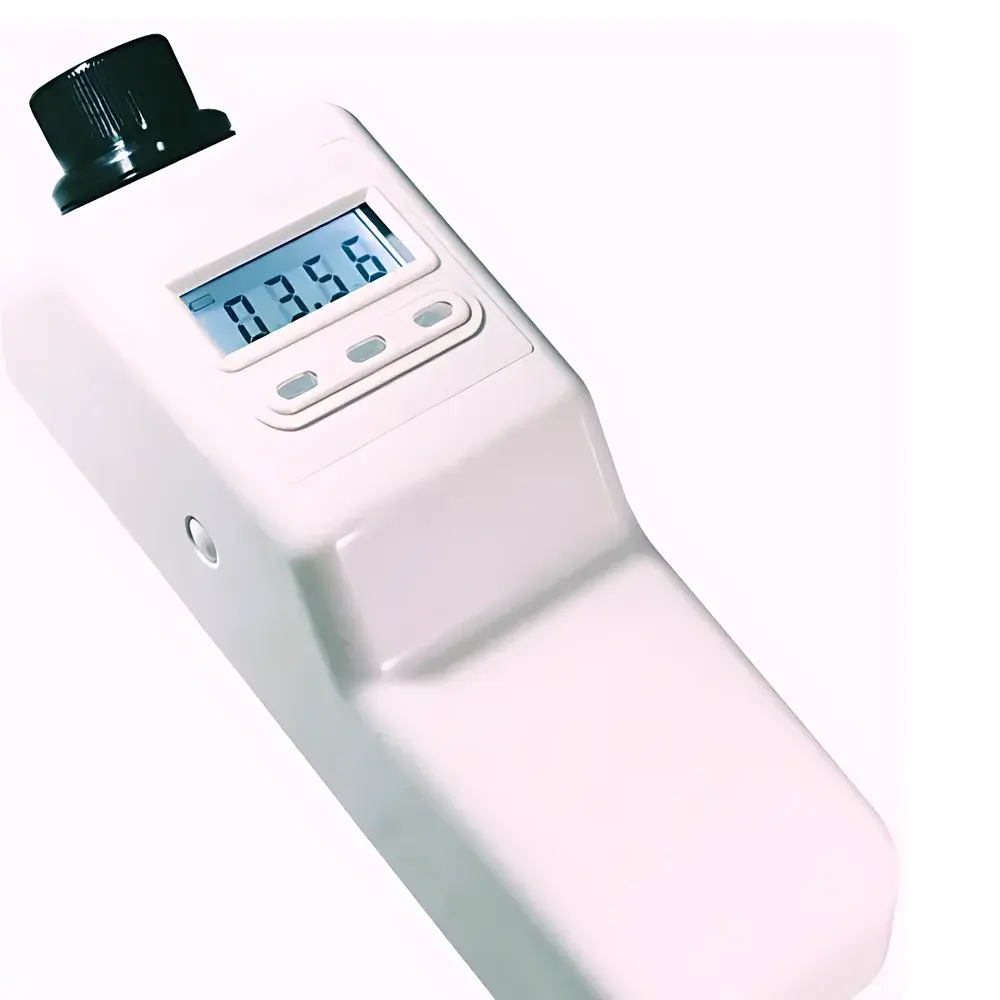
BY-TC1100 Portable Turbidimeter
| Brand | BJBY (Beijing Baoyun) |
|---|---|
| Origin | Beijing, China |
| Model | BY-TC1100 |
| Type | Portable Turbidimeter |
| Measurement Principle | 90° Nephelometric Scattering |
| Range Options | 0–20 NTU / 0–200 NTU |
| Minimum Detectable Value | 0.01 NTU (0–20 range) / 0.1 NTU (0–200 range) |
| Accuracy | ±8% of reading (±2.5% F.S.) |
| Repeatability | ≤1% |
| Zero Drift | ±1% F.S. |
| Light Source | Long-life LED (90° scattering geometry) |
| Warm-up Time | ≤30 s |
| Power Supply | 9 V alkaline battery or AC/DC adapter (220 V AC / 50 Hz input |
| Dimensions | 235 × 75 × 65 mm |
| Display | Backlit LCD with microprocessor control |
| Auto Functions | Auto-zero, auto-calibration, auto-shutdown after 10 min inactivity |
| Data Interface | Analog/digital output port (RS-232 or TTL-level, configurable) |
| Compliance | ISO 7027:2016 (Nephelometric method for turbidity measurement) |
Overview
The BY-TC1100 Portable Turbidimeter is a field-deployable, microprocessor-controlled nephelometer engineered for rapid, on-site quantification of turbidity in clear aqueous media. It operates on the standardized 90° light scattering principle defined in ISO 7027:2016, where incident light from a stable, long-life LED source interacts with suspended particulate matter—such as clay, silt, organic colloids, or microbial aggregates—and the intensity of scattered light measured at a right angle to the incident beam is directly correlated to turbidity concentration. Unlike transmission-based methods, this geometry ensures high sensitivity to low-concentration particles while minimizing interference from color or absorbance. Designed for routine monitoring in water treatment and quality assurance environments, the BY-TC1100 delivers traceable, repeatable measurements across two selectable ranges (0–20 NTU and 0–200 NTU), supporting both regulatory screening and process optimization tasks under variable ambient conditions.
Key Features
- True portable architecture: Compact form factor (235 × 75 × 65 mm) and lightweight construction enable single-handed operation during field surveys, distribution system audits, or emergency response scenarios.
- Dual-range measurement capability: User-selectable 0–20 NTU (resolution 0.01 NTU) and 0–200 NTU (resolution 0.1 NTU) modes accommodate diverse sample matrices—from finished drinking water to raw surface water intake points.
- Stable optical system: Integrated 90° scattering geometry with temperature-compensated LED source ensures minimal drift over extended field use; no warm-up beyond 30 seconds required prior to measurement initiation.
- Intelligent firmware functions: Automatic zero calibration, real-time averaging of sequential readings (configurable count), and adaptive backlight control optimize data integrity and operator efficiency.
- Robust power management: Dual-mode supply—reliable 9 V alkaline battery operation (typical life >2000 measurements per set) or optional AC/DC adapter (7.5 V DC / 0.2 A)—supports uninterrupted use in laboratories, mobile labs, or remote pumping stations.
- Compliance-ready interface: Standard analog/digital output port supports integration with data loggers, SCADA systems, or LIMS via RS-232 or TTL-level signal protocols—facilitating audit-trail generation and automated reporting workflows.
Sample Compatibility & Compliance
The BY-TC1100 is validated for use with potable water, groundwater, surface water, filtered effluent, and bottled water products meeting national and international organoleptic specifications. It excludes samples exhibiting significant fluorescence, strong UV absorption (e.g., highly colored industrial wastewater), or particle concentrations exceeding 200 NTU without dilution. Instrument performance adheres to ISO 7027:2016 requirements for nephelometric turbidimeters, including spectral bandwidth limits (40 dB). While not certified to USP or ASTM D6508 for pharmaceutical-grade applications, its design satisfies typical QA/QC criteria for municipal utilities operating under GB/T 5750.4–2023 (China), EPA Method 180.1 (US), and WHO Guidelines for Drinking-water Quality (4th ed.).
Software & Data Management
The device operates autonomously without external software dependency; however, its serial output interface permits direct communication with third-party acquisition platforms compliant with Modbus RTU or ASCII command sets. Logged measurements retain timestamps (via host system), support GLP-style metadata tagging (operator ID, sample ID, location code), and are exportable in CSV or Excel-compatible formats. Firmware supports user-defined calibration point storage (up to three standard points using Formazin or AMCO-AE traceable suspensions), with checksum-verified memory retention ensuring integrity during battery replacement or transport. No FDA 21 CFR Part 11 compliance is embedded natively, but full audit trail functionality—including calibration history, measurement logs, and parameter changes—is achievable when paired with validated LIMS or ELN environments.
Applications
- Real-time verification of filtration efficiency at municipal water treatment plants and packaged water production lines.
- Routine monitoring of distribution system integrity—detecting main breaks, sediment resuspension, or cross-connection events.
- Field validation of membrane integrity in reverse osmosis or ultrafiltration pilot studies.
- Quality control of source water entering bottling facilities, including spring, mineral, and purified water categories.
- Educational use in environmental science laboratories for teaching optical scattering theory and water quality parameter interrelationships.
- Supporting ISO/IEC 17025-accredited testing laboratories in performing internal method verification per CNAS-CL01:2018 Annex A.4 requirements.
FAQ
What turbidity standards are compatible with the BY-TC1100 for calibration?
Formazin suspension (primary standard) and AMCO-AE polymer standards are recommended; calibration should follow ISO 7027:2016 procedures using at least two points within the selected measurement range.
Can the instrument measure colored samples accurately?
Yes—provided color does not generate significant fluorescence or absorb at the LED emission wavelength (~850 nm); strongly yellow or brown samples may require spectral correction or alternative methods such as ratio-turbidimetry.
Is the output interface compatible with common data loggers?
Yes—the TTL/RS-232 port supports standard baud rates (9600, 19200, 38400 bps) and ASCII command-response protocol; configuration files and driver examples are available upon request from authorized distributors.
How often should zero calibration be performed?
Before each measurement session and after exposure to extreme temperature shifts (>10 °C); automatic zero function executes on startup and may be manually triggered via front-panel key sequence.
Does the device meet GLP documentation requirements?
It provides timestamped raw data and calibration records locally; full GLP compliance depends on host system implementation—e.g., validated PC software or LIMS integration with electronic signature and change control capabilities.





