
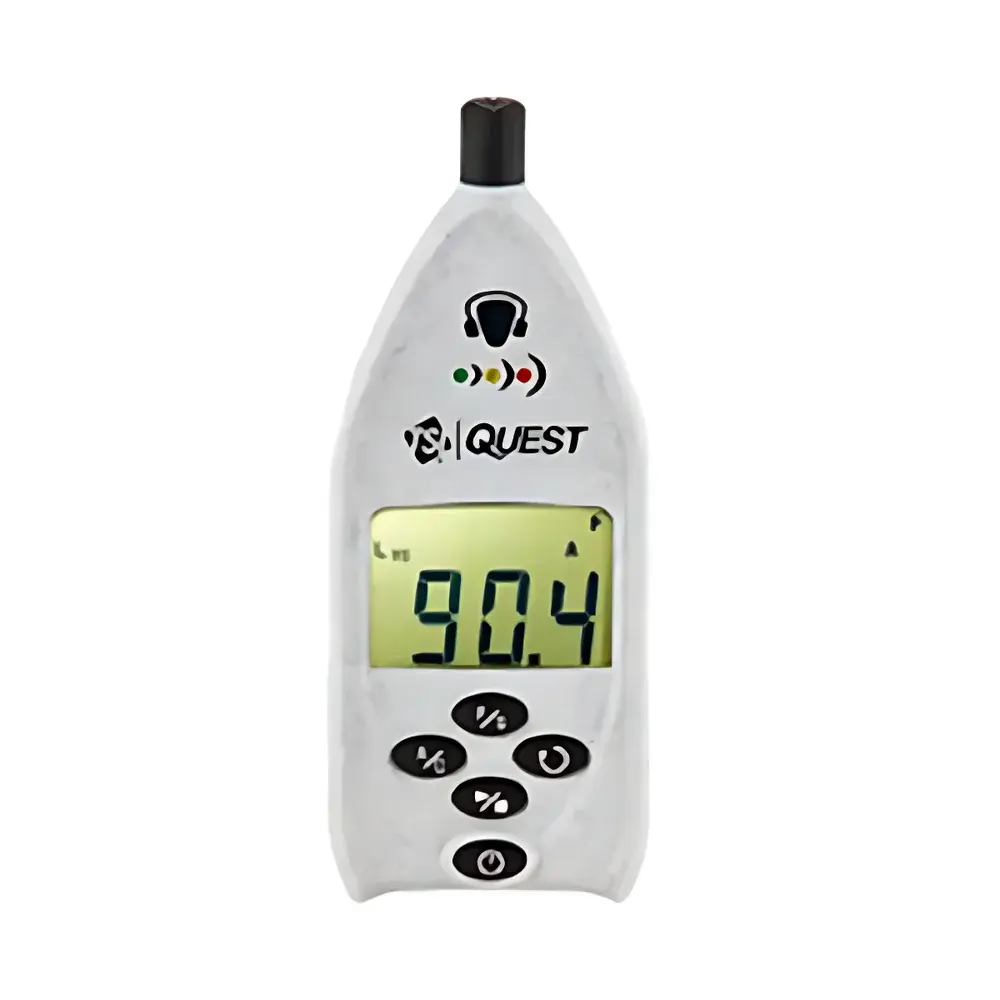
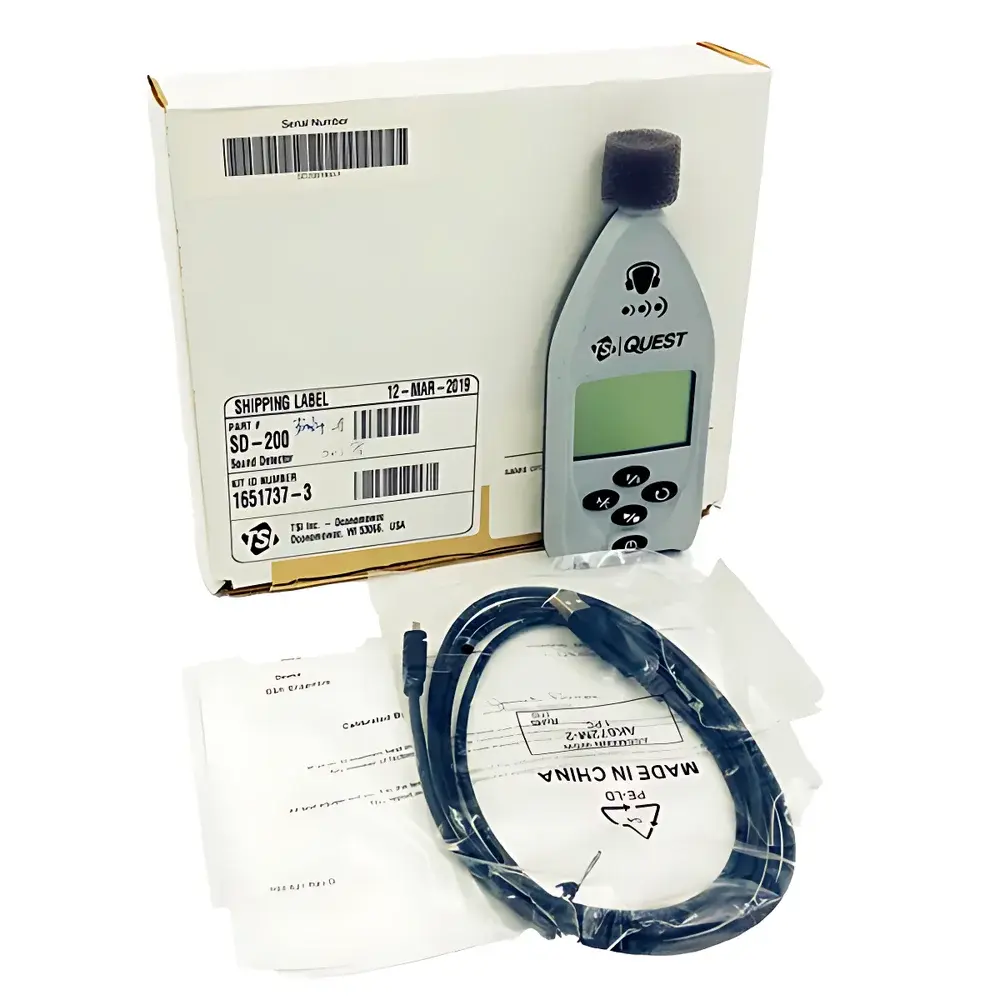
TSI SD-200 Sound Level Meter
| Brand | TSI |
|---|---|
| Origin | USA |
| Model | SD-200 |
| Instrument Type | Handheld Sound Level Meter |
| Measurement Range | 45–130 dB |
| Accuracy Class | IEC/ANSI Class 2 |
| Compliance Standards | ANSI S1.4-1983 (R2006), ANSI S1.43-1997 (R2007), IEC 61672-1:2002, IEC 61010-1:2010 |
| Dimensions | 16.5 × 6.1 × 2.3 cm |
| Weight | 125 g |
| Power Source | Rechargeable Li-polymer battery (1000 mAh), >50 h runtime (LED off) |
| Microphone | Omnidirectional electret condenser, Class 2 |
| Frequency Weighting | A or C |
| Time Weighting | Fast or Slow |
| Exchange Rate (ER) | 3 dB or 5 dB |
| Operating Temperature | 0–40 °C |
| Relative Humidity | 0–90 % RH (non-condensing) |
| Tripod Mount | 1/4"-20 threaded socket |
Overview
The TSI SD-200 Sound Level Meter is a compact, handheld instrument engineered for occupational noise assessment in industrial, construction, and facility management environments. It operates on the fundamental principle of acoustic pressure transduction via a calibrated omnidirectional electret condenser microphone, converting incident sound waves into proportional electrical signals processed in real time according to internationally recognized electroacoustic standards. Designed explicitly for compliance-driven noise surveys, the SD-200 delivers Class 2 accuracy per IEC 61672-1:2002 and ANSI S1.4-1983 (R2006), ensuring traceable measurement integrity suitable for preliminary hazard identification and hearing conservation program support. Its integrated time-averaging function computes equivalent continuous sound pressure level (LEQ) over user-defined intervals—critical for evaluating intermittent or variable noise exposures where peak-based assessments alone are insufficient for regulatory interpretation.
Key Features
- Intuitive five-button interface with dedicated controls for frequency weighting (A/C), time weighting (Fast/Slow), measurement mode selection, start/stop, and power management—enabling single-hand operation without menu navigation delays.
- Real-time LED visual alarm system that activates when measured SPL exceeds user-set thresholds, displaying a standardized hearing protection symbol to support immediate risk awareness in high-noise zones.
- Rechargeable lithium-polymer battery (1000 mAh) providing over 50 hours of continuous operation without LED activation—reducing long-term consumable costs compared to disposable battery-dependent alternatives.
- Rugged dual-material housing (ABS and polycarbonate) rated for field durability, with IP54-equivalent ingress protection against dust and light splashing water.
- Integrated 1/4″-20 tripod thread located at the base rear panel for stable mounting during extended monitoring sessions or fixed-point noise mapping.
Sample Compatibility & Compliance
The SD-200 is optimized for airborne sound pressure measurements in occupational settings where broadband noise sources dominate—such as machinery operation, HVAC systems, assembly lines, and transportation infrastructure. It does not support octave-band or 1/3-octave analysis, nor does it provide dosimetry logging or impulse/noise burst discrimination. As a Class 2 instrument, it meets minimum performance requirements defined in IEC 61672-1:2002 and ANSI S1.43-1997 (R2007) for use in workplace noise screening, preliminary OSHA 29 CFR 1910.95 or EU Directive 2003/10/EC evaluations, and hearing protection device (HPD) selection guidance. While not certified for legal metrology or court-admissible evidence, its calibration traceability to NIST standards (via optional factory calibration certificate) supports internal audit readiness under ISO 45001 and ANSI Z10 frameworks.
Software & Data Management
The SD-200 operates as a standalone meter with no embedded data logging or Bluetooth/Wi-Fi connectivity. All measurements are displayed in real time on the integrated LCD; values for LEQ, LMAX, LMIN, and instantaneous SPL are retained until manually cleared. USB port functionality is limited exclusively to charging—the device lacks firmware update capability or PC-based data export. For organizations requiring documentation, users must manually record readings alongside contextual metadata (location, duration, task observed). When deployed within quality management systems governed by ISO 17025 or GLP principles, periodic verification using an accredited acoustic calibrator (e.g., TSI 901A or equivalent) is recommended at least before each measurement campaign.
Applications
- Pre-shift and task-specific noise exposure screening to inform HPD assignment per NIOSH and OSHA guidelines.
- Baseline noise mapping of manufacturing cells, warehousing zones, and maintenance workshops for engineering control prioritization.
- Verification of acoustic enclosure effectiveness and barrier installation performance.
- Supporting ISO 9001 clause 8.5.1 (Control of production and service provision) through documented environmental parameter monitoring.
- Educational use in occupational hygiene training modules emphasizing practical field instrumentation fundamentals.
FAQ
Is the SD-200 compliant with OSHA or EU noise directive requirements?
Yes—its Class 2 certification per IEC 61672-1 and ANSI S1.4 qualifies it for initial noise hazard identification under both OSHA 29 CFR 1910.95 and EU Directive 2003/10/EC, though formal compliance verification requires follow-up with Class 1 instrumentation for enforcement-level reporting.
Can the SD-200 store measurement data internally?
No—it displays real-time and averaged values only; no memory or timestamped logging functionality is included.
What calibration standard is recommended for field verification?
A Class 1 pistonphone calibrator (e.g., Brüel & Kjær Type 4231 or TSI 901A) at 1 kHz and 94 dB or 114 dB is recommended prior to each day’s use.
Does the SD-200 support impulse noise measurement?
No—it applies exponential time weighting only (Fast/Slow) and does not implement peak-hold or impulse-response algorithms required for impact noise assessment per ISO 1996-2.
Is the battery replaceable by the end user?
No—the sealed Li-polymer cell is non-user-replaceable; battery service requires return to an authorized TSI service center.
Related Products







