
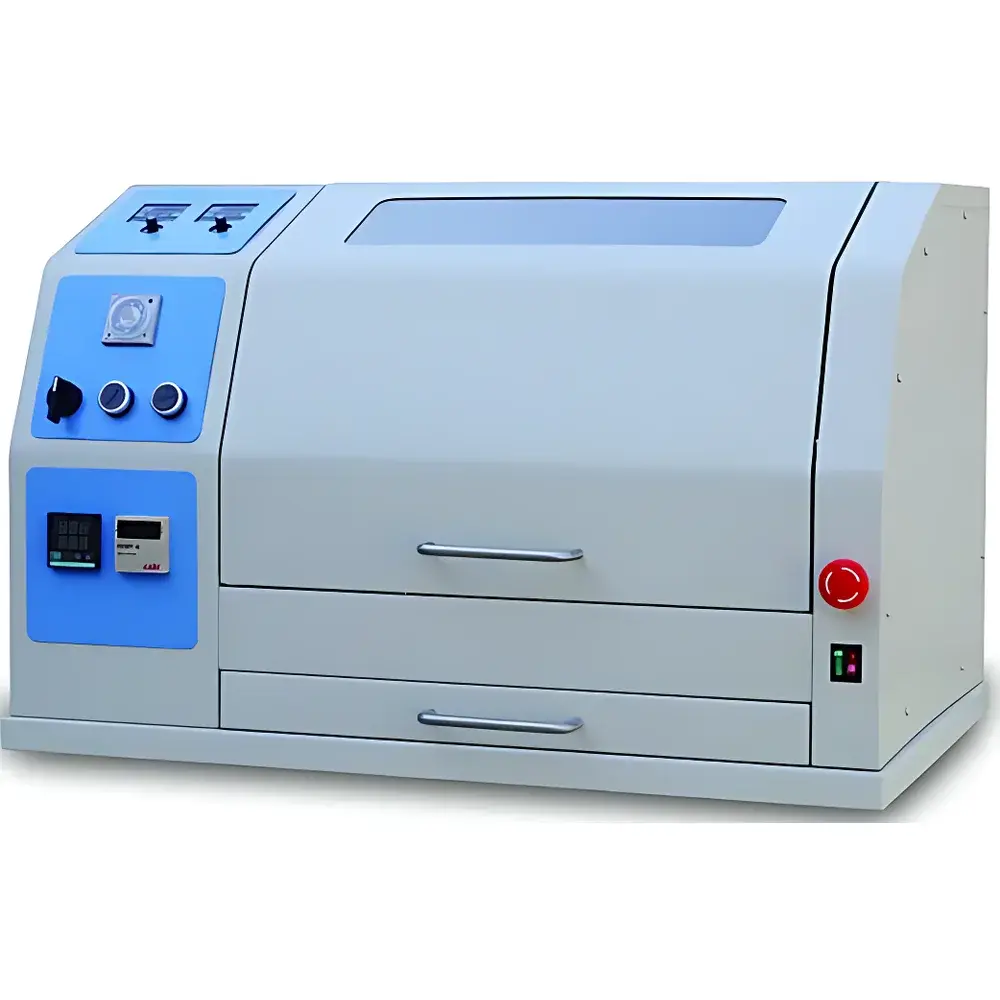
Tongtai Union TTL-864 Tilt-and-Rotate Shaker
| Brand | Tongtai Union (TTL) |
|---|---|
| Origin | Beijing, China |
| Manufacturer Type | Direct Manufacturer |
| Instrument Category | Electric Stirrer / Rotational Shaker |
| Model | TTL-864 |
| Maximum Sample Volume | 2 L |
| Speed Range | 0–100 ±0.2 rpm |
| Temperature Control Range | Ambient to 50 °C (±0.5 °C accuracy at 30 rpm) |
| Tilt Angle | 30° |
| Rotation Modes | Continuous forward, pause, reverse (manual override included) |
| Cycle Timing | Forward/reverse duration: 1 s–99 h |
| Pause duration | 1 s–99 s |
| Vibration Frequency | 0–200 cycles/min |
| Vibration Amplitude | 8 mm |
| Vibration Duration Control | 0–30 min / 0–30 h / 0–300 h |
| Chamber Illumination | Integrated LED viewing window |
| Construction Material | Full 304 stainless steel |
| Safety Features | Interlocked door stop, leakage-proof drawer tray, overload/overheat/堵转 (stall) protection, emergency stop, soft-start/soft-stop motor control |
Overview
The Tongtai Union TTL-864 Tilt-and-Rotate Shaker is an engineered laboratory shaker designed for controlled, low-shear mixing of heterogeneous liquid-solid or liquid-liquid samples requiring gentle yet reproducible agitation under temperature-regulated conditions. Unlike conventional orbital or reciprocating shakers, the TTL-864 employs a dual-axis motion profile: a 30° mechanical tilt combined with programmable forward-reverse rotation and optional superimposed vertical vibration. This architecture enables uniform suspension of particulates, efficient extraction from solid matrices (e.g., soil, sediment, or tissue), and consistent re-suspension of precipitated phases—critical for environmental analysis, pharmaceutical stability testing, and regulatory-compliant leaching studies (e.g., EPA Method 1311, TCLP). The device operates on Couette-type rotational mechanics within a thermally insulated stainless-steel chamber, supporting temperature-controlled incubation up to 50 °C while maintaining speed stability within ±0.2 rpm across its full 0–100 rpm range.
Key Features
- Programmable bidirectional rotation with configurable forward-pause-reverse sequences and independent timing resolution down to 1 second
- Simultaneous or standalone vertical vibration mode (0–200 cycles/min, 8 mm amplitude), adjustable in discrete or continuous increments
- Precision digital PID temperature control (ambient to 50 °C, ±0.5 °C accuracy at 30 rpm), validated per ISO 17025 calibration traceability protocols
- Full 304 stainless-steel construction—including chamber walls, sample rack, and door mechanism—for corrosion resistance and cleanroom-compatible operation
- Interlocked safety system: automatic motor shutdown upon door opening, integrated GFCI circuitry, thermal cut-off, stall detection, and emergency stop button compliant with IEC 61000-6-2 EMC standards
- Ergonomic front-access design with recessed rotating door, large acrylic observation window with internal LED illumination, and slide-out spill containment drawer
- Modular sample rack accommodating standard 2000 mL glass, PE, PTFE, FEP, or ZHE containers—with adjustable clamping geometry to secure varying diameters and heights without tools
Sample Compatibility & Compliance
The TTL-864 supports a broad range of container materials and geometries commonly used in regulated laboratories, including borosilicate glass, polyethylene (PE), polytetrafluoroethylene (PTFE), fluorinated ethylene propylene (FEP), and chemically inert ZHE composites. Its low-speed, high-torque drive system minimizes foaming and shear-induced degradation—making it suitable for biological suspensions, viscous polymer solutions, and fragile cell cultures. The instrument complies with key international standards for laboratory equipment safety and performance: IEC 61010-1 (Electrical Safety), ISO 13485 (for medical device-related validation workflows), and ASTM D4084 (Standard Practice for Determining Leachability of Solid Wastes). Optional IQ/OQ documentation packages are available to support GLP and GMP environments requiring 21 CFR Part 11–compliant audit trails.
Software & Data Management
While the TTL-864 operates via intuitive front-panel controls with real-time digital display of speed, temperature, elapsed time, and active phase (forward/pause/reverse/vibration), it also supports RS-485 serial communication for integration into centralized lab management systems. A dedicated PC configuration utility (Windows-compatible, no proprietary runtime required) enables remote parameter upload/download, event logging (with timestamps), and export of CSV-formatted operational records—including temperature ramp profiles, cycle completion logs, and fault diagnostics. All stored data retains immutable metadata (user ID, timestamp, firmware version) to satisfy ALCOA+ data integrity principles required by FDA and EMA inspectors.
Applications
- Environmental leaching tests (TCLP, SPLP, ASTM D5233) for heavy metal and organic contaminant release from soils and sediments
- Pharmaceutical dissolution and extractable/leachable (E&L) studies per USP and
- Soil and sludge homogenization prior to ICP-MS or GC-MS analysis
- Cell culture maintenance during low-shear suspension protocols
- Chemical synthesis requiring staged reagent addition under controlled agitation and temperature
- Calibration verification of turbidity or particle concentration sensors using standardized suspensions
FAQ
What is the maximum load capacity per bottle, and how many bottles can be processed simultaneously?
The TTL-864 accommodates one 2000 mL container per run. Its structural design and torque rating are optimized for single-vessel operation at full volume to ensure mechanical stability and thermal uniformity.
Is the temperature control validated across the entire speed range?
Temperature accuracy (±0.5 °C) is specified and verified at 30 rpm under steady-state conditions. At speeds below 10 rpm or above 80 rpm, thermal equilibrium may require extended stabilization time; users should allow ≥15 minutes after speed adjustment before initiating temperature-critical assays.
Can the vibration and rotation functions operate independently?
Yes. Vibration mode can be activated or deactivated regardless of rotation state. Both parameters are controlled separately via the main interface or remote protocol.
Does the unit support external temperature probes for chamber mapping?
No. The built-in Pt100 sensor is fixed and calibrated at the chamber’s geometric center. For spatial temperature profiling, third-party data loggers with external probes may be placed inside the chamber during qualification runs.
What maintenance intervals are recommended for long-term reliability?
Biannual inspection of belt tension, door seal integrity, and vibration motor mounting bolts is advised. Lubrication is not required—the brushless DC motor and sealed bearing assembly are maintenance-free for ≥10,000 operating hours.



