
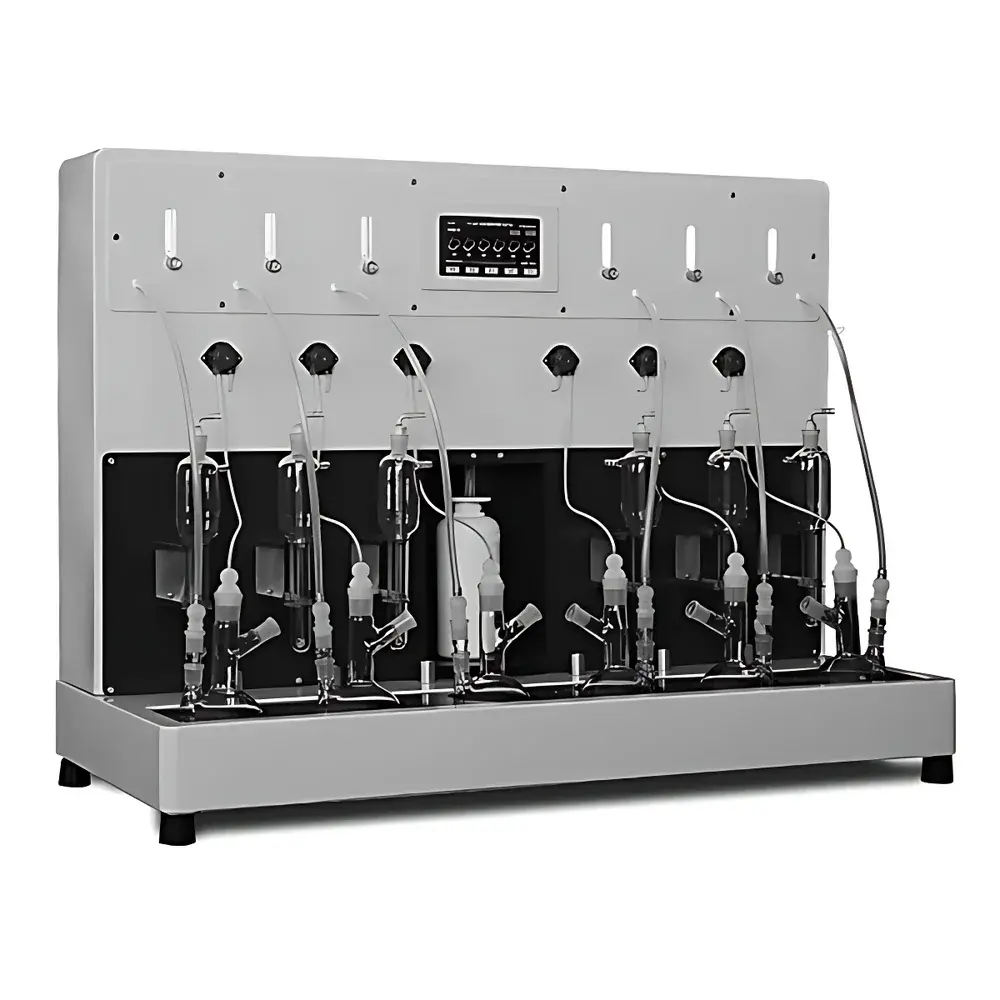
TTL-QHS Automated Sulfide Acidification, Purge-and-Trap Analyzer
| Brand | TTL |
|---|---|
| Origin | Beijing, China |
| Manufacturer Type | Direct Manufacturer |
| Country of Origin | China |
| Model | TTL-QHS |
| Price Range | USD 7,000 – 14,000 |
| Sample Capacity | 6 positions |
| Heating Method | PID-controlled recirculating water bath |
| Temperature Range | Ambient to 99 °C |
| Temperature Accuracy | ±1 °C |
| Nitrogen Flow Range | 60–800 mL/min per sample |
| Total Mass Flow Range | 0–10 L/min |
| Reaction Vessel | 500 mL × 6 |
| Absorption Vial | 100 mL × 6 |
| Display | 7-inch color touchscreen with graphical interface |
| Power Rating | 1000 W |
| Dimensions (W×D×H) | 1110 × 500 × 800 mm |
Overview
The TTL-QHS Automated Sulfide Acidification, Purge-and-Trap Analyzer is an integrated laboratory instrument engineered for precise, reproducible quantification of total sulfide (H₂S, HS⁻, S²⁻) in aqueous environmental matrices. It implements the standardized acidification-purge-absorption principle defined in China’s HJ 1226–2021 — “Determination of Sulfide in Water—Methylene Blue Spectrophotometric Method” — which aligns methodologically with internationally recognized approaches such as EPA Method 376.1 and ISO 10571. The system automates the full analytical sequence: programmable acid addition, temperature-controlled acidification, nitrogen-assisted purge of volatile hydrogen sulfide, and quantitative trapping in alkaline absorbent (typically zinc acetate or NaOH). This eliminates manual intervention during critical reaction phases, minimizing analyst exposure to hazardous acids and gaseous H₂S while ensuring strict adherence to time-, temperature-, and flow-dependent protocol requirements.
Key Features
- 6-position parallel processing with independent control per sample station — including individual mass flow meters, acid dosing units, and real-time status monitoring
- PID-regulated recirculating water bath (stainless steel construction, acid-resistant) maintaining uniform thermal distribution across all reaction vessels; temperature range: ambient to 99 °C (±1 °C accuracy)
- Automated water level management: auto-fill, overflow drainage, and low-water alarm with system lockout to prevent dry-heating
- Digital mass flow control for nitrogen (0–10 L/min total; 60–800 mL/min per channel), programmable in up to four discrete purge stages with independent timing and flow setpoints
- High-precision acid delivery system featuring corrosion-resistant fluidic pathways (imported PTFE/FFKM tubing) and timed, volumetric acid injection (H₃PO₄ or HCl) into each 500 mL reaction bottle
- Post-purge rinse function: residual gas-phase sulfide in transfer lines is swept into the 100 mL absorption vial, complying with HJ 1226–2021 recovery validation criteria
- 7-inch capacitive touchscreen interface with graphical workflow visualization, step-by-step guidance, and real-time progress tracking
- Integrated exhaust manifold with centralized venting to external fume hood or scrubber — reducing ambient H₂S accumulation in the laboratory workspace
Sample Compatibility & Compliance
The TTL-QHS supports a broad spectrum of water-based environmental samples, including surface water, groundwater, domestic wastewater, and industrial effluents with moderate suspended solids and organic load. Its design accommodates variable sulfide concentrations (typical working range: 2–1000 µg/L after dilution/preconcentration) and meets matrix-specific handling requirements outlined in HJ 1226–2021. Instrument operation supports GLP-compliant workflows: all method parameters (acid volume, purge duration, temperature setpoint, flow rate) are stored with timestamps; system logs record start/stop events, alarms, and user actions. While not pre-certified to ISO/IEC 17025 or FDA 21 CFR Part 11, its architecture permits integration with validated LIMS environments and supports audit-trail generation when paired with compliant data acquisition software.
Software & Data Management
The embedded firmware enables full method programming via intuitive touch navigation. Users define multi-stage protocols — e.g., initial degassing (N₂ at 100 mL/min for 2 min), acid addition (10 mL H₃PO₄, pH <2), primary purge (600 mL/min for 15 min), and final rinse (200 mL/min for 3 min). All parameters are saved as reusable methods with version tagging. Data export is supported via USB storage (CSV format) containing run ID, timestamp, setpoints, actual measured temperatures/flows, and alarm history. No cloud connectivity or remote access functionality is included — consistent with secure laboratory network policies for environmental testing facilities.
Applications
This analyzer serves laboratories performing routine regulatory compliance testing under China’s GB 3838–2002 (Surface Water Environmental Quality Standards) and GB 8978–1996 (Comprehensive Wastewater Discharge Standard). Primary application domains include municipal environmental monitoring stations, CDC and provincial disease control institutes, urban water supply and drainage research centers, university environmental science departments, and third-party testing laboratories accredited to CNAS CL01. It is especially suited for high-throughput batch analysis where operator safety, inter-batch precision (92%) are essential performance criteria.
FAQ
Does the TTL-QHS comply with international standards such as ISO or ASTM?
The instrument implements methodology equivalent to ISO 10571 and ASTM D4129, though formal certification under those standards requires end-user validation per local accreditation requirements.
Can the system be used for seawater or high-salinity samples?
Yes — with appropriate method adaptation (e.g., matrix-matched calibration, increased acid volume to overcome buffering capacity); however, prolonged exposure to undiluted seawater may accelerate corrosion of non-coated metal components.
Is calibration of the mass flow controllers required by the user?
Factory-calibrated flow sensors are supplied; annual verification using a NIST-traceable rotameter or bubble meter is recommended for continued compliance with HJ 1226–2021 QA/QC provisions.
What maintenance is required for long-term reliability?
Routine tasks include periodic cleaning of water bath interior, inspection of acid tubing for crystallization, replacement of O-rings every 12 months, and verification of absorption vial seal integrity prior to each batch run.
Is the instrument compatible with downstream spectrophotometers from other vendors?
Yes — the 100 mL absorption vials conform to standard borosilicate glass dimensions and are directly compatible with benchtop UV-Vis spectrophotometers (e.g., Shimadzu UV-1900i, Agilent Cary 60) used for methylene blue absorbance measurement at 670 nm.
Related Products







