
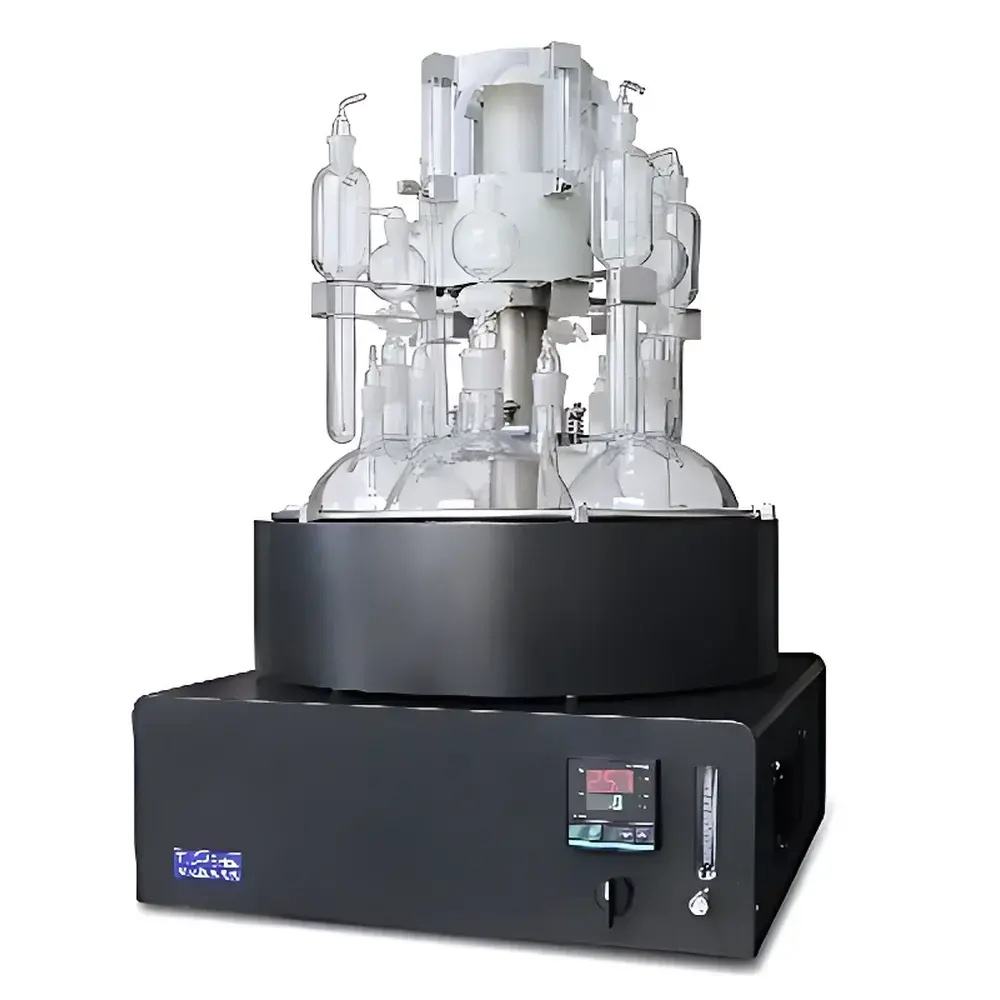
Tongtai Union TTL-4SH Hydrogen Sulfide Aeration System
| Brand | Tongtai Union (TTL) |
|---|---|
| Origin | Beijing, China |
| Manufacturer Type | Direct Manufacturer |
| Country of Origin | China |
| Model | TTL-4SH |
| Instrument Category | Laboratory Water Quality Analyzer |
| Analyte | Hydrogen Sulfide (H₂S) |
| Detection Method | Methylene Blue Spectrophotometry (per HJ 1226–2021 & GB 17378.4–2007) |
| Heating Range | Ambient to 90 °C |
| Temperature Accuracy | ±1 °C |
| Power Supply | AC 220 V, 50/60 Hz, 2000 W |
| Total Heating Power | 1800 W |
| Water Bath Capacity | 2000 mL × 4 positions |
| Nitrogen Flow Control | 0–10 L/min per channel |
| Stirring Speed Range | 0–3000 rpm |
| Stirring Control | Stepless (independent per sample) |
| Sample Rack Travel | 100 ±2 mm vertical lift |
| Construction Materials | Stainless steel frame with PTFE-coated internal components |
| Drain Valve | Stainless steel manual valve |
| Dimensions (W×D×H) | 540 × 520 × 835 mm |
Overview
The Tongtai Union TTL-4SH Hydrogen Sulfide Aeration System is a laboratory-grade, multi-channel gas-stripping instrument engineered for the quantitative determination of dissolved and acid-volatile sulfide (AVS) species—primarily hydrogen sulfide (H₂S)—in aqueous environmental matrices. It operates on the principle of controlled nitrogen sparging under acidic conditions (using hydrochloric acid), followed by colorimetric quantification via methylene blue spectrophotometry in accordance with HJ 1226–2021 (China’s national standard for sulfide analysis in water) and GB 17378.4–2007 (Marine Monitoring Specifications, Part 4: Seawater Analysis). Designed for reproducible, high-throughput sample preparation, the TTL-4SH integrates precise thermal regulation, independent gas flow management, and synchronized mechanical agitation to ensure complete liberation and transfer of volatile H₂S from complex saline or sediment-laden samples into absorbing reagents—minimizing analyte loss and improving method robustness.
Key Features
- Four-position circular rotating sample rack with 2000 mL borosilicate glass aeration bottles—enabling simultaneous processing of up to four samples while maintaining ergonomic front-access loading.
- Independent nitrogen flow control per channel (0–10 L/min), each equipped with a calibrated rotameter and shutoff valve, ensuring traceable and repeatable sparging conditions across all positions.
- Integrated magnetic stirring system with stepless speed adjustment (0–3000 rpm), individually actuated per sample vessel to homogenize matrix composition and accelerate acid–sulfide reaction kinetics.
- Automated vertical lift mechanism (100 ±2 mm travel) for sample rack and gas distribution assembly—driven by an internal motorized system to eliminate external linkage and enhance structural stability during operation.
- PTFE-lined stainless steel construction throughout wetted and heated zones—including valves, tubing, and bath interior—providing long-term resistance to HCl corrosion, elevated temperature exposure, and aggressive marine/sediment-derived matrices.
- Modular design separating the thermostatic water bath (ambient to 90 °C, ±1 °C accuracy) from electrical control units—reducing thermal stress on electronics and extending service life under continuous laboratory use.
- Front-mounted digital display panel for real-time monitoring of bath temperature, power status, and operational mode; stainless steel drain valve facilitates rapid bath cleaning and maintenance.
Sample Compatibility & Compliance
The TTL-4SH is validated for use with seawater, estuarine water, wastewater effluents, porewater extracts, and suspended particulate matter digests—particularly where high chloride content, organic interference, or suspended solids may compromise conventional sulfide recovery. Its design aligns with the procedural requirements of HJ 1226–2021 and GB 17378.4–2007, including mandatory acidification pH control, nitrogen purge duration, and absorbent solution volume specifications. The system supports GLP-aligned workflows through consistent parameter documentation (temperature setpoint, flow rate, agitation speed, and timing), enabling full traceability during regulatory audits or inter-laboratory comparison studies. While not certified to ISO/IEC 17025 out-of-the-box, its operational repeatability and modular calibration points allow integration into accredited testing laboratories following internal validation protocols.
Software & Data Management
The TTL-4SH operates as a hardware-controlled standalone unit without embedded firmware or network connectivity. All operational parameters—including bath temperature, nitrogen flow rates, and stirrer speeds—are manually set and monitored via analog/digital interfaces. For laboratories requiring electronic recordkeeping, the instrument is compatible with external data loggers (e.g., USB-connected thermocouple arrays or flow meter signal converters) and LIMS-integrated acquisition platforms. Users are advised to document critical settings and run logs manually or via spreadsheet templates aligned with FDA 21 CFR Part 11 principles (e.g., operator ID, date/time stamps, and parameter verification signatures) when employed in regulated environments.
Applications
- Marine and coastal environmental monitoring programs assessing H₂S generation in anoxic sediments or hypoxic water columns.
- Emergency response to marine pollution incidents—including dredged material disposal, shipwreck-associated sulfide release, or algal bloom decay events.
- Regulatory compliance testing for industrial discharge permits involving sulfur-containing effluents.
- Research-scale investigation of sulfate-reducing bacterial activity in biogeochemical cycling studies.
- Method development and validation for sulfide speciation in complex matrices such as sewage sludge leachates or landfill leachate.
FAQ
What analytical method does the TTL-4SH support?
It is specifically configured for methylene blue spectrophotometric determination of sulfide (H₂S and AVS) per HJ 1226–2021 and GB 17378.4–2007.
Can the TTL-4SH be used for freshwater samples?
Yes—its acid-resistant construction and adjustable agitation/sparging parameters accommodate both freshwater and high-salinity marine samples without modification.
Is nitrogen the only acceptable carrier gas?
While nitrogen is recommended for inert, low-moisture delivery, argon may also be used; oxygen or air must be avoided due to oxidation risk of H₂S.
How is temperature uniformity maintained across all four positions?
The circular water bath employs radial heater distribution and forced convection via integrated circulation—not passive diffusion—ensuring ≤±0.5 °C inter-bottle variance at steady state.
What maintenance intervals are recommended for routine operation?
Daily visual inspection of tubing integrity and valve function; monthly cleaning of PTFE-coated surfaces and calibration verification of rotameters and temperature sensors using NIST-traceable references.







