
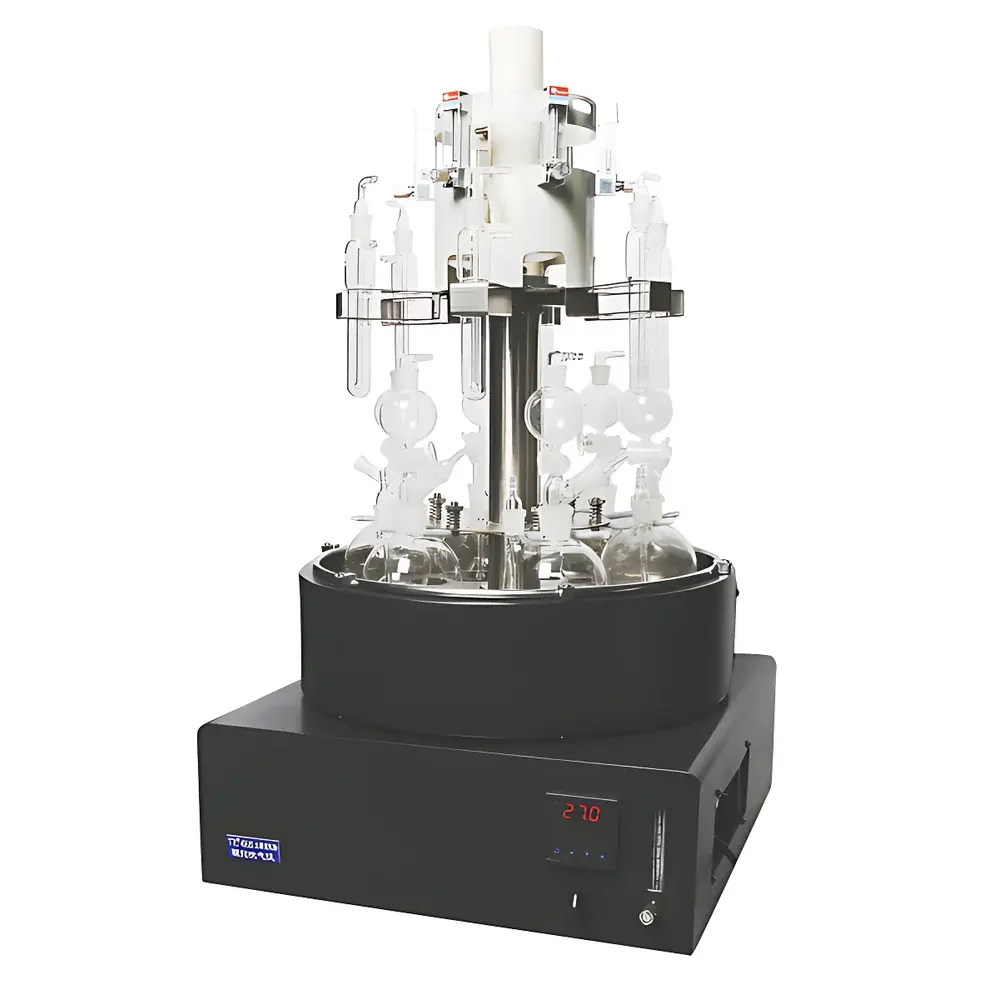
Tongtailian TTL-6SS Soil and Sediment Sulfide Acidification and Purge System
| Brand | Tongtailian (TTL) |
|---|---|
| Origin | Beijing, China |
| Manufacturer Type | Direct Manufacturer |
| Country of Origin | China |
| Model | TTL-6SS |
| Instrument Type | Laboratory Benchtop System |
| Price Range | USD 2,800 – 7,000 (FOB China) |
Overview
The Tongtailian TTL-6SS Soil and Sediment Sulfide Acidification and Purge System is a dedicated laboratory instrument engineered for the quantitative determination of acid-volatile sulfide (AVS) in solid and aqueous environmental matrices. It operates on the principle of controlled acidification followed by nitrogen-purge-assisted volatilization of hydrogen sulfide (H₂S), which is subsequently trapped and quantified—typically via methylene blue spectrophotometry per EPA Method 9035, ASTM D4810, or Chinese national standards HJ 833–2017 (Soil and Sediment – Determination of Sulfide) and HJ 1226–2021 (Water Quality – Determination of Sulfide by Methylene Blue Spectrophotometry). Designed for reproducible, operator-independent sample preparation, the TTL-6SS eliminates manual gas flow adjustment and thermal inconsistency common in conventional glassware-based setups. Its architecture supports strict adherence to GLP-compliant workflows through traceable parameter control, mechanical repeatability, and physical separation of thermal and electrical subsystems.
Key Features
- Integrated constant-temperature water bath with precise ±0.5 °C uniformity across all six sample positions, ensuring consistent acid hydrolysis kinetics.
- Motorized vertical sample rack with fully concealed linear actuator (stroke: 100 ± 2 mm), enabling programmable immersion depth and eliminating manual handling errors.
- Rotatable sample holder with full 360° horizontal rotation and adjustable tilt angle—facilitating ergonomic front-access loading and uniform reagent mixing during acid addition.
- Independent mass flow control per sample channel using calibrated needle valves and individual rotameters (range: 0–1.5 L/min N₂), with total purge gas flow digitally monitored and displayed.
- Internalized nitrogen distribution manifold with PTFE-lined stainless steel tubing—preventing gas line entanglement, minimizing dead volume, and resisting corrosion from acidic vapors.
- Variable-speed magnetic stirring (0–600 rpm, continuously adjustable) synchronized across all six vessels to ensure homogeneous suspension and complete H₂S release from particulate-bound sulfides.
- Modular design: thermally isolated water bath tank and electronics compartment—reducing heat-induced component stress and extending service life of control circuitry and sensors.
- Corrosion-resistant construction: 316 stainless steel chassis, PTFE-coated internal surfaces, and acid-resistant stainless steel drain valve for rapid decontamination and long-term stability in aggressive chemical environments.
Sample Compatibility & Compliance
The TTL-6SS accommodates standard 100–500 mL digestion vessels (e.g., EPA-approved borosilicate glass bubblers or quartz reaction tubes) and accepts heterogeneous matrices including soil cores, sediment slurries, sludge digests, and aqueous effluents. Its operational parameters align with method-defined requirements for AVS extraction under inert atmosphere (N₂), temperature-controlled acidification (typically 60–80 °C), and stoichiometric H₂S transfer efficiency (>95% recovery verified per HJ 833–2017 Annex B). The system supports audit-ready documentation when paired with compliant LIMS or ELN platforms, and its mechanical repeatability meets ISO/IEC 17025 criteria for method validation in accredited environmental testing laboratories.
Software & Data Management
While the TTL-6SS operates as a hardware-controlled benchtop system without embedded firmware or touchscreen interface, it is fully compatible with external data acquisition systems via analog output signals (0–5 V or 4–20 mA) for water bath temperature, total gas flow, and stir speed. All mechanical adjustments—including rack position, gas flow per channel, and stirring rate—are mechanically indexed and lockable, supporting SOP-driven operation and reducing inter-operator variability. When integrated into GLP/GMP environments, the system’s fixed parameter ranges and physical controls facilitate straightforward validation protocols, including IQ/OQ documentation and traceability of calibration records for flow meters and temperature sensors (calibration certificates available upon request).
Applications
- Determination of acid-volatile sulfide (AVS) in contaminated sediments for ecological risk assessment and dredging decision support.
- Quantitative analysis of total sulfide in landfill leachate, anaerobic digester effluent, and industrial wastewater prior to discharge compliance reporting.
- Method validation and reference material analysis in CNAS-accredited environmental testing laboratories operating under HJ 833–2017 or HJ 1226–2021.
- Research on sulfur biogeochemistry in wetland soils, estuarine deposits, and mine tailings where speciation and redox state influence metal mobility.
- Quality control of sulfide scavengers and iron-based remediation amendments used in in-situ treatment technologies.
FAQ
What standards does the TTL-6SS comply with?
It is designed and validated for full conformance with HJ 833–2017 (soil/sediment) and HJ 1226–2021 (water), and its operational principles are compatible with EPA 9035, ASTM D4810, and ISO 16242:2015.
Can the system be used for both soil and water samples without modification?
Yes—the sample rack accommodates varied vessel geometries and volumes; protocol-specific parameters (e.g., acid volume, temperature, purge duration) are adjusted manually per standard method requirements.
Is nitrogen purity critical for accurate results?
Yes—use of ≥99.998% pure nitrogen is recommended to avoid interference from oxygen or moisture that may oxidize H₂S or cause precipitate formation in trapping solutions.
How is maintenance performed on the water bath system?
The stainless steel drain valve allows full emptying; PTFE-coated interior surfaces resist scale buildup, and periodic calibration of temperature sensors and rotameters is advised every 6 months or per lab QA schedule.
Does the TTL-6SS support automated data logging?
Not natively—but analog outputs enable integration with third-party DAQ systems or PLC controllers for time-stamped parameter recording and electronic lab notebook (ELN) synchronization.







