
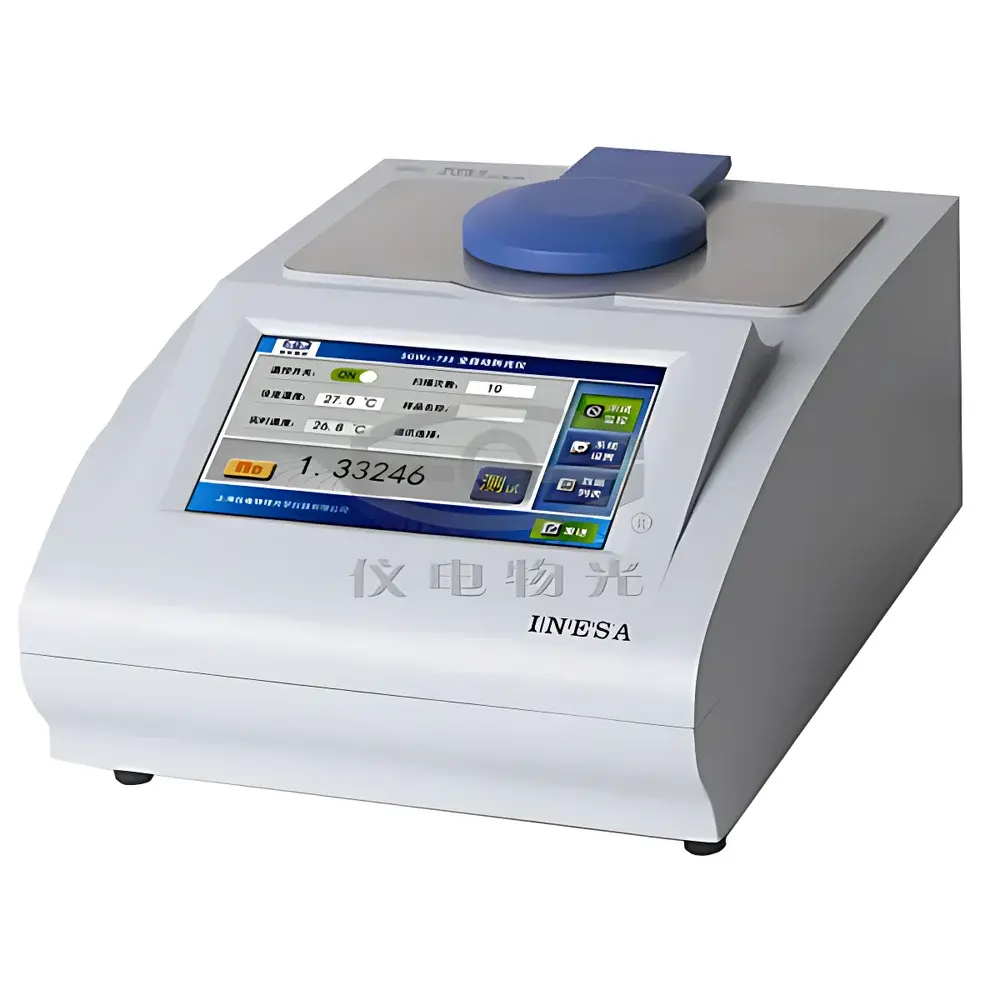
Yidian Woguang SGW®-731 Fully Automated Digital Refractometer
| Brand | Yidian Woguang (YDWG) |
|---|---|
| Origin | Shanghai, China |
| Model | SGW®-731 |
| Type | Benchtop Refractometer |
| Measurement Range | nD 1.30000–1.70000 |
| Brix | 0–100% |
| Resolution | nD 0.00001 / Brix 0.01% |
| Accuracy | nD ±0.0002 / Brix ±0.1% |
| Precision | nD ±0.00001 / Brix ±0.01% |
| Display | 7-inch color TFT touchscreen |
| Data Storage | 1000 measurements |
| Interface | RS232, USB, USB flash drive support |
| Power | 220 V ±22 V, 50 Hz ±1 Hz, 30 W |
| Dimensions | 345 × 245 × 165 mm |
| Weight | 4 kg |
| Prism Material | High-hardness optical glass |
| Light Source | Long-life LED (≥100,000 h) |
| Sample Volume | ≥0.5 mL |
| Compliance | GB/T 12143–2008, GB/T 18963–2012, GB/T 21730–2008 |
Overview
The Yidian Woguang SGW®-731 Fully Automated Digital Refractometer is a precision benchtop instrument engineered for rapid, non-destructive determination of refractive index (nD) and related concentration units—including Brix, glucose, sucrose, fructose syrup (F42/F55), honey moisture content, and total soluble solids—in liquid and semi-liquid samples. It operates on the principle of critical angle measurement using a high-stability LED light source and a high-resolution CCD linear array detector. Unlike traditional Abbe-type refractometers requiring manual focusing and subjective scale reading, the SGW®-731 employs fully automated optical alignment and digital image processing to eliminate parallax and operator-induced variability. Its fixed-optics architecture—devoid of mechanical moving parts—ensures long-term stability and minimal maintenance. The instrument delivers traceable, reproducible results under ambient laboratory conditions and is calibrated per national standards applicable to food, beverage, pharmaceutical, and chemical quality control workflows.
Key Features
- Fully automated measurement cycle with <1.5-second acquisition time and <0.5-second stabilization, enabling high-throughput routine analysis.
- High-precision CCD detection system with 0.00001 refractive index resolution and ±0.00001 repeatability—validated across multiple independent test points per ISO 5725-2.
- 7-inch capacitive color touchscreen interface supporting intuitive navigation, multi-language prompts (English, Chinese), and real-time graphical display of measurement curves and statistics.
- Durable sapphire-coated high-hardness optical glass prism with chemical resistance to organic solvents, acids, and alkaline solutions; easy cleaning with ethanol or deionized water.
- Minimal sample requirement (≥0.5 mL), non-invasive measurement, and full sample recoverability—critical for high-value or limited-availability materials.
- Integrated data management architecture: local storage of up to 1000 measurement records with timestamp, user ID, sample ID, and environmental metadata (ambient temperature).
- LED illumination source rated for >100,000 hours of operational life—eliminating lamp replacement cycles and associated calibration drift.
Sample Compatibility & Compliance
The SGW®-731 accommodates clear to moderately turbid aqueous and organic liquid samples—including fruit juices, soft drinks, syrups, honey, wine must, pharmaceutical elixirs, and industrial glycol solutions—provided they do not permanently coat or etch the prism surface. It is explicitly validated for compliance with Chinese national standards GB/T 12143–2008 (for soft drinks), GB/T 18963–2012 (for honey), and GB/T 21730–2008 (for fruit and vegetable juices). While it does not incorporate active Peltier temperature control, its built-in ambient temperature sensor (0–90 °C range) enables passive correction using pre-characterized temperature–refractive index coefficients for common matrices. For regulated environments operating under GLP or GMP, the instrument supports audit-ready data export via USB or RS232, with optional integration into LIMS systems through standardized ASCII or CSV protocols.
Software & Data Management
Data handling is implemented via embedded firmware without external PC dependency. Each measurement record includes nD, Brix, and up to seven additional derived values (e.g., F42 %, glucose %, moisture %) calculated in real time using factory-loaded polynomial calibration models. All data are stored with ISO 8601 timestamps and can be exported in plain-text CSV format directly to USB flash drives or PCs. No proprietary software installation is required for basic operation or data retrieval. For laboratories requiring electronic signature or 21 CFR Part 11 compliance, third-party middleware (e.g., LabWare LIMS or Thermo Fisher SampleManager) may be deployed to manage user authentication, change control, and electronic audit trails—though native Part 11 functionality is not embedded.
Applications
- Quality assurance in beverage manufacturing: rapid Brix verification of orange juice concentrate, soft drink syrup dilution, and carbonated beverage consistency.
- Honey adulteration screening: simultaneous reporting of moisture content and refractive index deviation from GB/T 18963–2012 reference limits.
- Pharmaceutical excipient QC: verification of glycerin, propylene glycol, or sorbitol solution concentrations prior to formulation.
- Food R&D labs: real-time monitoring of sugar inversion kinetics during thermal processing of jams and preserves.
- Academic teaching labs: demonstration of dispersion relationships, temperature dependence of nD, and calibration transfer between instruments.
FAQ
Does the SGW®-731 include built-in temperature control?
No. It features ambient temperature sensing (0–90 °C) and automatic nD correction using matrix-specific temperature coefficients, but lacks active thermoelectric (Peltier) regulation.
Can measurement units be customized beyond the eight preset modes?
Yes. Users may define custom calibration curves via two-point or multi-point input, assigning arbitrary concentration units to measured nD values.
Is prism cleaning compatible with aggressive solvents like acetone or chloroform?
The high-hardness glass prism resists short-term exposure to most common organic solvents; however, prolonged contact with strong alkalis or hydrofluoric acid is prohibited.
What is the minimum measurable sample volume?
0.5 mL is sufficient to cover the prism sensing area; smaller volumes may yield incomplete coverage and erroneous readings.
How is traceability maintained for calibration verification?
Factory calibration uses NIST-traceable certified refractive index standards (e.g., Cargille series); users may perform periodic verification with secondary standards such as sucrose solutions prepared per USP .



