
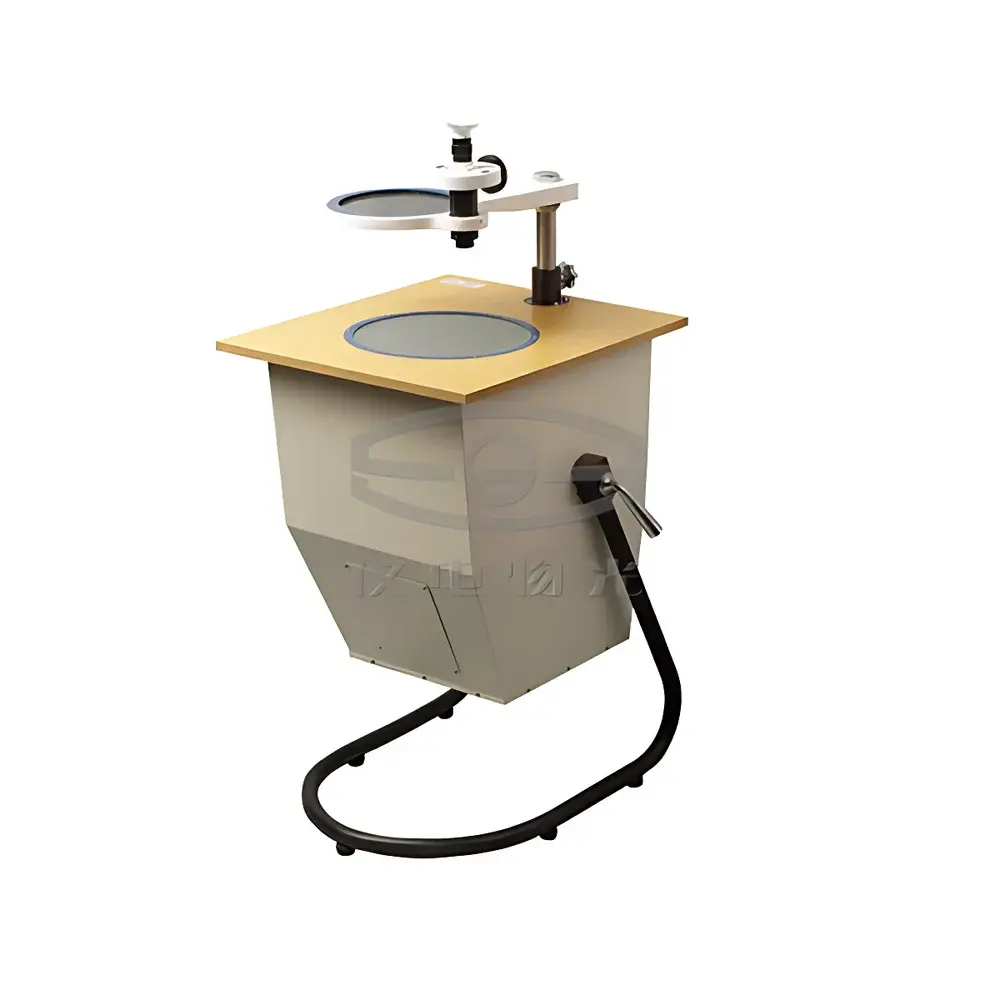
YDWG WYL-2 Photoelastic Stress Analyzer
| Brand | YDWG |
|---|---|
| Origin | Shanghai, China |
| Model | WYL-2 |
| Light Source | 12 V / 50 W Tungsten-Halogen Lamp |
| Qualitative Measurement Range | ≤560 nm (First-Order Interference Color) |
| Full-Wave Retardation Plate | 560 nm |
| Analyzer Aperture Diameter | φ150 mm |
| Stage Glass Aperture Diameter | φ220 mm |
| Max. Sample Height | 250 mm |
| Power Supply | 220 V ± 22 V, 50 Hz ± 1 Hz, 30 W |
| Dimensions (L×W×H) | 570 mm × 510 mm × 870 mm |
| Net Weight | 20 kg |
Overview
The YDWG WYL-2 Photoelastic Stress Analyzer is a benchtop polarimetric instrument engineered for the qualitative assessment of residual stress in transparent isotropic materials through the detection of stress-induced birefringence. Based on the principle of photoelasticity—where mechanical stress alters the refractive index tensor in dielectric media—the WYL-2 utilizes crossed polarizers and a calibrated full-wave retardation plate (560 nm) to visualize and interpret interference colors generated by optical path differences within stressed specimens. This method conforms to foundational photoelastic standards referenced in ASTM E1724 (Standard Guide for Photoelastic Stress Analysis) and ISO 11492 (Plastics — Determination of Residual Stresses in Transparent Thermoplastics by Optical Methods). Designed for production-line quality assurance and R&D screening, the WYL-2 delivers rapid, non-destructive evaluation without sample preparation or contact, making it suitable for routine inspection in optical glass fabrication, precision lens manufacturing, and injection-molded transparent polymer components.
Key Features
- Stable 12 V / 50 W tungsten-halogen illumination system with uniform spectral output across the visible range (400–700 nm), optimized for high-contrast interference fringe observation.
- Crossed polarizer configuration with rotatable analyzer (φ150 mm clear aperture) and fixed polarizer, enabling angular sensitivity for directional stress mapping.
- Integrated full-wave retardation plate (560 nm) aligned perpendicular to the optical axis, facilitating direct correlation between observed interference color and approximate retardation magnitude per ASTM D4093.
- Large-diameter stage glass (φ220 mm) supporting specimens up to 250 mm in height, accommodating flat panels, curved lenses, and molded plastic housings.
- Robust steel-and-aluminum frame with vibration-damped base, ensuring optical alignment stability during extended operation in industrial laboratory environments.
- Low-power consumption (30 W) and standard 220 V AC input compatible with GLP-compliant facility power infrastructure.
Sample Compatibility & Compliance
The WYL-2 is validated for use with optically isotropic, transparent materials exhibiting stress-optic response—including borosilicate and crown optical glasses (e.g., BK7, SF6), polycarbonate (PC), polymethyl methacrylate (PMMA), and cyclic olefin copolymer (COC). It supports qualitative pass/fail evaluation per internal QC protocols aligned with ISO 10110-7 (Optics and photonics — Preparation of drawings for optical elements — Part 7: Surface imperfection tolerances) and USP (Glass Containers). While not certified for quantitative stress calculation (requiring calibration with known stress-optic coefficients and compensators), the instrument meets essential functional requirements for visual birefringence screening under ISO/IEC 17025-accredited quality systems when operated with documented SOPs and periodic verification using NIST-traceable reference plates.
Software & Data Management
The WYL-2 operates as a manual optical instrument with no embedded microprocessor or digital interface. All observations are conducted visually via the eyepiece or optional external CCD camera (not included). Users record interference patterns using standardized color charts (e.g., Michel-Lévy chart) and document results in paper-based or LIMS-integrated electronic lab notebooks. For regulated environments, manual entries must include operator ID, date/time stamp, sample ID, and observed interference order—supporting audit readiness under FDA 21 CFR Part 11 when paired with compliant ELN platforms featuring electronic signatures and change tracking.
Applications
- Routine inspection of annealing efficacy in optical lens blanks and prisms prior to coating.
- Verification of stress uniformity in tempered display cover glass (e.g., Gorilla Glass variants) after thermal processing.
- Root-cause analysis of premature cracking in transparent polymer enclosures subjected to thermal cycling or ultrasonic welding.
- Evaluation of mold design impact on residual stress distribution in injection-molded optical light guides and LED lenses.
- Teaching tool for undergraduate mechanics of materials and optical physics laboratories demonstrating stress-optic law (σ = C·Δn).
FAQ
Does the WYL-2 provide quantitative stress values in MPa or nm/cm?
No. The WYL-2 is a qualitative instrument; it identifies relative stress magnitude via interference color but does not output calibrated numerical stress data.
Can it measure stress in curved or thick samples?
Yes—within optical path length limits. Samples up to 250 mm tall and with moderate curvature may be evaluated if the central region remains within the φ150 mm analyzer aperture and maintains collimated transmission.
Is a calibration certificate included?
The instrument ships with a factory verification report confirming retardation plate wavelength accuracy (±5 nm at 560 nm) and polarizer extinction ratio (>1000:1); NIST-traceable calibration is available as an optional service.
What safety certifications does it meet?
It complies with IEC 61010-1:2010 for electrical safety in laboratory equipment and carries CE marking for EMC and low-voltage directive compliance.
Is technical support available outside China?
Yes—YDWG partners with authorized distributors in North America, Europe, and Southeast Asia who provide localized application support, spare parts logistics, and service contract options.





