
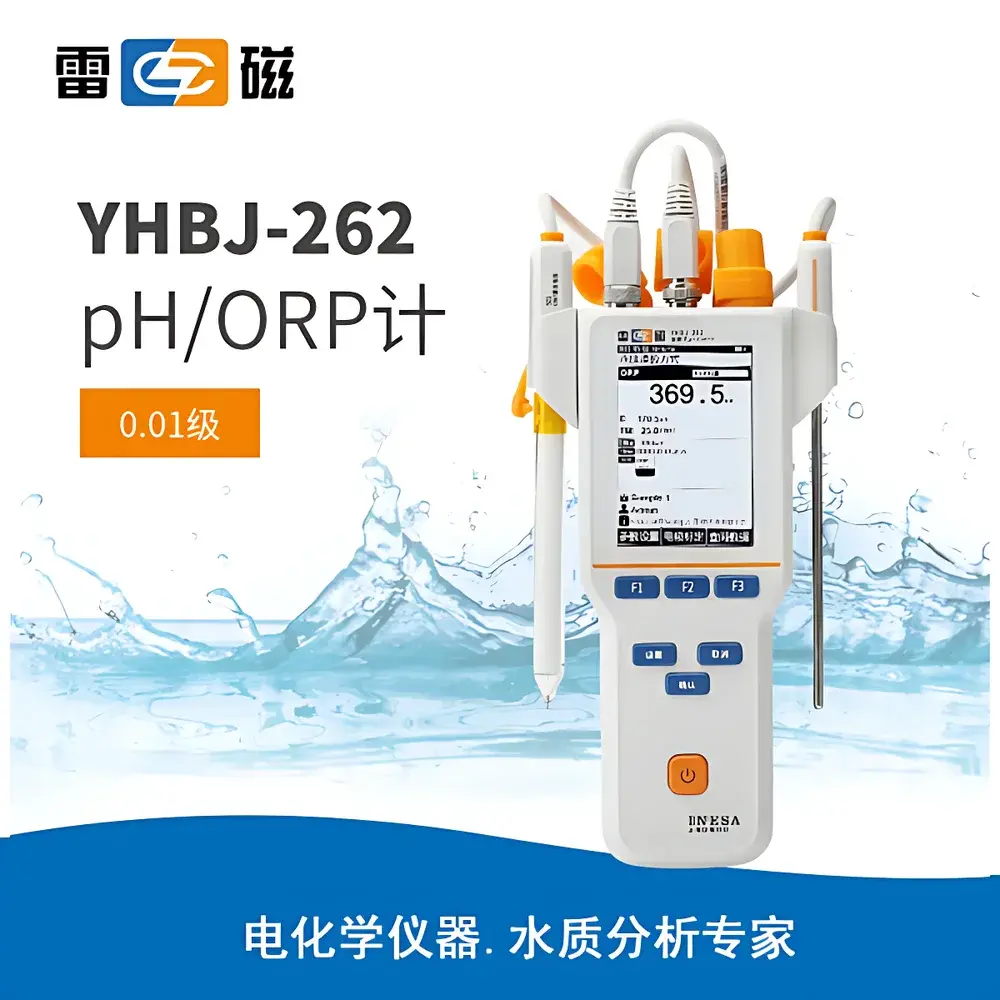
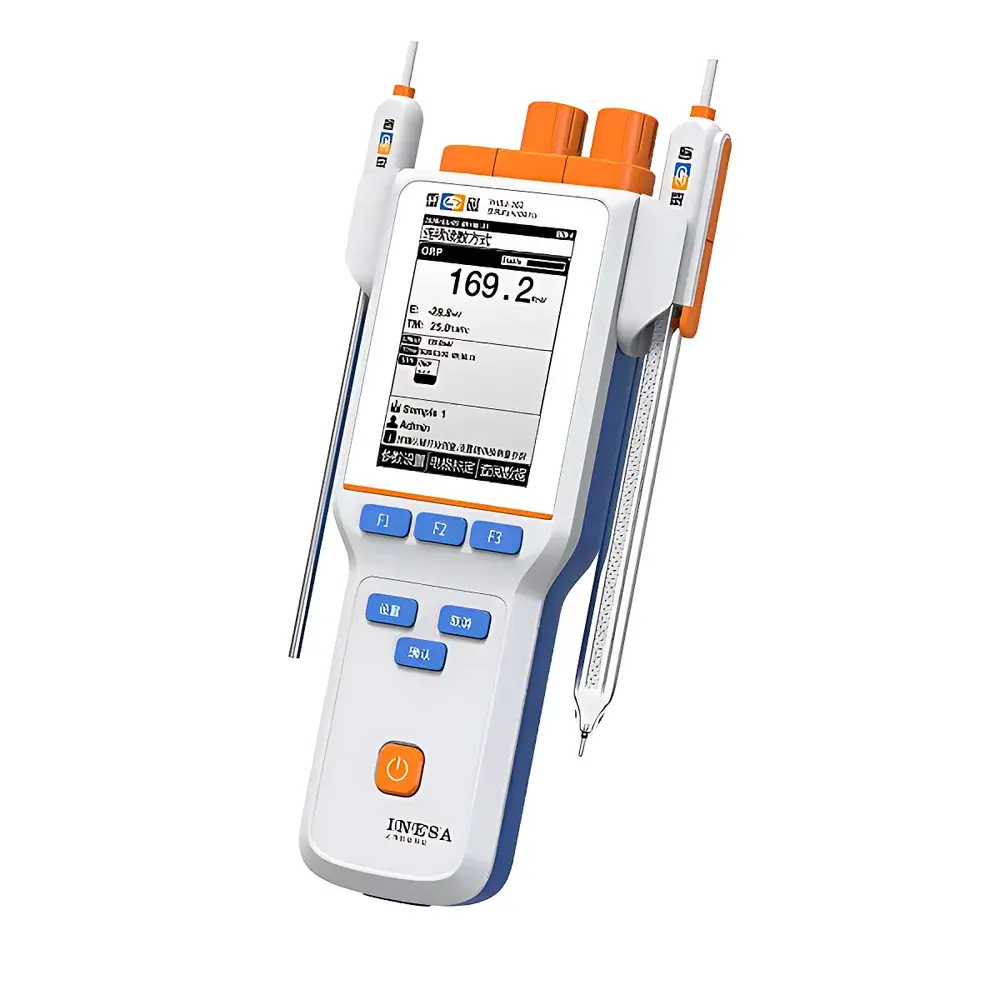
Leici YHBJ-262 Portable pH/ORP Meter
| Brand | Leici |
|---|---|
| Origin | Shanghai, China |
| Model | YHBJ-262 |
| Instrument Type | Laboratory-Grade Portable ORP and pH Meter |
| ORP Range | (−2000.0 to +2000.0) mV |
| ORP Resolution | 0.1 mV |
| ORP Accuracy (Electronic Unit) | ±0.1% or ±0.3 mV |
| ORP Repeatability (Electronic Unit) | 1 mV |
| ORP System Accuracy | ±15 mV |
| pH Range | −2.00 to 20.00 |
| pH Resolution | 0.01 |
| pH Accuracy (Electronic Unit) | ±0.01 pH |
| pH Repeatability (Electronic Unit) | 0.005 pH |
| Input Current | ≤1 × 10⁻¹² A |
| Input Impedance | ≥1 × 10¹² Ω |
| pH System Accuracy | ±0.02 pH |
| pH System Repeatability | 0.01 pH |
| Temperature Range | −5.0 to 110.0 °C |
| Temp Resolution | 0.1 °C |
| Temp Accuracy (Electronic Unit) | ±0.2 °C |
| Temp System Accuracy | ±0.4 °C (0.0–60.0 °C), ±1.0 °C (other ranges) |
| IP Rating | IP65 |
| Data Storage | 500 measurement records |
| Power | Rechargeable Li-ion battery |
| Dimensions | 80 × 225 × 35 mm |
| Weight | 0.4 kg |
Overview
The Leici YHBJ-262 Portable pH/ORP Meter is a laboratory-grade electrochemical instrument engineered for high-reliability field and benchtop measurements of hydrogen ion activity (pH) and oxidation-reduction potential (ORP) in aqueous solutions. It operates on the fundamental principles of potentiometric measurement: pH is determined via the Nernst equation using a glass electrode and reference junction, while ORP is measured as the open-circuit potential difference (in millivolts) between a noble metal indicator electrode (typically platinum or gold) and a stable reference electrode (e.g., Ag/AgCl). Designed for rigorous use across environmental monitoring, quality control, and academic research, the YHBJ-262 integrates robust analog front-end circuitry with low-drift amplification, ultra-high-input-impedance (>1 × 10¹² Ω) signal conditioning, and temperature-compensated calibration algorithms to ensure traceable, reproducible results under variable ambient conditions.
Key Features
- Triple-parameter measurement capability: simultaneous real-time display of pH, ORP (mV), and temperature (°C/°F)
- Three operational modes: continuous measurement, equilibrium-based measurement with dynamic stability detection, and programmable timed acquisition (interval or sequential)
- Comprehensive GLP compliance: each stored record includes timestamp, user ID, sample ID, electrode status, calibration history, and ambient temperature — fully audit-ready
- Intelligent electrode calibration: pH supports 1–5 point calibration with automatic recognition of GB, DIN, and NIST-certified buffer standards; ORP supports single-point standardization against certified redox buffers (e.g., quinhydrone or Zobell’s solution)
- High-capacity local storage: 500 measurement sets with graphical review mode — trend curves support temporal analysis of drift, stabilization behavior, or batch consistency
- Ruggedized industrial design: IP65-rated enclosure ensures protection against dust ingress and low-pressure water jets, enabling reliable operation in humid laboratories, wastewater treatment plants, or outdoor sampling sites
- Dual connectivity architecture: RS232 interface for direct thermal printer output; USB port for bidirectional communication with PC-based data management software supporting CSV export and report generation
- Firmware-upgradable platform: field-deployable updates enable protocol enhancements, new buffer libraries, or expanded regulatory reporting templates without hardware modification
Sample Compatibility & Compliance
The YHBJ-262 is validated for use with standard combination pH/ORP electrodes featuring double-junction reference systems and gel-filled electrolytes, minimizing liquid junction potential errors in complex matrices. It accommodates samples ranging from ultrapure water (conductivity <1 µS/cm) to high-ionic-strength industrial effluents (up to 1 S/m), provided appropriate electrode selection and maintenance protocols are followed. The instrument conforms to general requirements outlined in ISO 7027 (water quality — determination of pH), ASTM D1293 (standard test method for pH of water), and USP (pH measurement in pharmaceutical preparations). Its GLP-compliant data structure aligns with FDA 21 CFR Part 11 expectations for electronic records when used in regulated QC environments — including mandatory audit trails, operator authentication, and immutable result metadata.
Software & Data Management
Leici’s dedicated PC communication software provides secure, encrypted transfer of all stored datasets, supporting hierarchical folder organization by project, location, or analyst. Raw data files retain full calibration context and sensor diagnostics, enabling retrospective validation of measurement integrity. Export formats include UTF-8 CSV (compatible with LIMS, Excel, and statistical packages such as JMP or Minitab) and PDF summary reports with embedded calibration certificates. The software enforces role-based access control and supports digital signature workflows for QA sign-off. Firmware updates are delivered via signed binary packages verified through SHA-256 checksums to prevent unauthorized modification.
Applications
The YHBJ-262 serves critical functions in environmental fieldwork (acid rain monitoring, river basin assessment, groundwater redox profiling), municipal water treatment (chlorine residual correlation, disinfection by-product precursor tracking), food safety (fermentation endpoint detection, brine stability verification), pharmaceutical manufacturing (clean-in-place rinse validation, excipient dissolution monitoring), and academic teaching labs (electrochemistry fundamentals, buffer capacity experiments). Its portability and battery endurance (≥12 hours typical usage) make it ideal for multi-site surveys where lab-grade precision must be maintained outside controlled environments.
FAQ
Does the YHBJ-262 support automatic temperature compensation (ATC) during pH and ORP measurements?
Yes — it accepts input from integrated or external Pt1000 thermistors and applies Nernstian correction in real time for both pH and ORP values.
Can the instrument store calibration data separately for multiple electrodes?
No — calibration parameters are device-bound and not electrode-specific; however, user-defined IDs and notes allow manual tracking of electrode usage history.
Is the USB interface compatible with modern Windows and macOS operating systems?
Yes — drivers are WHQL-certified for Windows 10/11 and class-compliant on macOS 12+ (Monterey) and later; no additional kernel extensions required.
What is the recommended recalibration frequency under routine QC use?
Per ISO/IEC 17025 guidance, daily verification with at least one check standard is advised; full multi-point calibration should be performed at start-of-shift or after electrode replacement.
Does the instrument meet IEC 61000-4 electromagnetic compatibility standards?
It complies with IEC 61000-4-2 (ESD), -4-3 (radiated RF), and -4-4 (electrical fast transients) for industrial environments, as verified in third-party EMC testing reports available upon request.




