
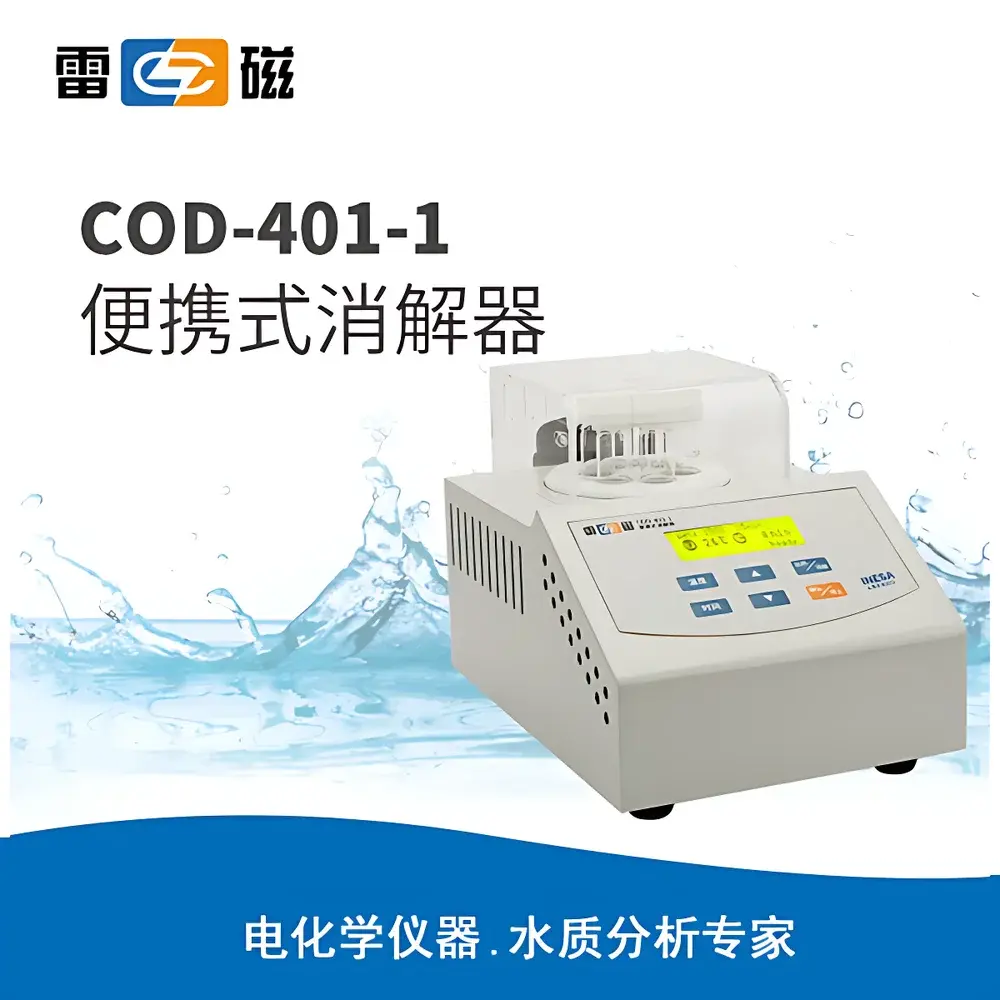
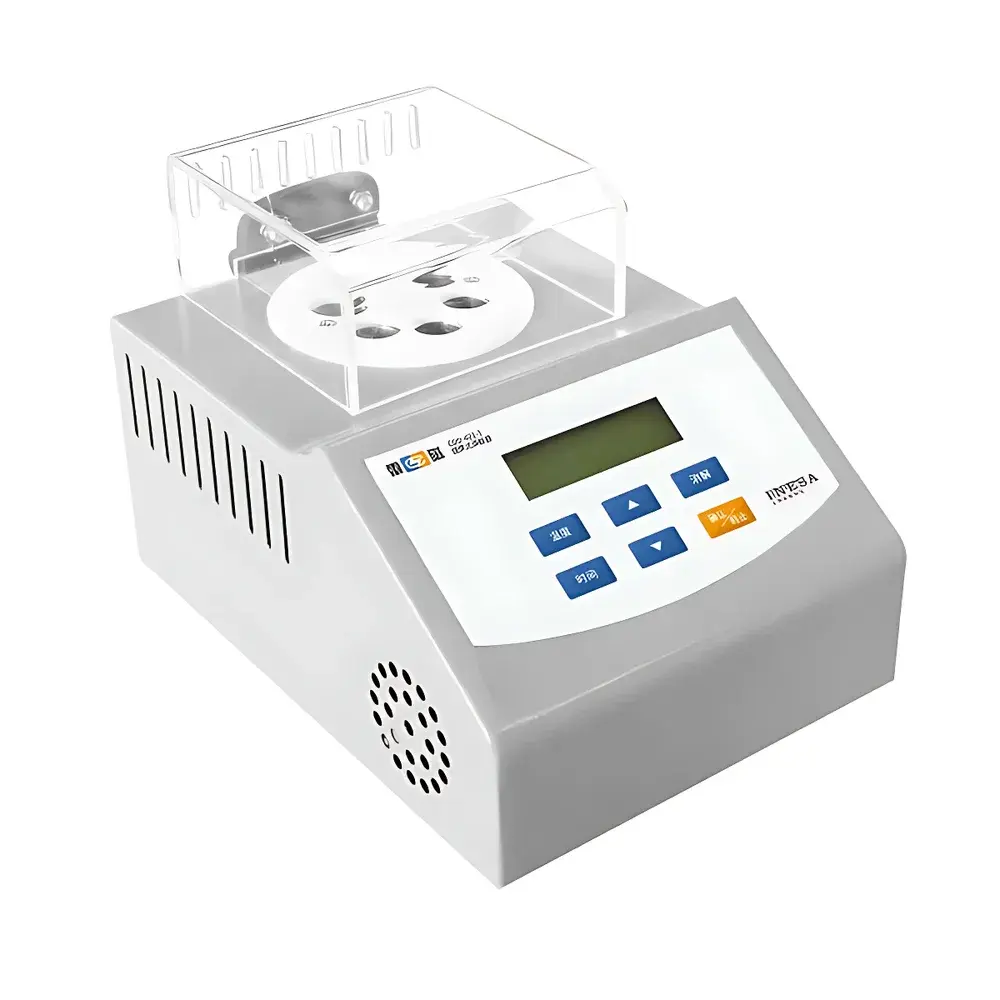
Leici COD-401-1 Portable Digestion Block
| Temperature Range | 0–190 °C |
|---|---|
| Temperature Accuracy | ±2 °C |
| Capacity | 6 Samples |
| Power Options | AC 220 V / 12 V DC (cigarette lighter socket) / Optional High-Capacity Rechargeable Battery |
| Dimensions | Compact, Field-Deployable Form Factor |
| Origin | Shanghai, China |
| Instrument Type | Portable Digestion Unit for COD Analysis |
Overview
The Leici COD-401-1 Portable Digestion Block is an engineered thermal platform designed specifically for the controlled, standardized oxidation of organic matter in water samples prior to Chemical Oxygen Demand (COD) quantification. Unlike integrated analyzers, this device functions exclusively as a digestion module—complying with core method requirements outlined in ISO 6060, APHA Standard Methods 5220B (Closed Reflux Colorimetric Method), and HJ 828–2017 (Chinese EPA standard for COD determination). It utilizes resistive heating elements embedded within an aluminum alloy block to deliver uniform thermal distribution across six independent sample wells. The unit operates without reagents or optical components, serving solely as a precision thermal preconditioning stage that ensures consistent reaction kinetics—critical for inter-laboratory reproducibility and regulatory data validity.
Key Features
- Thermally stable aluminum digestion block with optimized heat conduction geometry, minimizing radial temperature gradients across all six wells
- Digital PID temperature controller with real-time feedback loop, enabling setpoint accuracy within ±2 °C over the full 0–190 °C operating range
- Compact footprint (≤280 × 180 × 120 mm) and low mass (<3.2 kg) for field deployment, vehicle-mounted operation, or mobile laboratory integration
- Triple-mode power architecture: compatible with standard 220 V AC mains, 12 V DC automotive power (via cigarette lighter adapter), and optional external Li-ion battery pack (rated for ≥4 hours continuous operation at 165 °C)
- Integrated safety features including overtemperature cutoff (195 °C hard limit), auto-shutdown after user-defined digestion duration (1–180 minutes), and non-slip rubberized base
- Corrosion-resistant well inserts (borosilicate glass-compatible design) accommodating standard 16 mm OD digestion vials used in EPA-compliant COD protocols
Sample Compatibility & Compliance
The COD-401-1 supports all standard digestion vial formats used in dichromate-based COD methods—including 16 mm OD × 100 mm length glass tubes (e.g., Hach Reactor Vials, Thermo Scientific COD Vials) and compatible PTFE-lined screw-cap vessels. Its thermal profile has been validated to achieve complete oxidation of refractory organics (e.g., pyridine, benzene derivatives) under 165 °C/2-hour reflux conditions per ISO 6060 Annex A. The device meets mechanical and electrical safety requirements per GB 4793.1–2019 (equivalent to IEC 61010-1) and carries CE marking for portable laboratory equipment. While not a measuring instrument itself, its thermal performance directly impacts COD result traceability—making it suitable for GLP environments where digestion step documentation and temperature audit trails are required.
Software & Data Management
The COD-401-1 operates as a standalone hardware module with no embedded firmware or connectivity interfaces. Temperature setpoint, hold time, and power mode are configured via tactile membrane keypad with LED status indicators. For regulated workflows, users integrate the unit into broader LIMS or ELN ecosystems by recording operational parameters (start time, setpoint, actual block temperature log via external calibrated thermometer, shutdown confirmation) manually or via time-stamped digital photography. Though lacking native USB/Bluetooth, its predictable thermal behavior enables synchronization with spectrophotometers (e.g., Hach DR3900, Thermo Genesys 10S) in fully documented COD testing sequences compliant with ISO/IEC 17025 clause 7.2.2 (method validation) and USP Analytical Instrument Qualification.
Applications
- Routine wastewater effluent monitoring at municipal treatment plants during shift-based sampling campaigns
- Field-based assessment of industrial discharge compliance in remote locations lacking fixed lab infrastructure
- Educational laboratories requiring robust, entry-level digestion platforms for APHA-standard COD training modules
- Emergency response teams conducting rapid water quality triage following chemical spills or flood events
- Contract environmental testing labs performing multi-client batch digestion prior to centralized spectrophotometric analysis
FAQ
Is the COD-401-1 certified for use in EPA-approved COD methods?
Yes—it delivers the thermal conditions required by EPA Method 410.4 (Closed Reflux, Titrimetric) and 410.5 (Closed Reflux, Colorimetric), provided vial type, reagent ratios, and cooling protocols are strictly followed.
Can it be used for total phosphorus or total nitrogen digestion?
No. Its thermal calibration and safety limits are specific to COD’s dichromate oxidation protocol (165 °C, acidic medium). TP/TN digestion typically requires higher temperatures (>200 °C) and different acid mixtures, exceeding design specifications.
Does the unit include calibration certificates or NIST-traceable documentation?
Factory calibration verification data is supplied with each unit. Users must perform periodic in-house verification using a calibrated reference thermometer per ISO/IEC 17025 clause 6.5.2; third-party calibration services are available upon request.
What maintenance is required for long-term reliability?
Annual inspection of heater element continuity, cleaning of well bores with ethanol to prevent residue buildup, and verification of thermal insulation integrity around the block housing.







