
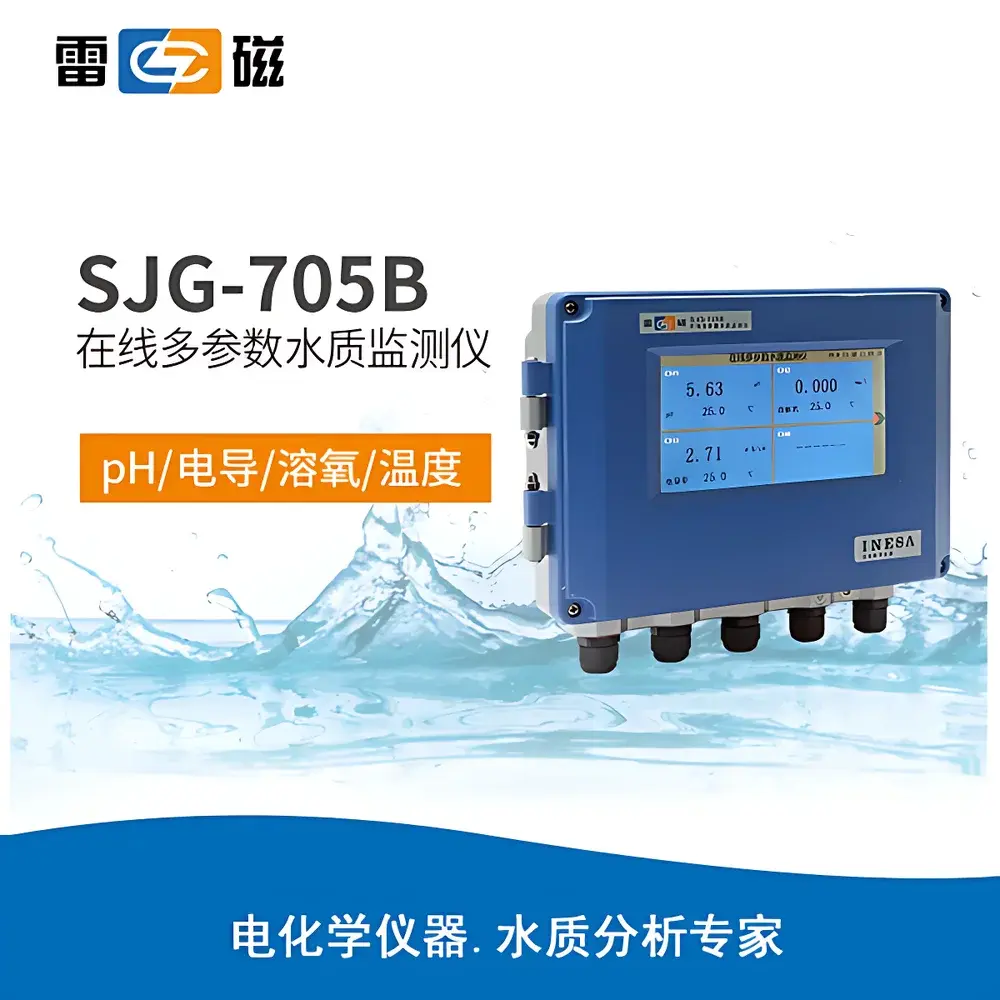
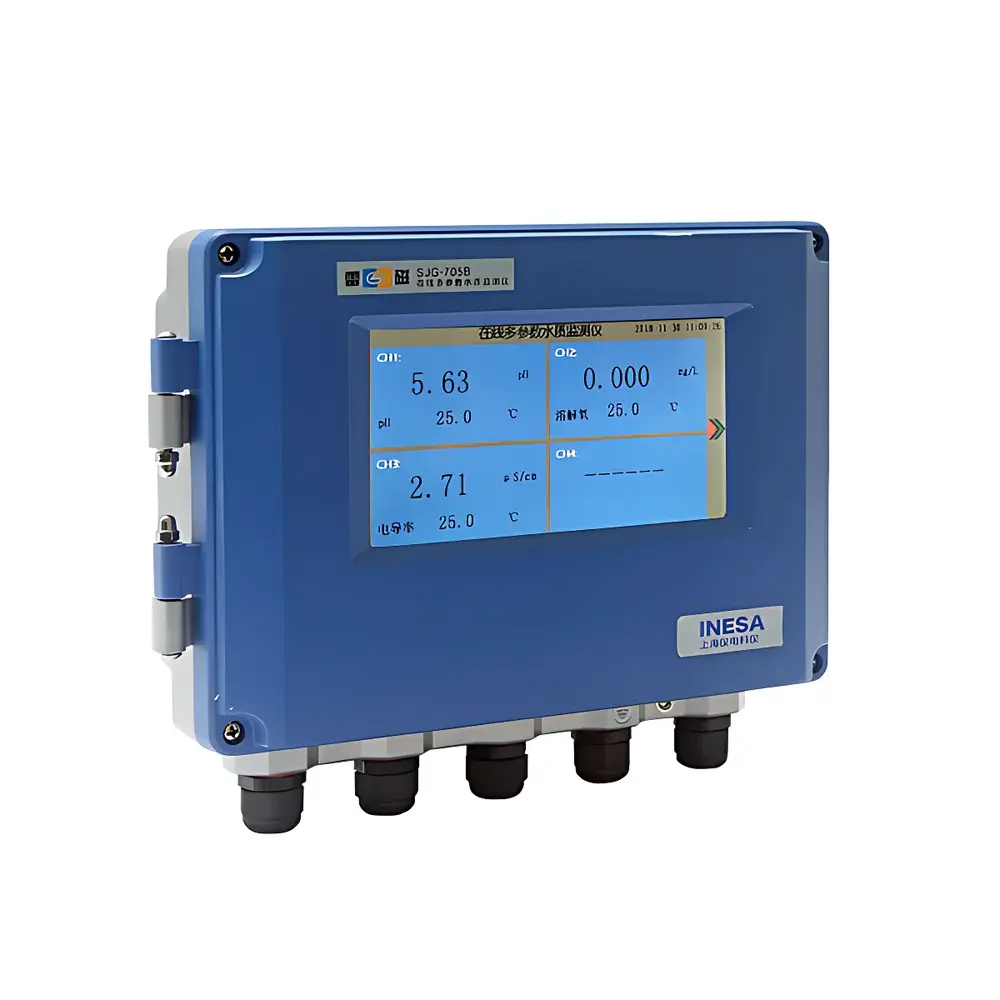
Leici SJG-705B Online Five-Parameter Water Quality Monitor
| Brand | Leici |
|---|---|
| Origin | Shanghai, China |
| Model | SJG-705B |
| Instrument Type | Online Monitor |
| Temperature Range | (−10.0 to 120.0) °C |
| pH Range | (0.00 to 14.00) pH |
| Dissolved Oxygen (DO) | Concentration (0.00–20.00) mg/L |
| Conductivity Ranges | 0.000 µS/cm–0.199 µS/cm |
| Turbidity Range | (0.00–1000.0) NTU |
Overview
The Leici SJG-705B Online Five-Parameter Water Quality Monitor is an integrated, wall-mountable analytical platform engineered for continuous, real-time surveillance of critical water quality indicators in municipal drinking water distribution systems, wastewater treatment effluent channels, industrial process water loops, and environmental surface water monitoring stations. It simultaneously measures pH, electrical conductivity (EC), dissolved oxygen (DO), turbidity, and temperature—each parameter acquired via dedicated, factory-calibrated sensor modules operating under standardized electrochemical and optical principles. The system employs potentiometric measurement for pH, four-electrode conductivity cell architecture for wide-range EC quantification, polarographic membrane-covered DO sensors compliant with ISO 5814, nephelometric detection at 90° scattering angle for turbidity (per ISO 7027), and Pt1000-grade thermistors for temperature compensation and direct reporting. Designed for unattended operation over extended deployment cycles, the SJG-705B conforms to fundamental performance expectations outlined in ISO 5667-22 (water quality — sampling — guidance on field instrumentation) and supports traceability through built-in calibration verification protocols.
Key Features
- Simultaneous five-parameter acquisition with automatic temperature compensation applied to pH, EC, and DO measurements
- 7-inch high-resolution color TFT touchscreen interface with intuitive Chinese-language navigation and context-sensitive soft keys
- Configurable alarm logic: independent upper/lower limit thresholds for any selected parameter, with relay outputs for external actuation
- Continuous measurement mode with user-defined sampling intervals (1 s to 3600 s); no manual intervention required during routine operation
- Onboard non-volatile memory supporting ≥100,000 data records with timestamp, parameter values, and status flags (e.g., calibration due, sensor fault)
- Dual serial communication interfaces: RS-232 (local diagnostics/debug) and RS-485 (multi-drop Modbus RTU support up to 32 nodes, max 1200 m cable length)
- Modular sensor design: turbidity module includes dedicated flow-through cuvette; optional inline flow cell available for pressurized pipe installations
- Robust industrial enclosure (IP65-rated front panel, NEMA 4X equivalent) with DIN-rail mounting brackets and wall-mounting hardware included
Sample Compatibility & Compliance
The SJG-705B is validated for use with natural freshwater, treated potable water, secondary-treated wastewater effluent, and low-salinity industrial cooling water. It is not intended for seawater, highly abrasive slurries, or samples containing >50 mg/L suspended solids without pre-filtration. Sensor materials comply with NSF/ANSI Standard 61 for drinking water system components. While not certified to full IEC 61508 SIL2 or EN 14181 QAL1, the instrument meets essential functional safety requirements for Class B monitoring per EN 17125. Data integrity features—including immutable timestamps, cyclic redundancy check (CRC) on stored records, and audit-trail-capable configuration logs—support alignment with GLP documentation practices and preliminary readiness for FDA 21 CFR Part 11 compliance when deployed within validated IT infrastructure.
Software & Data Management
The embedded firmware supports scheduled auto-calibration prompts and manual calibration initiation via touchscreen. Raw sensor outputs are digitally filtered using adaptive median + low-pass algorithms to suppress transient noise from pump pulsation or air entrainment. All measurement data can be exported in CSV format via USB host port or retrieved remotely via Modbus TCP gateway integration. Optional Leici DataBridge PC software provides trend visualization, statistical summaries (min/max/avg/std dev per parameter), and PDF report generation with embedded calibration certificates. Configuration parameters—including alarm setpoints, communication baud rates, and unit preferences—are password-protected and stored with versioned change history.
Applications
- Real-time compliance monitoring at drinking water plant discharge points per national regulatory thresholds (e.g., GB 5749–2022)
- Biological treatment zone surveillance in activated sludge basins, where DO and pH dynamics directly correlate with nitrification efficiency
- Intake water quality assessment for power plant condenser cooling circuits to prevent scaling and microbiologically influenced corrosion (MIC)
- Environmental monitoring of rivers and reservoirs under national surface water quality standards (e.g., GB 3838–2002)
- Pre-treatment validation in pharmaceutical water systems prior to reverse osmosis or electrodeionization stages
- Performance verification of UV disinfection units via upstream/downstream turbidity differentials
FAQ
What is the recommended calibration frequency for each sensor module?
pH and DO sensors require verification before each shift in critical applications; conductivity and turbidity modules may be calibrated weekly under stable conditions. Full multi-point calibration is advised after sensor replacement or exposure to fouling agents.
Can the SJG-705B operate in outdoor enclosures exposed to rain and temperature extremes?
Yes—the front panel meets IP65 ingress protection, and the internal thermal management sustains operation between −10 °C and 50 °C ambient. For sustained exposure above 50 °C or below −10 °C, an insulated, ventilated cabinet with active heating/cooling is recommended.
Is Modbus TCP supported natively, or only via external gateway?
Native protocol support is limited to Modbus RTU over RS-485. Integration into Ethernet-based SCADA systems requires a commercially available RS-485-to-TCP converter configured as a Modbus TCP server.
How does the system handle sensor drift during long-term deployment?
The firmware implements baseline drift correction algorithms for turbidity and conductivity based on zero-point stability monitoring. For pH and DO, drift is flagged via deviation from historical median values; automated alerts trigger maintenance workflows.
Are replacement sensors supplied with individual calibration certificates?
Yes—each factory-replacement sensor ships with a traceable calibration certificate referencing NIST-traceable standards, including raw output vs. reference value tables and uncertainty budgets at defined temperatures.
Related Products







