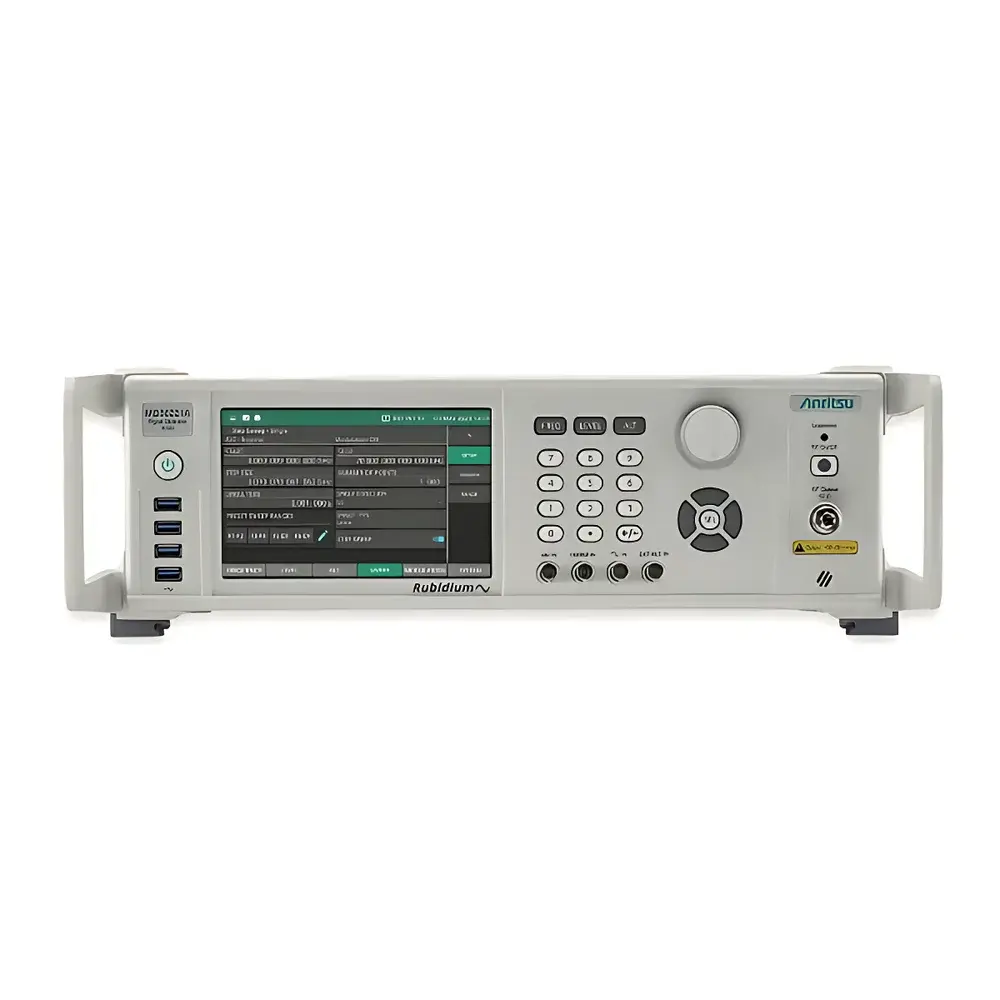
Anritsu Rubidium™ MG362x1A Low-Noise RF/Microwave Signal Generator (9 kHz to 70 GHz)
| Brand | Anritsu |
|---|---|
| Origin | Japan |
| Model | Rubidium™ MG362x1A |
| Frequency Range | 9 kHz – 70 GHz (extendable to 72 GHz) |
| Phase Noise Options | Standard / Low-Noise (Option 3) / Ultra-Low-Noise (Option 13) |
| Output Power | Up to +30 dBm (standard), +16 dBm @ 43.5 GHz, +6 dBm @ 70 GHz |
| Modulation Types | AM, FM, PM, Pulse, Arbitrary Waveform |
| Rack Height | 3U |
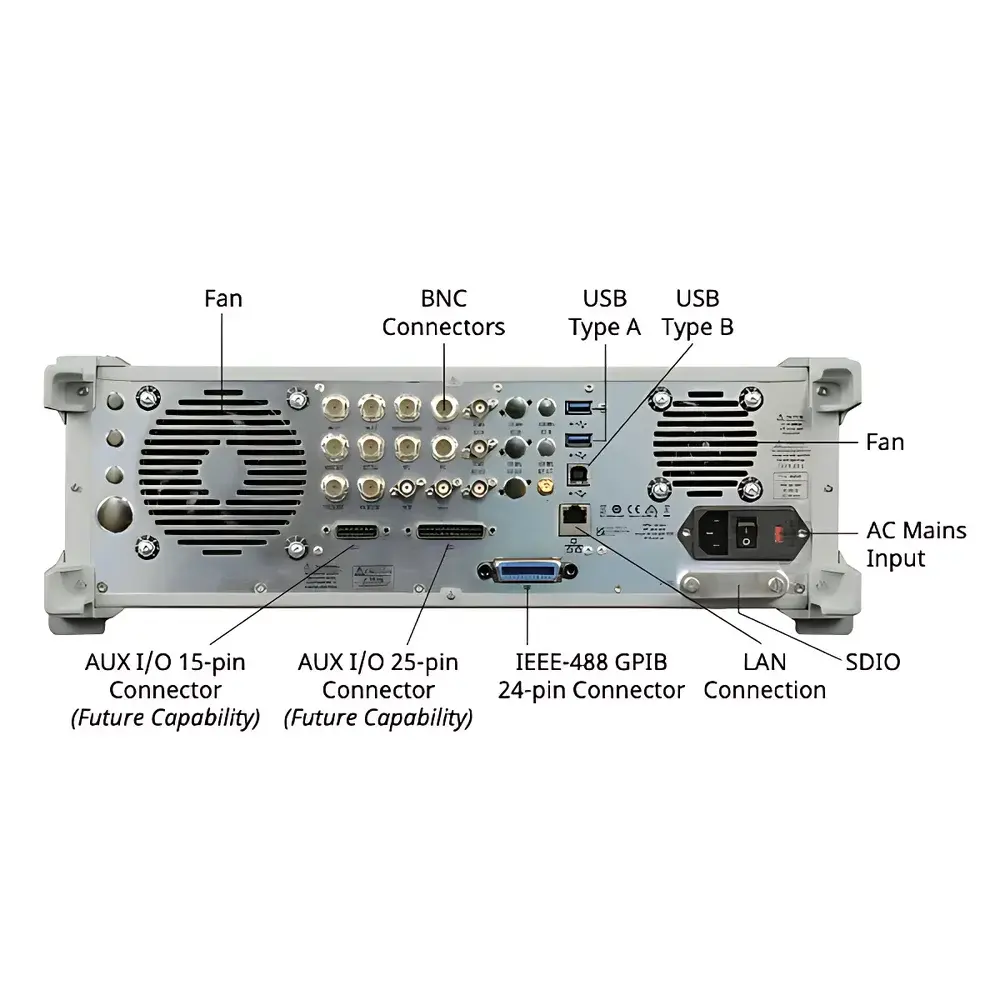
| Interface Standards | GPIB (IEEE-488), LAN (10/100/1000BASE-T), USB 2.0 (Type A/B), SDIO, Auxiliary I/O (25-pin & 15-pin), Rear-panel RF Output (K(m)-type, Option 9) |
Overview
The Anritsu Rubidium™ MG362x1A is a high-performance, low-noise RF and microwave signal generator engineered for metrology-grade applications requiring exceptional spectral purity, long-term frequency stability, and wideband coverage from 9 kHz to 70 GHz — extendable to 72 GHz with optional waveguide extensions. Based on advanced direct digital synthesis (DDS) and fractional-N phase-locked loop (PLL) architecture with ultra-low-noise voltage-controlled oscillators (VCOs), the MG362x1A delivers industry-leading phase noise performance across its entire operating band. Its design prioritizes traceable accuracy and reproducibility, making it suitable for calibration laboratories, defense R&D, satellite communications testing, and quantum device characterization where atomic-clock-level timing integrity and sub-millihertz frequency resolution are critical. The instrument’s architecture supports both continuous-wave (CW) and complex modulated signal generation, with built-in pulse sequencing and arbitrary waveform synthesis capabilities enabling rigorous validation of radar receivers, phased-array systems, and high-speed ADC/DAC components.
Key Features
- Ultra-low phase noise: Standard configuration exceeds typical industry benchmarks; optional Low-Noise (Option 3) and Ultra-Low-Noise (Option 13) variants further reduce close-in and broadband phase noise — especially optimized for 2–20 GHz CW operation via dedicated rear-panel RF output with up to 3 dB improvement.
- High output power: Standard models deliver up to +30 dBm at lower frequencies, +16 dBm at 43.5 GHz, and +6 dBm at 70 GHz — consistently exceeding competitive offerings by 2–4 dB without add-on amplifiers. High-Power Option 15 extends this margin across the full band.
- Rubidium atomic frequency reference (optional): Provides ±5 × 10⁻¹² aging rate and <1 × 10⁻¹¹ short-term stability (1 s), meeting ISO/IEC 17025 requirements for accredited calibration labs.
- Comprehensive modulation suite: Includes analog AM/FM/PM, pulse modulation (5 ns rise/fall time), pulse sequence generation, and user-defined arbitrary waveforms via internal AWG — all fully programmable and synchronized.
- Modular hardware architecture: 3U rack-mount chassis with 7-inch capacitive touchscreen, physical rotary encoder and keypad for tactile precision, and extensive option compatibility for application-specific configuration without over-specification.
- Full remote control support: Native SCPI command set compliant with IEEE-488.2, IVI-COM and IVI-C drivers, plus web-based GUI accessible via LAN — compatible with MATLAB®, Python (PyVISA), LabVIEW™, and Keysight PathWave.
Sample Compatibility & Compliance
The MG362x1A is designed for use with coaxial test fixtures, waveguide interfaces (via K(m)-type rear-panel output, Option 9), and automated test equipment (ATE) environments requiring strict electromagnetic compatibility and thermal stability. It complies with IEC 61000-4 series immunity standards and meets CE, UKCA, and FCC Part 15 Class A emission limits. For metrological traceability, optional calibration packages (Options 0097–0099) include full uncertainty budgets per ISO/IEC 17025 and ANSI/NCSL Z540-1, with documented traceability to NIST or JCSS-certified primary standards. The instrument supports GLP/GMP audit readiness through secure user access levels, electronic signature-capable calibration logs, and firmware versioning with SHA-256 integrity verification.
Software & Data Management
Anritsu provides the free Signal Studio for MG362x1A software, enabling intuitive waveform creation, modulation parameter scripting, and real-time instrument control. All configurations — including sweep tables, pulse sequences, and arbitrary waveform memory — are saved in open XML format for version control and lab-wide interoperability. Data export supports CSV, HDF5, and MATLAB .mat formats. Remote sessions maintain full state persistence over LAN or USB, and the embedded web server enables TLS 1.2-secured access with configurable HTTPS authentication. Audit trails record all parameter changes, user logins, and calibration events — supporting FDA 21 CFR Part 11 compliance when deployed with validated IT infrastructure.
Applications
- Metrology and primary standards laboratories performing RF power, frequency, and phase calibration against national measurement institutes.
- Defense and aerospace testing of active electronically scanned arrays (AESA), missile seeker simulators, and EW system stimulus generators.
- 5G NR FR2 and 6G THz research platforms requiring stable local oscillator sources with < −140 dBc/Hz phase noise at 10 kHz offset from 28 GHz carriers.
- Quantum computing infrastructure, where ultra-stable microwave tones are used for superconducting qubit control and readout.
- Automotive radar validation (77/79 GHz bands) using pulse-modulated stimuli with precise timing jitter control (< 1 ps RMS).
- Academic and industrial R&D involving nonlinear device characterization (e.g., mixer LO drive, parametric amplifier pumping) under controlled spectral conditions.
FAQ
What frequency range does the MG362x1A cover?
The base model operates from 9 kHz to 70 GHz; with optional waveguide extensions, coverage extends to 72 GHz.
Is the rubidium atomic clock standard included or optional?
The rubidium frequency reference is an optional feature (Option 56 or Option 66 with GNSS disciplining); standard units use oven-controlled crystal oscillators (OCXOs) with ±100 ppb stability.
Can the MG362x1A generate arbitrary waveforms?
Yes — with Modulation Hardware Option 27 and Arbitrary Waveform Option 10, users can load custom I/Q data up to 1 GSa/s sample rate and 16-bit resolution.
Does it support pulse radar simulation with variable PRI and PW?
Yes — the integrated pulse sequence generator (Option 25) allows full definition of pulse trains, including staggered PRI, burst modes, and amplitude/phase dithering.
How is calibration traceability ensured for ISO/IEC 17025 compliance?
Options 0097–0099 provide full accreditation-ready documentation, including measurement uncertainty budgets, environmental condition records, and certificate issuance by Anritsu’s A2LA-accredited calibration laboratory.
Are GPIB and LAN interfaces simultaneously active?
Yes — all control interfaces operate concurrently, allowing parallel remote access from multiple hosts without conflict or session locking.