
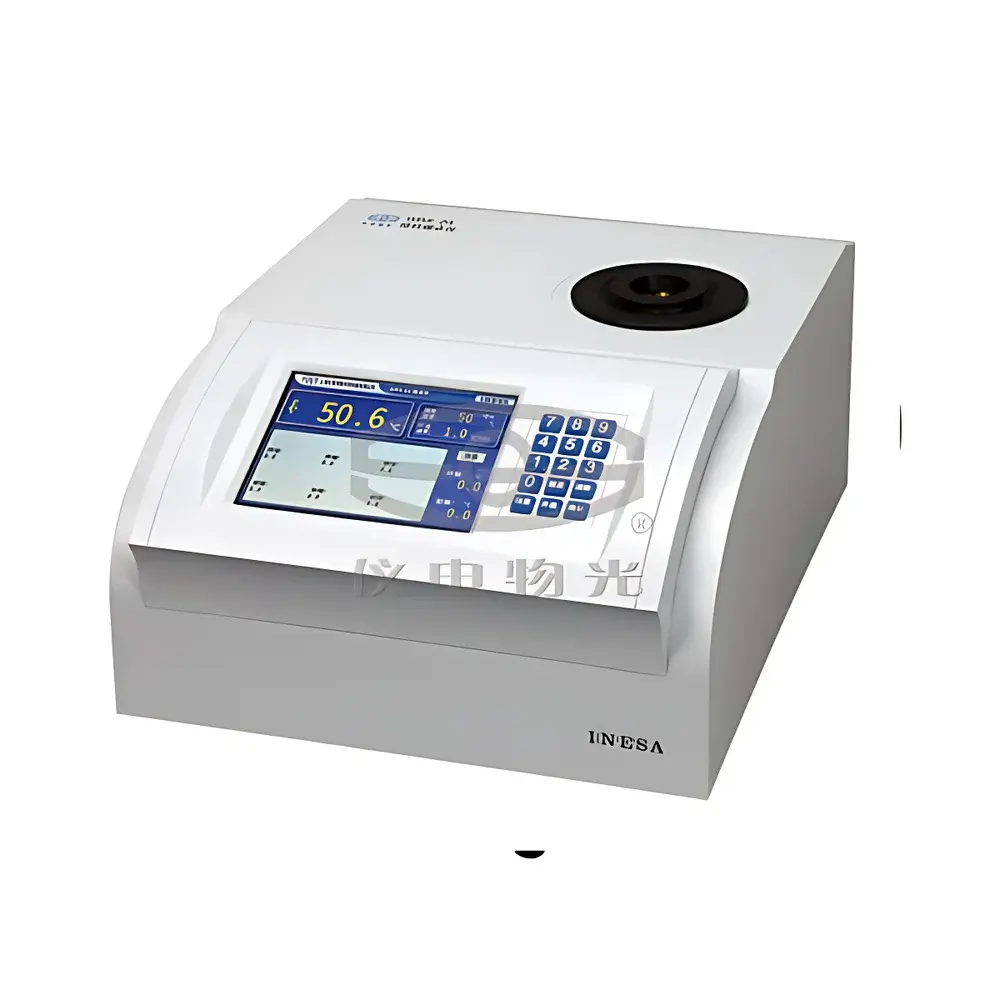
YDWG WRS-2A Microprocessor-Controlled Melting Point Apparatus
| Brand | YDWG |
|---|---|
| Origin | Shanghai, China |
| Model | WRS-2A |
| Temperature Range | Ambient to 300 °C |
| Heating Rates | 0.2, 0.5, 1.0, 1.5, 2.0, 3.0, 4.0, 5.0 °C/min (8 fixed steps) |
| Temperature Repeatability | ±0.3 °C at 1.0 °C/min |
| Temperature Accuracy | ±0.4 °C ≤200 °C |
| Capillary Dimensions | OD 1.4 mm, ID 1.0 mm, Length 90 mm |
| Sample Capacity | 3 capillaries |
| Temperature Resolution | 0.1 °C |
| Display | 7-inch color LCD touchscreen |
| Calibration | Multi-point calibration |
| Interface | RS232 and USB |
| Power Supply | 220 V ±10 %, 50 Hz ±1 Hz, 100 W |
| Dimensions | 360 × 290 × 170 mm |
| Net Weight | 9 kg |
Overview
The YDWG WRS-2A Microprocessor-Controlled Melting Point Apparatus is a precision thermal analysis instrument engineered for reliable, reproducible determination of melting point ranges in solid organic compounds, pharmaceuticals, polymers, and reference standards. It operates on the principle of optical detection of phase transition: as a crystalline sample in a standard pharmacopoeial capillary undergoes solid-to-liquid transition, changes in light transmission through the column are captured by a high-stability photodiode array. These optical signals—corresponding to onset (initial softening), clear point (complete liquefaction), and intermediate melt progression—are processed in real time by an embedded microcontroller. The system integrates a platinum resistance thermometer (Pt100) as its primary temperature sensor, ensuring linearity and long-term stability across its full operating range (ambient to 300 °C). PID-based temperature control enables precise ramp regulation with minimal overshoot, critical for compliance with pharmacopeial methods such as USP <741>, EP 2.2.17, and ChP 0612.
Key Features
- Triple-capillary measurement station enabling parallel analysis of up to three independent samples per run—reducing inter-sample variability and improving throughput in QC laboratories.
- Eight discrete, pre-configured heating rates (0.2–5.0 °C/min) optimized for method transfer and regulatory alignment; each rate is factory-validated for thermal uniformity and temporal fidelity.
- 0.1 °C temperature resolution with traceable accuracy: ±0.4 °C up to 200 °C and ±0.7 °C above—meeting or exceeding requirements specified in ISO 11357-3 and ASTM D3418 for differential thermal analysis instrumentation.
- 7-inch color LCD touchscreen interface supporting intuitive parameter entry, real-time melt curve visualization, and on-device storage of up to 100 test records with timestamp, operator ID, and method metadata.
- Integrated multi-point calibration routine compliant with GLP documentation standards; supports user-defined calibration points using NIST-traceable reference standards (e.g., indium, caffeine, phenacetin).
- Robust mechanical architecture featuring thermally insulated heating block, low-drift optical path, and EMI-shielded electronics—designed for continuous operation in regulated environments subject to 21 CFR Part 11 audit requirements.
Sample Compatibility & Compliance
The WRS-2A accepts standard pharmacopoeial capillaries (1.4 mm OD / 1.0 mm ID / 90 mm length) filled to a consistent 3 mm sample height—ensuring uniform heat transfer and optical path geometry. Its design conforms to the physical specifications mandated by USP, EP, JP, and ChP monographs for melting point apparatus validation. All thermal profiles generated are fully traceable and exportable via RS232 or USB to LIMS or electronic lab notebooks. The instrument supports audit trail generation (including parameter changes, calibration events, and result modifications) when connected to compliant data management software—facilitating GMP-aligned workflows in pharmaceutical development and quality control labs.
Software & Data Management
Data output includes digital melt curves (time vs. transmittance), annotated start/mid/end melt temperatures, and statistical summaries (mean, SD, RSD) across replicates. Raw data files (.csv) preserve full-resolution timestamps and sensor readings for retrospective analysis. Optional PC software provides extended functionality including method library management, automated report generation (PDF/Excel), electronic signature support, and integration with enterprise-level validation packages. All firmware updates are delivered via signed binary files with SHA-256 checksum verification—ensuring integrity and version control per ICH Q5A and Annex 11 expectations.
Applications
- Pharmaceutical raw material identification and purity assessment per USP <741> and ICH Q5A guidelines.
- Stability-indicating assay development for thermal degradation studies under accelerated conditions.
- Polymorph screening and characterization during solid-form selection.
- Quality control release testing of APIs and excipients in cGMP manufacturing environments.
- Educational use in university chemistry and pharmacy curricula for hands-on thermal behavior instruction.
- Reference standard certification and inter-laboratory comparison programs requiring documented repeatability (≤0.3 °C at 1.0 °C/min).
FAQ
Does the WRS-2A comply with 21 CFR Part 11 requirements for electronic records?
Yes—when used with validated PC software supporting role-based access control, audit trails, and electronic signatures, the system meets predicate rule requirements for record retention and integrity.
Can custom heating rates be programmed beyond the eight preset options?
No—the WRS-2A implements fixed-rate ramps only; variable-rate programming requires the higher-tier WRS-3 model with continuous ramp capability.
What capillary types are supported?
Only standard thin-wall glass capillaries conforming to USP/EP dimensions (1.4 mm OD, 1.0 mm ID, 90 mm length); no alternative tube formats (e.g., metal, quartz) are compatible.
Is external calibration verification possible?
Yes—multi-point calibration using certified reference materials (e.g., NIST SRM 721b, indium) is supported via the built-in calibration wizard and documented in the instrument’s calibration log.
How is temperature uniformity across the heating block ensured?
The block incorporates a dual-zone Pt100 sensor array and closed-loop PID feedback to maintain axial and radial thermal homogeneity within ±0.5 °C across all three capillary positions during active ramping.



