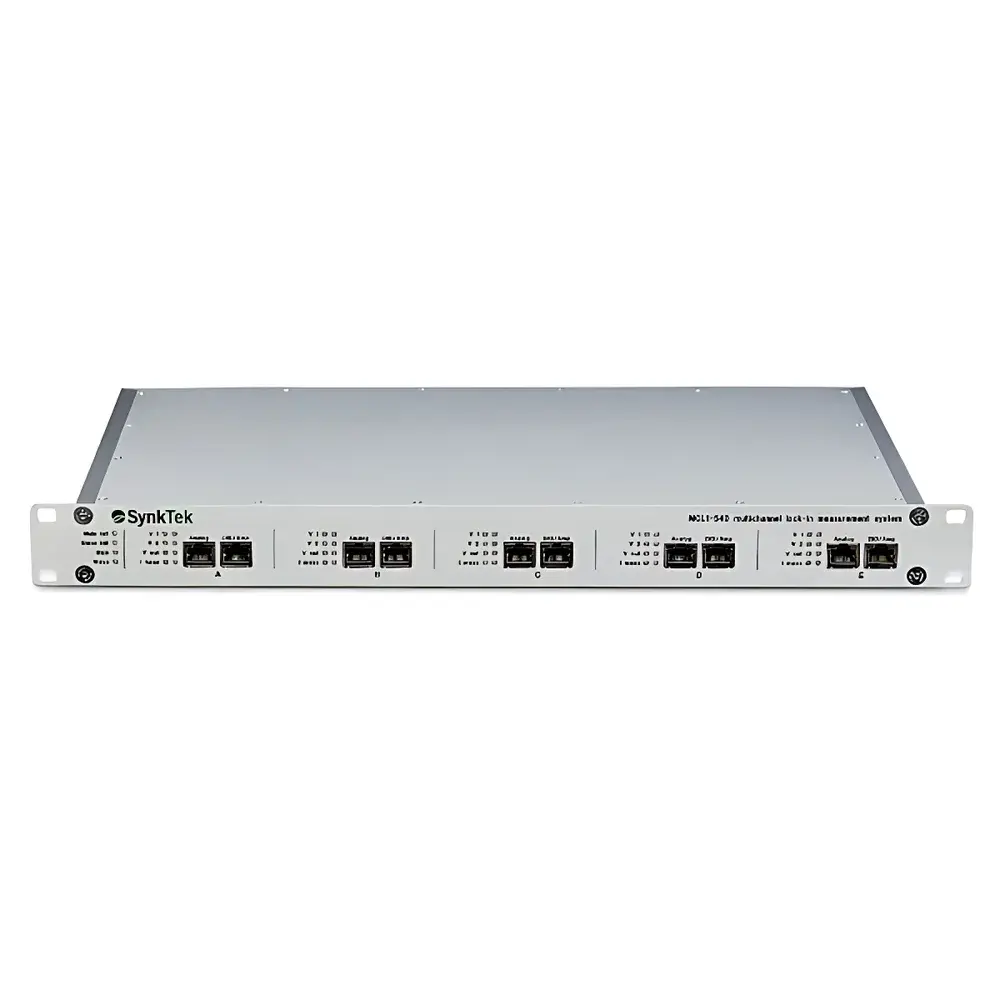
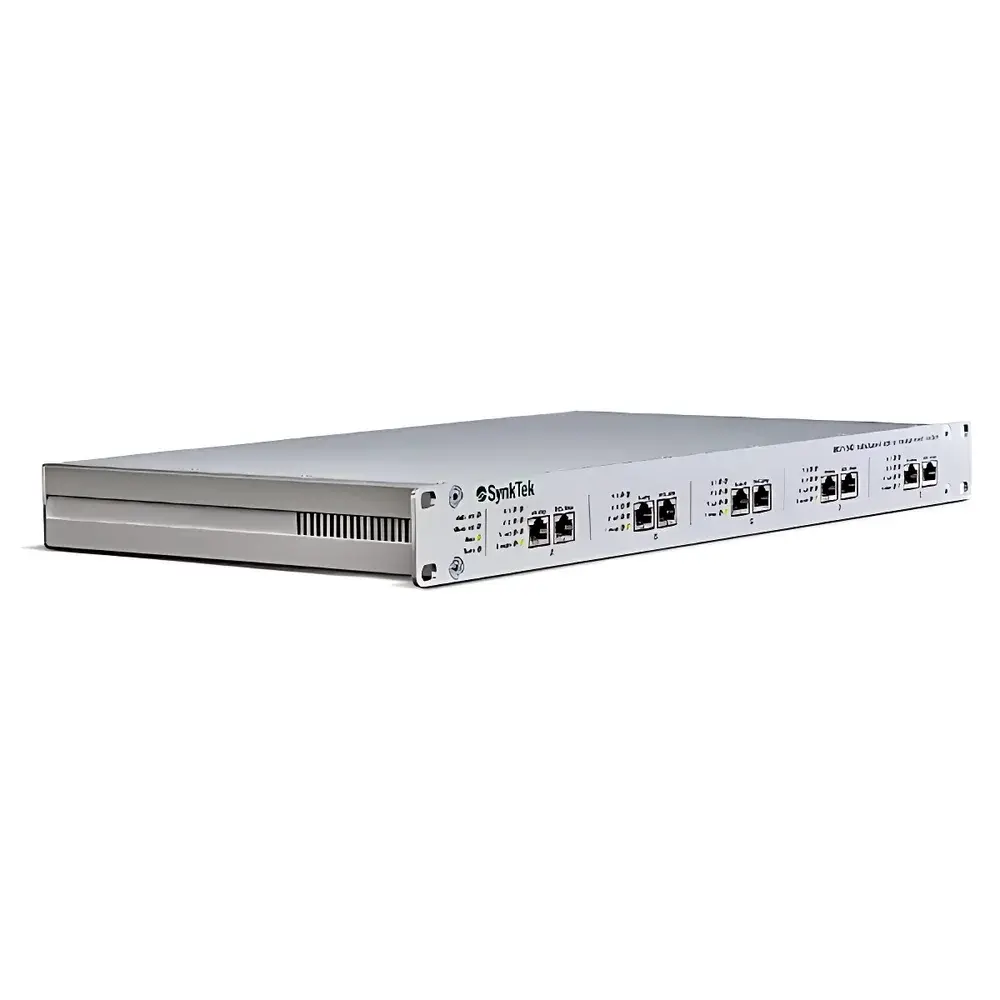
SynkTek MCL1-540 Multi-Channel Lock-in Amplifier System
| Brand | SynkTek |
|---|---|
| Origin | Sweden |
| Model | MCL1-540 |
| Frequency Range | DC to 100 kHz (up to 500 kHz with optional firmware) |
| Number of Inputs | Up to 10 voltage channels + 5 current channels |
| Input Noise Density | 1.8 nV/√Hz (low-noise), 3.7 nV/√Hz (medium), 18 nV/√Hz (high-impedance) |
| Input Impedance | ~1 GΩ (low-noise), ~30 GΩ (medium), ~1 TΩ (high-impedance) |
| Demodulators per Channel | Up to 3 independent sets (X, Y, R, θ, DC) |
| ADC/DAC Resolution | >6.5 effective digits |
| Dynamic Range | ±10 V full-scale with auto-ranging down to sub-nV sensitivity |
| Synchronization | Fully synchronous sampling across all analog I/O |
| Interface | 1000BASE-T Ethernet, USB 2.0 |
| Form Factor | 19-inch rack-mountable modular chassis |
| Compliance | Designed for GLP/GMP-aligned lab environments |
Overview
The SynkTek MCL1-540 Multi-Channel Lock-in Amplifier System is a precision-engineered instrumentation platform developed at Stockholm University’s Department of Physics and commercialized by SynkTek since 2015. Built upon over two decades of academic research in ultra-low-noise signal recovery, the MCL1-540 implements true parallel, synchronous lock-in detection using direct digital synthesis (DDS) and fully synchronized analog-to-digital conversion (ADC) and digital-to-analog conversion (DAC). Unlike time-multiplexed or software-based lock-in approaches, the MCL1-540 performs real-time, hardware-level demodulation on up to 15 simultaneous analog signals—10 voltage inputs and 5 current outputs—with independent frequency control, phase tracking, and harmonic analysis per channel. Its core architecture eliminates timing jitter and inter-channel crosstalk, enabling reproducible measurements of weak periodic signals buried beneath noise floors as low as 1.8 nV/√Hz. The system is routinely deployed in quantum transport experiments, nanocalorimetry, multi-terminal device characterization, optical heterodyne spectroscopy, and dynamic impedance mapping—applications demanding strict phase coherence, high dynamic reserve, and deterministic latency.
Key Features
- Fully synchronous, parallel acquisition across all 15 analog channels—no multiplexing, no shared clock drift
- Three independent demodulator groups per input/output channel, each supporting X, Y, R, θ, and DC outputs simultaneously
- Integrated low-noise preamplification stages with selectable input configurations: low-noise (1.8 nV/√Hz, ~1 GΩ), medium-impedance (3.7 nV/√Hz, ~30 GΩ), and ultra-high-impedance (18 nV/√Hz, ~1 TΩ)
- Auto-ranging ADC with seamless gain switching, maintaining >6.5 effective digits across ±10 V full-scale range and resolving sub-nanovolt signals
- Hardware-synchronized 100 MS/s ADC and 50 MS/s DAC with deterministic sample alignment—critical for closed-loop feedback and real-time parameter sweeps
- Modular 19-inch rack-mount chassis supporting up to five functional modules, scalable without recalibration or firmware reconfiguration
- Dual high-bandwidth interfaces: Gigabit Ethernet (1000BASE-T) for remote control and streaming, plus USB 2.0 for local configuration and firmware updates
Sample Compatibility & Compliance
The MCL1-540 accommodates diverse physical measurement modalities—including four-terminal resistance, differential thermoelectric voltage, photodiode current, piezoelectric displacement, and RF reflectometry—through configurable input termination, programmable biasing, and galvanically isolated channel options. All analog front-ends meet IEC 61000-4-3 immunity standards for laboratory electromagnetic environments. The system’s firmware and host software support traceable calibration workflows compliant with ISO/IEC 17025 requirements for testing laboratories. Audit trails, electronic signatures, and data integrity safeguards align with FDA 21 CFR Part 11 for regulated research settings. While not certified for clinical or industrial safety standards (e.g., UL/CSA), its design adheres to EN 61326-1 for EMC and electrical safety in laboratory use.
Software & Data Management
The MCL1-540 ships with SynkTek Control Suite—a cross-platform application built on Qt and Python APIs (PyMCL), enabling scriptable experiment sequencing, real-time visualization, and hierarchical data export in HDF5 format with embedded metadata (timestamps, instrument state, calibration coefficients). The software implements deterministic buffer management for gap-free acquisition at sustained rates up to 1 MS/s aggregate bandwidth. All demodulated outputs (X, Y, R, θ, DC) are timestamped with sub-microsecond resolution and stored with lossless compression. Remote operation via TCP/IP allows integration into LabVIEW, MATLAB, or custom Python frameworks using documented RESTful endpoints and WebSocket streaming. Data provenance is preserved through immutable session logs, including user identity, parameter changes, and hardware revision IDs—supporting GLP-compliant documentation practices.
Applications
- Quantum transport in 2D materials: simultaneous dual-gate lock-in detection of conductance harmonics under magnetic field sweeps
- Nanocalorimetry: phase-resolved heat capacity measurement using amplitude-modulated AC heating and third-harmonic thermal response detection
- Multi-terminal spintronic devices: correlated lock-in analysis of nonlocal spin signals across ≥4 contacts with common-mode rejection
- Optical heterodyne spectroscopy: real-time dispersion and absorption extraction from balanced photodetector pairs modulated at distinct frequencies
- Dynamic impedance spectroscopy: multi-frequency EIS with synchronized excitation and detection across 10+ electrodes for battery electrode mapping
- Cryogenic sensor readout: low-temperature resistive thermometer arrays interfaced via high-impedance inputs with minimal self-heating
FAQ
What is the maximum harmonic order supported per demodulator?
Each demodulator group supports fundamental and integer harmonics up to the 16th order, with user-defined harmonic selection per channel.
Can the MCL1-540 perform real-time FFT alongside lock-in detection?
Yes—the system includes a dedicated spectral analysis engine that operates concurrently with demodulation, delivering power spectra with configurable resolution bandwidths from 1 mHz to 50 kHz.
Is external reference synchronization supported?
Yes, the system accepts TTL or sine-wave external references (0.1–500 kHz) with automatic phase-lock acquisition and jitter compensation below 10 ps RMS.
How is calibration traceability maintained across modules?
Each module undergoes factory calibration against NIST-traceable standards; calibration coefficients are stored in onboard EEPROM and applied automatically during initialization.
Does the system support trigger-based acquisition sequences?
Yes, hardware triggers (TTL input/output) enable precise coordination with external equipment such as pulse lasers, mechanical choppers, or cryostat controllers.