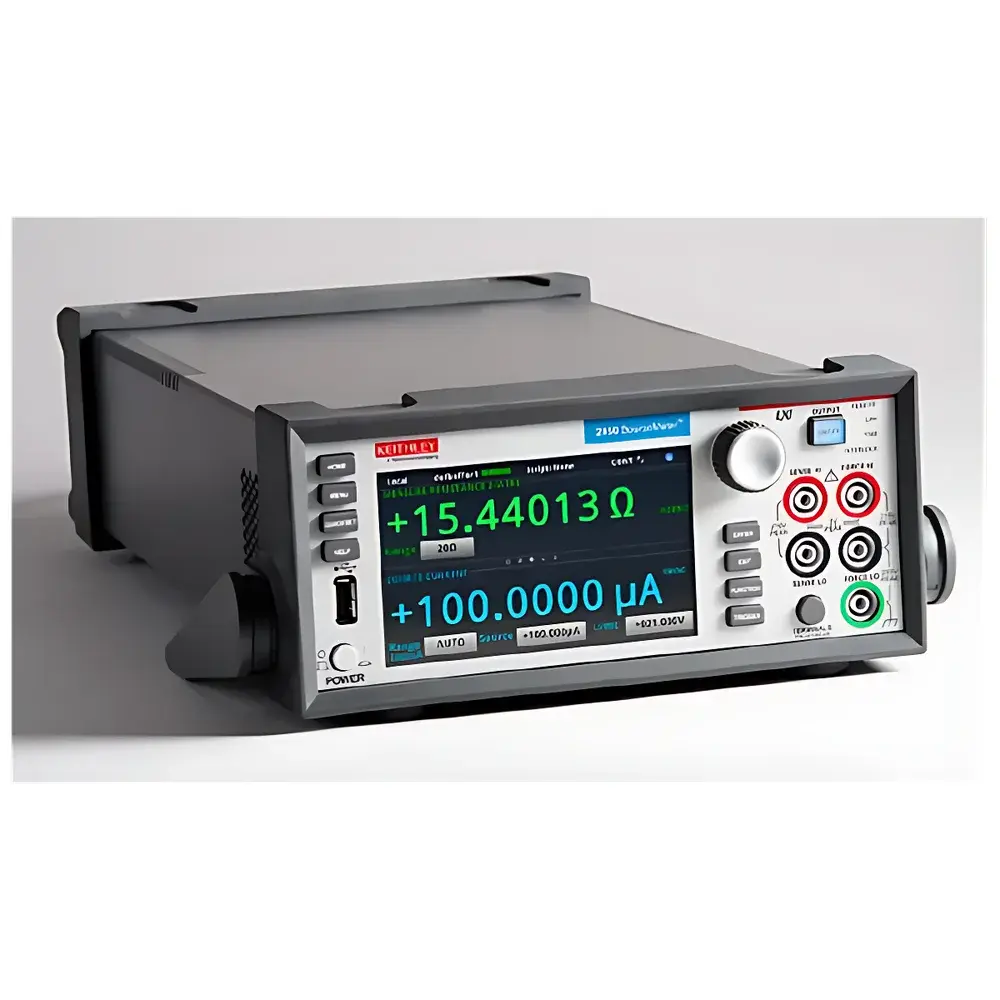
Keithley 2450 Touchscreen SourceMeter Instrument
| Brand | prtronic |
|---|---|
| Origin | Shanghai, China |
| Manufacturer Type | Original Equipment Manufacturer (OEM) |
| Country of Origin | China |
| Model | 2450 |
| Price | USD 9,800 (approx.) |
| Voltage Range | 20 mV to 200 V |
| Current Range | 10 nA to 1 A |
| Basic Accuracy | 0.012% |
| Broadband Noise | 2 mVrms (typical) |
| Sweep Types | Linear, Logarithmic, Bipolar Linear, Bipolar Logarithmic, Custom |
| Source Memory | 2400 SCPI-compatible mode |
| Reading Buffer | >250,000 points |
| Maximum Reading Rate | >3,000 readings/sec |
| Programming Interfaces | SCPI, TSP® Scripting |
| Communication Ports | GPIB, USB-TMC, Ethernet (LXI-C compliant) |
| Front Panel Connectors | Banana Jacks |
| Rear Panel Connectors | Triax (single channel) |
Overview
The Keithley 2450 Touchscreen SourceMeter® Instrument is a precision integrated source-measure unit (SMU) engineered for high-fidelity characterization of semiconductor devices, passive components, and emerging electronic materials. Unlike conventional power supplies or multimeters, the 2450 combines four-quadrant sourcing (voltage or current) with simultaneous high-resolution measurement in a single instrument—enabling true I-V curve tracing, parameter extraction, and functional testing under programmable bias conditions. Its embedded 5-inch capacitive touchscreen interface eliminates dependency on external PCs during bench-level debugging, while maintaining full compatibility with industry-standard SCPI and Keithley’s proprietary Test Script Processor (TSP®) architecture for automated test system integration. The instrument operates on a closed-loop feedback architecture with low-noise analog front-end design, delivering stable DC sourcing and sub-nanoamp current resolution essential for leakage analysis, diode ideality factor determination, and thin-film transistor (TFT) threshold voltage mapping.
Key Features
- Integrated 5-inch high-resolution capacitive touchscreen with intuitive graphical UI—supports direct waveform plotting, sweep configuration, and real-time data inspection without host PC connection
- Four-quadrant operation: sources and sinks up to ±200 V and ±1 A, enabling forward/reverse biasing, load-line analysis, and battery simulation
- High-accuracy DC measurements: voltage accuracy down to 0.012% of reading + 0.002% of range; current accuracy optimized for both high-current (1 A) and ultra-low-current (10 nA) regimes
- Low broadband noise floor of 2 mVrms (typical) ensures signal integrity during sensitive device characterization, especially critical for low-voltage nanoelectronics and memristor switching studies
- Dual operating modes: 2400 SCPI-compatibility for legacy test system migration and native TSP® scripting for distributed, trigger-synchronized multi-instrument control
- Hardware-accelerated linear/logarithmic sweeps with user-definable step resolution, dwell time, and compliance enforcement per point
- Onboard reading buffer stores >250,000 data points at acquisition rates exceeding 3,000 readings per second—enabling transient response capture and high-speed parametric screening
Sample Compatibility & Compliance
The 2450 is routinely deployed in R&D labs and production test environments for discrete semiconductors (diodes, MOSFETs, GaN HEMTs), photovoltaic cells, OLED pixels, printed electronics, and electrochemical interfaces. Its triax rear-panel output supports guarded measurements to minimize leakage errors in high-impedance applications (e.g., insulator resistivity, gate oxide integrity). Front-panel banana jacks facilitate rapid prototyping and educational use. The instrument complies with CE marking requirements, meets EN 61326-1 (EMC) and EN 61010-1 (safety) standards, and supports audit-ready operation under GLP and ISO/IEC 17025 frameworks when configured with TSP-based script logging and timestamped data export. While not FDA 21 CFR Part 11 certified out-of-box, its deterministic scripting engine and secure file I/O enable validation pathways for regulated QC/QA workflows.
Software & Data Management
Instrument control is supported via native touchscreen interface, PC-based KickStart Software (free download), or direct command-line access using SCPI over GPIB, USB-TMC, or LXI-compliant Ethernet. All communication channels support full TSP® script execution—including branching, looping, math operations, and inter-instrument synchronization via TSP-Link. Measurement data exports in CSV, TXT, or MATLAB (.mat) formats with metadata headers (timestamp, settings, units). Optional Keithley TestScript Studio provides IDE-level debugging, syntax highlighting, and hardware-in-the-loop simulation. For enterprise deployment, the 2450 integrates seamlessly into National Instruments TestStand, Keysight PathWave, and Python-based automation stacks via PyVISA or the official Keithley IVI-COM drivers.
Applications
- DC parametric testing of diodes, Zener references, and ESD protection structures
- Subthreshold conduction and transconductance (gm) mapping of silicon and wide-bandgap FETs
- Current–voltage hysteresis analysis in resistive memory (ReRAM, FeRAM) devices
- Photocurrent–voltage (J–V) characterization of perovskite and organic solar cells
- Leakage current profiling across dielectric layers and PCB contamination studies
- Functional burn-in and life-test monitoring with programmable compliance limits and pass/fail thresholds
FAQ
Is the 2450 compatible with existing 2400-series test scripts?
Yes—the instrument supports 2400 SCPI command emulation mode, allowing drop-in replacement in legacy systems without script modification.
Can the touchscreen interface be disabled for remote-headless operation?
Yes—touchscreen functionality can be locked or disabled via SCPI command or system settings, enabling unattended rack-mounted deployments.
Does the 2450 support differential voltage sensing (4-wire Kelvin)?
No—it is a 2-wire or 3-wire (guarded) SMU; for true 4-wire remote sensing, the 2460 or 2470 models are recommended.
What is the maximum sampling rate for buffered acquisitions?
Up to 3,125 readings/sec in triggered mode with minimal post-processing overhead; sustained streaming to internal buffer at >3,000 readings/sec.
Is TSP® scripting license included or optional?
TSP® is fully embedded and available at no additional cost—no runtime license or dongle required.