
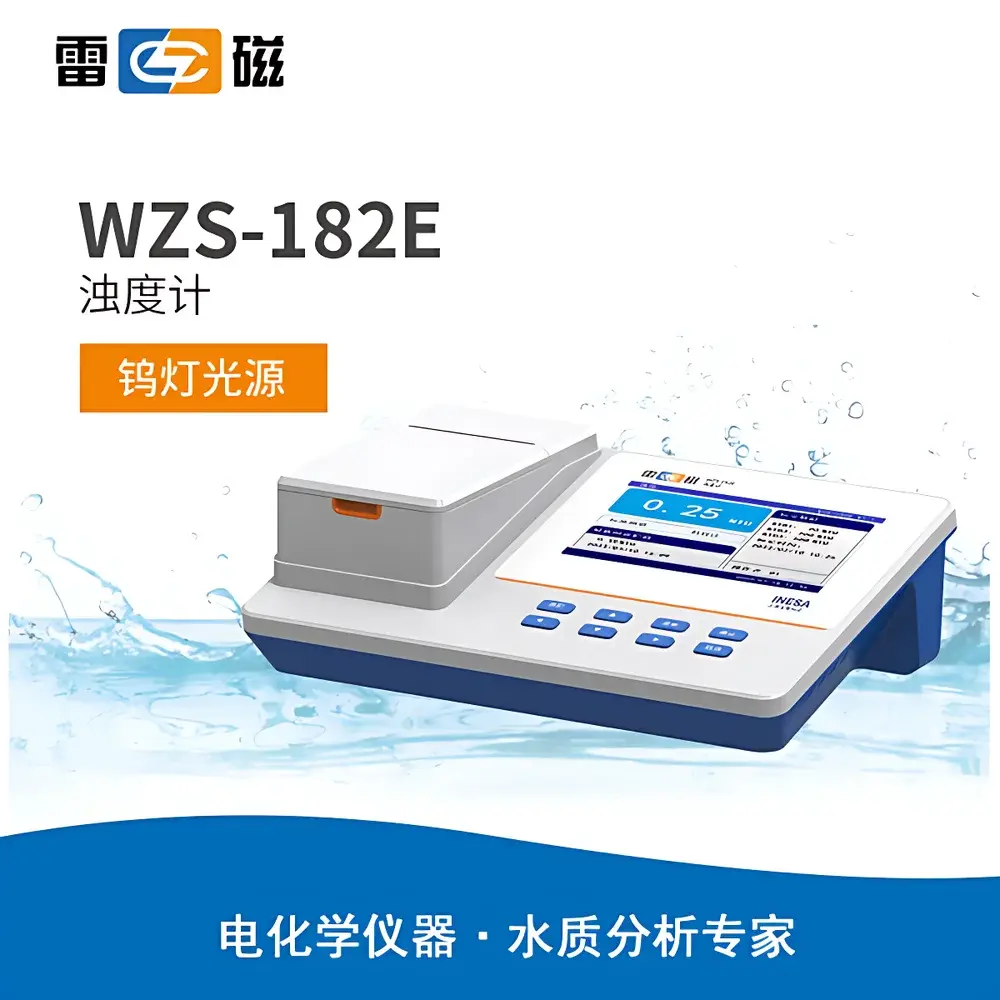
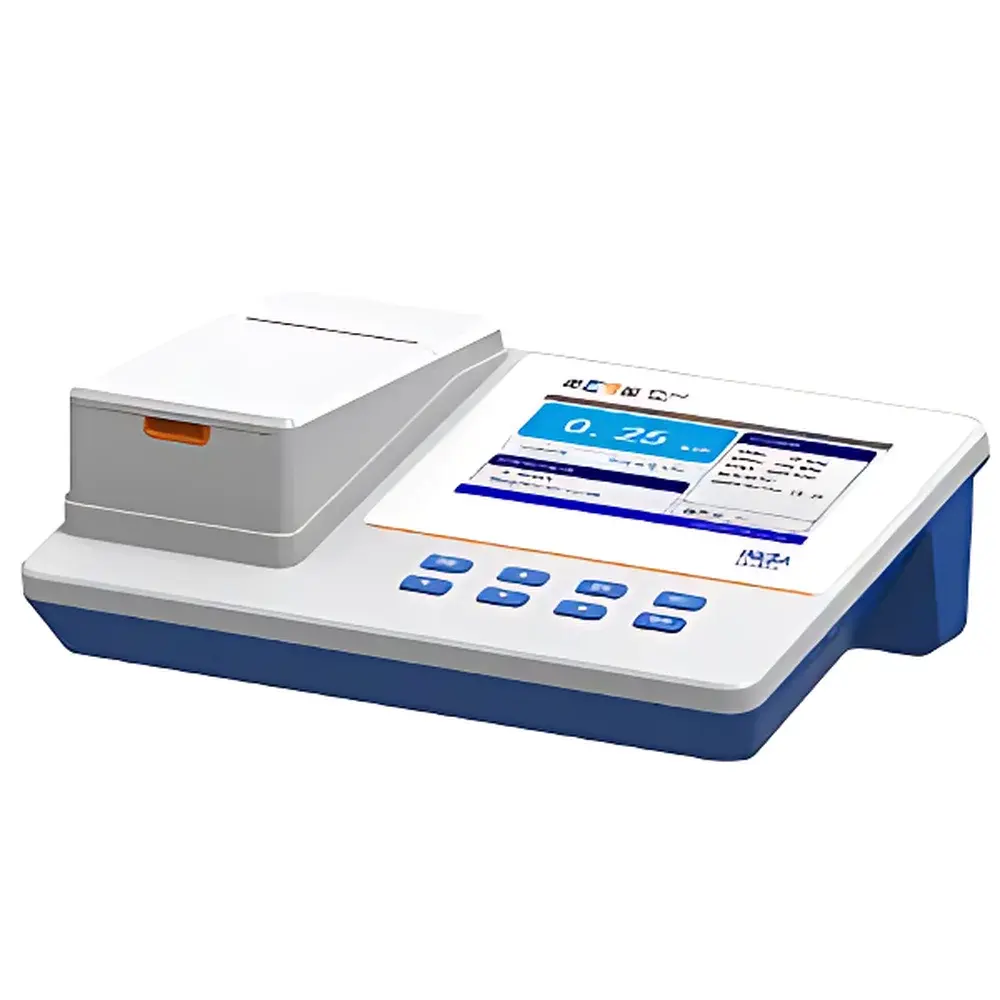
Leici WZS-182E Benchtop Turbidimeter
| Brand | Leici |
|---|---|
| Origin | Shanghai, China |
| Manufacturer Type | Authorized Distributor |
| Origin Category | Domestic (China) |
| Model | WZS-182E |
| Price | USD 865 (FOB Shanghai) |
| Instrument Type | Benchtop / Laboratory |
| Measurement Range | (0.00–9.99) NTU, (10.0–99.9) NTU, (100–500) NTU |
| Resolution | 0.01 / 0.1 / 1 NTU |
| Accuracy | ±6% of reading |
| Repeatability | ≤0.5% |
| Zero Drift | ±0.5% FS / 30 min |
| Stability | ±0.5% FS / 30 min |
| Calibration Points | Zero + up to 5 points (2, 20, 50, 200, 500 NTU) |
| Display | 5.7-inch color LCD |
| Ingress Protection | IP54 |
| Operating Temperature | 5–35 °C |
| Relative Humidity | ≤85% RH |
| Power Supply | AC 100–240 V input |
| Dimensions (L×W×H) | 189 × 282 × 84 mm |
| Weight | ~1.5 kg |
| Light Source | Tungsten-halogen lamp (400–600 nm), compliant with USEPA Method 180.1 and HJ 1075-2019 |
| Measurement Principle | Nephelometric (90° scattered light) and Ratio (scattered + transmitted light) modes |
| Units | NTU, FNU, EBC |
| Modes | Standard, Average (multi-read averaging), Zero Calibration, Multi-point Calibration |
| Data Storage | 1000 measurement records |
| Interface | RS-232 (for thermal printer), USB-B (for PC communication via proprietary software) |
| Compliance | GLP-compliant data logging with timestamp, operator ID, calibration history, and audit trail support |
Overview
The Leici WZS-182E is a benchtop turbidimeter engineered for precise, traceable water quality analysis in environmental monitoring laboratories, municipal water treatment facilities, and industrial QC environments. It operates on the nephelometric principle—measuring 90° scattered light intensity—as defined in USEPA Method 180.1 and aligned with Chinese standard HJ 1075-2019. For samples with high particulate load or color interference, the instrument supports ratio-mode measurement (simultaneous detection of scattered and transmitted light), minimizing errors caused by absorption or non-isotropic scattering. Its tungsten-halogen light source emits broadband visible radiation (400–600 nm), ensuring spectral compatibility with both NTU (Nephelometric Turbidity Unit) and FNU (Formazin Nephelometric Unit) definitions under ISO 7027-1:2016. Designed for routine compliance testing, the WZS-182E delivers stable optical performance across three auto-ranging segments (0.00–9.99, 10.0–99.9, and 100–500 NTU), with resolution dynamically adjusted per range to preserve signal fidelity.
Key Features
- Auto-ranging optical detection system with seamless switching between low-, mid-, and high-range turbidity segments
- Dual-measurement capability: selectable nephelometric (90° scatter) or ratio (scatter + transmission) mode for improved accuracy in colored or highly turbid samples
- 5.7-inch full-color LCD interface with intuitive icon-driven navigation and real-time graphical feedback during calibration and measurement
- Integrated zero-point verification and multi-point calibration support—up to five reference points (2, 20, 50, 200, and 500 NTU) using certified formazin or equivalent stable standards
- GLP-compliant data management: each stored record includes date/time stamp, operator ID (configurable), measurement mode, calibration status, and raw signal values
- IP54-rated enclosure ensures resistance to dust ingress and low-pressure water splashes—suitable for shared lab benches and field-deployable lab carts
- Built-in average mode performs up to 10 sequential readings and computes mean ± standard deviation, mitigating transient fluctuations from particle settling or convection currents
Sample Compatibility & Compliance
The WZS-182E accommodates standard 25-mm round glass cuvettes (included) and is compatible with ASTM D6708-22 and ISO 7027-1:2016 sample handling protocols. Its optical path design minimizes wall-scatter artifacts and supports measurements in drinking water, wastewater effluent, process streams, and filtered surface water. The instrument meets regulatory requirements for routine turbidity monitoring under US EPA Clean Water Act reporting frameworks and China’s “Technical Specification for Monitoring of Environmental Quality of Surface Water and Waste Water” (HJ 91.1–2019). All calibrations are traceable to NIST-traceable formazin standards; factory-installed calibration curves adhere to USEPA 180.1 linearity criteria (R² ≥ 0.999 over full range).
Software & Data Management
Data storage capacity: 1000 complete measurement entries, each containing raw detector voltage, calculated turbidity, unit selection, calibration epoch, and user-defined sample ID. Export is supported via USB-B connection using Leici’s certified PC communication software (v3.2+), which generates CSV and PDF reports compliant with 21 CFR Part 11 Annex 11 requirements—including electronic signatures, audit trails, and immutable record archiving. RS-232 output enables direct printing to industry-standard serial thermal printers (e.g., Epson TM-T20II) for hard-copy documentation during inspections or audits. All calibration events—including zero adjustments and multi-point curve generation—are time-stamped and retained independently of measurement data.
Applications
- Regulatory compliance testing for drinking water distribution systems (e.g., WHO Guidelines, GB 5749–2022)
- Effluent monitoring in municipal wastewater treatment plants prior to discharge
- In-process turbidity control in pharmaceutical water systems (PW, WFI) per USP and EU GMP Annex 1
- Quality assurance of filtration media, coagulant dosing efficiency, and sedimentation basin performance
- Environmental field labs conducting lake, river, and reservoir clarity assessments
- Educational laboratories teaching principles of light scattering, colloid stability, and optical metrology
FAQ
Does the WZS-182E comply with ISO 7027-1:2016 for FNU reporting?
Yes—the instrument’s tungsten-halogen source (400–600 nm) and 90° detector geometry satisfy ISO 7027-1’s spectral and angular specifications for FNU when operated in nephelometric mode.
Can the device store calibration curves independently from measurement data?
Yes—calibration metadata (date, points used, operator ID, deviation residuals) is archived separately and persists through power cycles and factory resets.
Is USB communication compatible with Windows 10/11 and macOS 12+?
Yes—Leici’s official communication software supports both platforms; driver installation is required only once per host machine.
What is the recommended recalibration frequency under GLP conditions?
Daily zero verification is advised; full multi-point calibration should be performed at start-of-shift, after maintenance, or when drift exceeds ±0.5% FS/30 min as verified by zero check.
Does the IP54 rating permit use in humid laboratory environments?
Yes—IP54 certifies protection against dust accumulation and water droplets from any direction, making it suitable for ambient lab spaces with controlled HVAC but no direct washdown requirements.





