
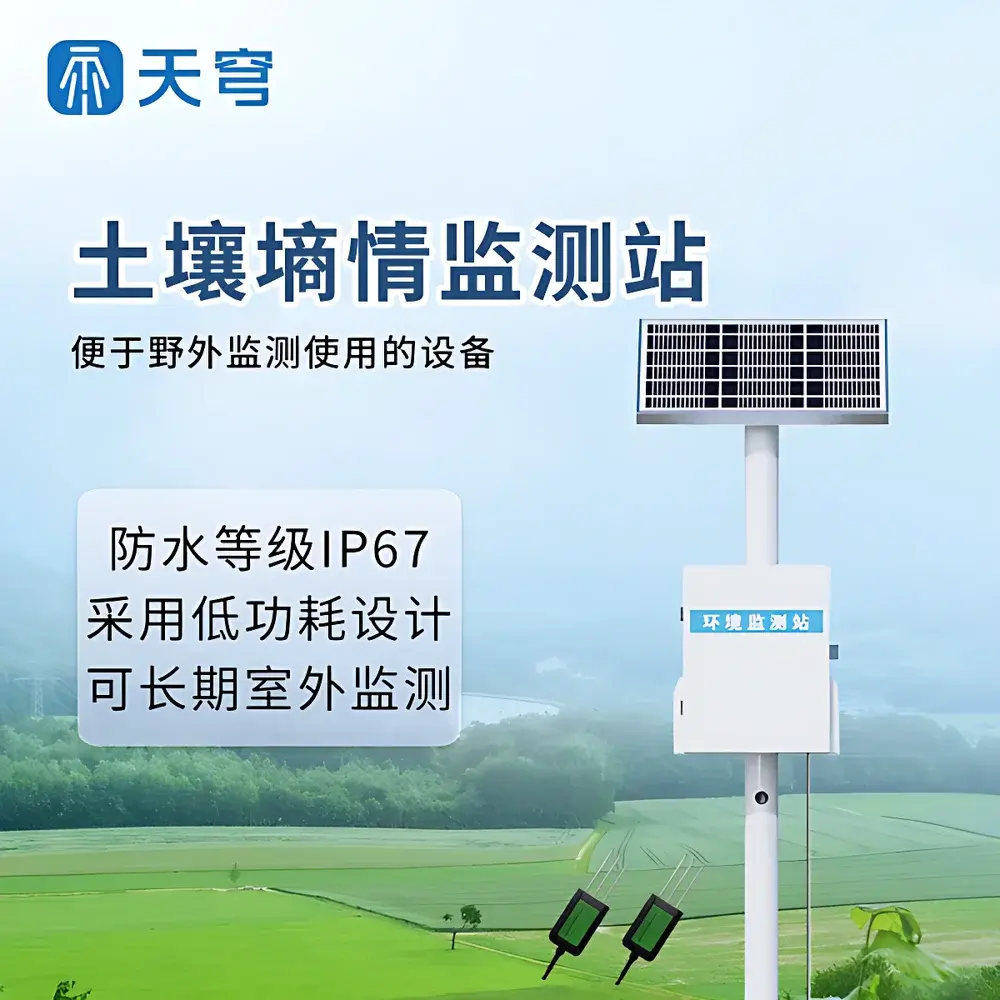
Fengtu TQ-TS200 Integrated Soil Moisture Monitoring Station
| Brand | Fengtu |
|---|---|
| Origin | Shandong, China |
| Model | TQ-TS200 |
| Soil Moisture Range | 0–100% VWC (±3% accuracy, 0.01% resolution) |
| Soil Temperature Range | −30 to +70°C (±0.3°C, 0.01°C resolution) |
| Soil EC Range | 0–20,000 µS/cm (±3% up to 10,000 |
Overview
The Fengtu TQ-TS200 Integrated Soil Moisture Monitoring Station is a field-deployable, multi-parameter environmental sensing platform engineered for continuous, autonomous monitoring of soil physical and electrochemical properties in agricultural, ecological, and geoscientific applications. It operates on the principle of frequency-domain reflectometry (FDR) for volumetric water content (VWC) measurement, combined with precision thermistor-based temperature sensing and four-electrode conductivity measurement to minimize electrode polarization effects. The system integrates dual-depth probe arrays—typically installed at 10 cm and 20 cm—to resolve vertical gradients in soil moisture, temperature, and electrical conductivity (EC), enabling stratified analysis of root-zone dynamics. Designed for unattended operation in remote or off-grid locations, it features an IP66-rated stainless-steel weatherproof enclosure, MPPT solar charging architecture, and embedded Android HMI for local visualization and configuration. Its modular sensor architecture supports optional expansion to atmospheric parameters—including air temperature, relative humidity, solar irradiance, and optical rain rate—making it suitable for cross-domain environmental observatories compliant with FAO irrigation scheduling frameworks and UNCCD land degradation neutrality monitoring protocols.
Key Features
- Dual-layer FDR-based soil moisture, temperature, and EC sensors with corrosion-resistant stainless-steel needle electrodes (3 mm diameter, 5.5 cm active length), validated for long-term burial in saline or acidic soils.
- Integrated 7-inch industrial-grade Android display (Android 4.4.2, quad-core Cortex-A7, 512 MB RAM / 4 GB flash optional), operable at temperatures down to −20°C, supporting local data review, alarm acknowledgment, and real-time parameter calibration.
- MPPT solar charge controller achieving >20% higher energy harvest efficiency versus conventional PWM controllers—critical for sustained winter operation in high-latitude deployments.
- Multi-protocol communication stack: GPRS for wide-area telemetry, LoRaWAN for private low-power networks, Bluetooth 4.2 for short-range commissioning, and RS485 Modbus RTU for integration into SCADA or PLC-based infrastructure.
- SMS-based threshold alerting: configurable upper/lower limits per parameter trigger automated SMS notifications to pre-registered mobile numbers—essential for irrigation control centers operating under SLA-driven response windows.
- On-device data logging capacity exceeding 500,000 timestamped records with automatic rollover, ensuring continuity during extended network outages without data loss.
Sample Compatibility & Compliance
The TQ-TS200 is compatible with mineral, organic, and loamy soil matrices across pH 4–9 and EC ranges up to 20 mS/cm. Probe geometry and FDR excitation frequency (70 MHz) minimize textural bias in sandy and clayey profiles, as verified per ISO 11274:2019 (soil water retention curve determination) and ASTM D5859-19 (in-situ soil moisture sensor performance testing). The stainless-steel housing and sensor pins conform to ISO 9223:2022 corrosion classification C5-M (marine/industrial environments). Manufacturing compliance includes ISO 9001:2015 (quality management), ISO 14001:2015 (environmental management), and ISO 45001:2018 (occupational health and safety). Software components—including the cloud platform and desktop client—support audit-trail generation and user-role access control aligned with GLP principles for environmental data integrity.
Software & Data Management
Three-tier software architecture ensures interoperability across operational scales: (1) Embedded Android application enables Bluetooth-initiated device pairing, JSON-based auto-discovery, background data acquisition during screen-off states, and CSV export with timestamped metadata; (2) Windows-based PC software supports serial/Modbus RTU ingestion, customizable dashboard widgets, JavaScript-powered post-processing (e.g., van Genuchten parameter fitting or EC-to-salinity conversion), and protocol extensibility via user-defined Modbus register maps; (3) Cloud platform (B/S architecture) delivers role-based web access, GIS-enabled device mapping, HJ-212-compliant data forwarding to provincial environmental monitoring centers, HTTP/TCP API endpoints for ERP/MES integration, and configurable alarm escalation workflows. All tiers implement SHA-256 data signing and TLS 1.2 encryption for transmission security.
Applications
- Precision irrigation scheduling in smart farms—correlating real-time VWC profiles with crop evapotranspiration models (e.g., FAO-56) to optimize water use efficiency (WUE) and reduce leaching losses.
- Soil salinization monitoring in arid-zone agriculture and reclaimed coastal farmland—tracking seasonal EC trends to inform gypsum amendment timing and drainage interventions.
- Ecological restoration projects—quantifying soil moisture recovery rates post-vegetation establishment in degraded grasslands or mine tailings.
- University research on soil–plant–atmosphere continuum (SPAC) dynamics—synchronizing soil sensor outputs with eddy covariance tower data for boundary layer modeling.
- National soil moisture network nodes—contributing standardized, QA/QC’d time-series to national drought early-warning systems (e.g., China’s National Drought Monitoring System).
FAQ
What communication protocols does the TQ-TS200 support for integration with existing SCADA systems?
It natively supports Modbus RTU over RS485, with register maps published in the technical manual. Custom protocol translation (e.g., IEC 60870-5-101/104) can be implemented via JavaScript scripting in the cloud platform.
Can the system operate continuously through winter in sub-zero ambient conditions?
Yes—the display and electronics are rated for −20°C operation, and the MPPT solar controller maintains battery charge efficiency down to −15°C. For prolonged <−25°C deployments, optional heater tape integration is available.
How is sensor calibration traceability maintained across field units?
Each sensor batch undergoes factory calibration against NIST-traceable reference standards (SRM 2100a for moisture, ITS-90 for temperature). Calibration certificates and deviation logs are embedded in device firmware and accessible via the Android app.
Is the cloud platform compliant with data sovereignty requirements for EU-based users?
While default hosting is in mainland China, private cloud deployment on AWS EU-Central-1 or Azure Germany West Central is available under enterprise licensing, including GDPR-aligned data processing agreements.
What is the expected service life of the buried probes under continuous exposure to high-salinity soils?
Stainless-steel 316L electrodes demonstrate >5 years functional stability in EC >15 mS/cm environments when installed per ISO 14688-1:2018 guidelines—verified by accelerated corrosion testing per ASTM B117.
Related Products







