
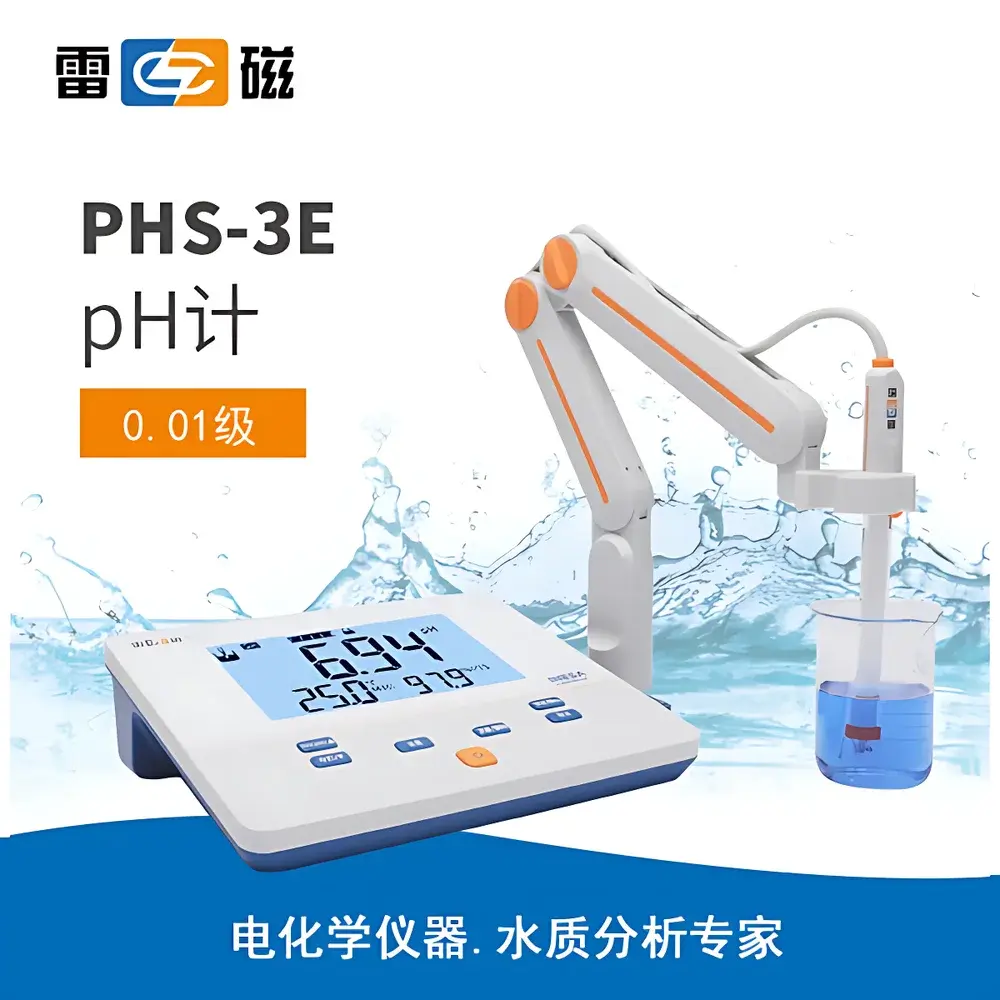
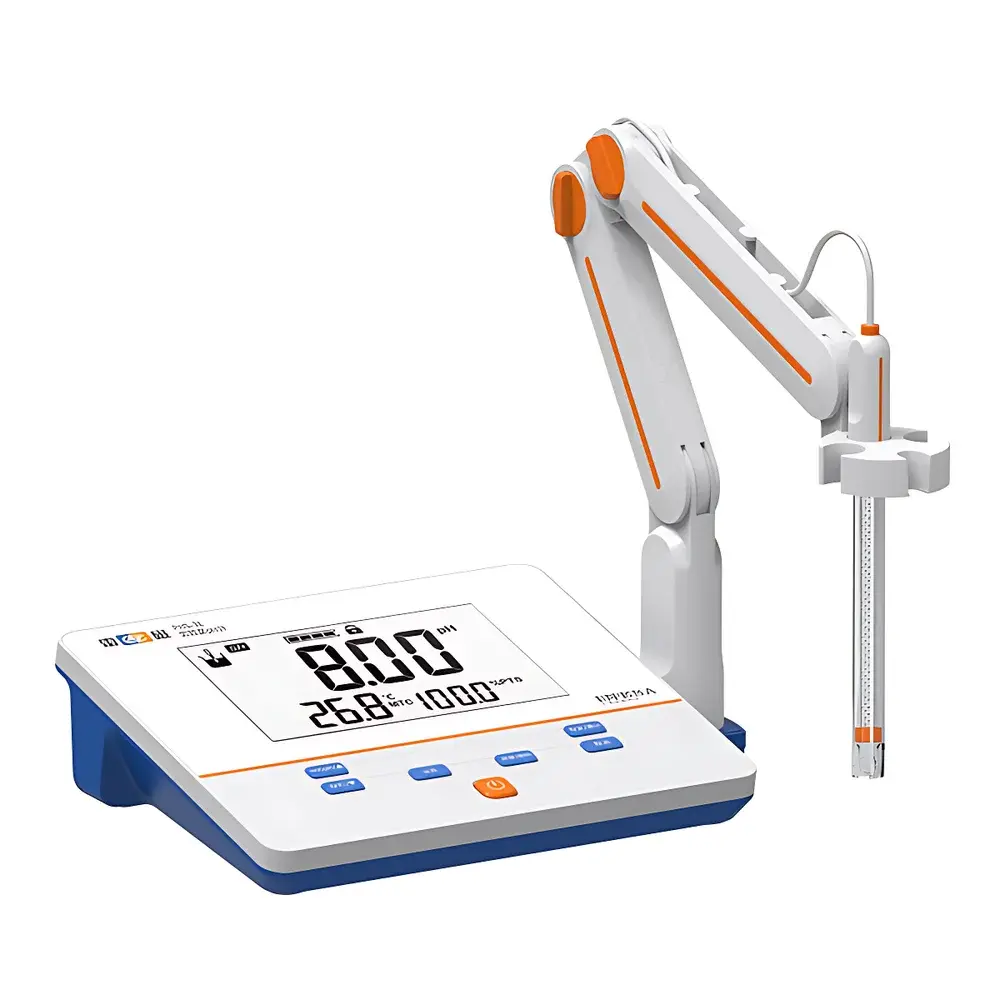
Leici PHS-3E Benchtop pH Meter
| Brand | Leici |
|---|---|
| Origin | Shanghai, China |
| Instrument Type | Benchtop |
| Measurement Mode | pH / mV / Temperature |
| pH Range | (-2.00 to 18.00) pH |
| pH Resolution | 0.01 pH |
| pH Accuracy | ±0.01 pH |
| mV Range | (-1999 to +1999) mV |
| mV Resolution | 1 mV |
| mV Accuracy | ±0.1% FS |
| Temperature Range | (-5.0 to 110.0) °C |
| Temperature Resolution | 0.1 °C |
| Temperature Accuracy | ±0.2 °C |
| Calibration Points | 1–3 point automatic buffer recognition (GB standard: pH 4.00, 6.86, 9.18) |
| Temperature Compensation | Automatic or manual |
| Measurement Modes | Stable-endpoint detection, continuous monitoring, equilibrium mode |
| Data Storage | 50 measurement sets |
| IP Rating | IP54 |
| Power Supply | AC 100–240 V input, DC 20 V / 1500 mA output |
| Dimensions (W×D×H) | 242 × 195 × 68 mm |
| Weight | 0.9 kg |
Overview
The Leici PHS-3E Benchtop pH Meter is a precision electrochemical instrument engineered for routine and quality-critical pH, mV, and temperature measurements in academic laboratories, industrial QC environments, and regulatory-compliant production facilities. Built upon a robust analog-to-digital signal architecture with low-noise amplification and high-impedance input circuitry (>1012 Ω), the PHS-3E employs potentiometric measurement principles compliant with ISO 3696, ASTM E70, and USP . Its core functionality centers on the Nernst equation-based quantification of hydrogen ion activity via a glass pH electrode, with integrated reference junction stability assurance and junction potential compensation algorithms. Designed for operational continuity in non-sterile but controlled lab settings, the unit meets IP54 ingress protection standards—ensuring resistance to dust accumulation and incidental water splashes during daily benchtop use.
Key Features
- High-contrast backlit LCD display with intuitive key navigation and real-time dual-parameter readout (e.g., pH + temperature)
- Intelligent endpoint detection algorithm that dynamically evaluates signal stability, reducing operator dependency and improving inter-user reproducibility
- Auto-recognition of three nationally certified GB buffer solutions (pH 4.00, 6.86, 9.18) with optional user-defined buffer entry for non-standard calibration protocols
- Configurable measurement modes: equilibrium mode (for stable sample conditions), continuous mode (for kinetic monitoring), and balance mode (for slow-drift samples)
- Comprehensive temperature compensation support—both automatic (via integrated Pt1000 sensor or external probe) and manual entry—ensuring thermodynamic correction per IUPAC-recommended pH scale conventions
- Built-in data management system storing up to 50 complete measurement records, each timestamped and including pH, mV, temperature, calibration status, and electrode ID metadata
- Power management suite featuring auto-shutdown (configurable timeout), power-loss recovery, and factory reset capability—critical for GLP-aligned instrument lifecycle control
Sample Compatibility & Compliance
The PHS-3E accommodates aqueous and mildly buffered solutions across a broad chemical matrix—including dilute acids and bases, saline media, and organic-aqueous mixtures—when used with appropriate electrode configurations (e.g., triple-junction pH electrodes for high-protein or sulfide-rich samples). It complies with national metrological verification regulations JJG 119–2018 (China) and aligns with international traceability frameworks through its adherence to defined electrode response characteristics and calibration validation procedures. While not intrinsically 21 CFR Part 11 compliant, audit-ready operation is achievable when deployed within documented SOPs that include calibration logs, user access controls, and periodic performance verification using NIST-traceable reference materials.
Software & Data Management
Data export is performed via manual record review and transcription; the PHS-3E does not feature USB, Bluetooth, or RS-232 connectivity. All stored entries include date/time stamps, electrode identification fields (user-entered), calibration history flags, and environmental parameters—enabling retrospective assessment per ISO/IEC 17025 clause 7.7 requirements. The internal memory retains data integrity during power interruption, and full calibration history is preserved alongside each measurement set to support root-cause analysis during out-of-specification investigations.
Applications
- Academic teaching labs: foundational electrochemistry instruction, buffer preparation verification, titration endpoint confirmation
- Pharmaceutical manufacturing: raw material pH screening (excipients, APIs), cleaning validation rinse water testing, stability study solution monitoring
- Food & beverage QA: product acidity profiling (juices, dairy, fermented goods), process water pH verification, HACCP critical control point logging
- Environmental testing labs: surface water and wastewater pH compliance checks per GB 3838–2002 and EPA Method 150.1
- Chemical synthesis R&D: reaction mixture acidity tracking, catalyst activation monitoring, hydrolysis kinetics evaluation
FAQ
What calibration buffers are pre-programmed into the PHS-3E?
The instrument automatically identifies and applies correction factors for three Chinese national standard buffers: pH 4.00, 6.86, and 9.18 at 25 °C, as specified in GB/T 27502–2011.
Does the PHS-3E support GLP documentation requirements?
While lacking electronic signature or audit trail features, it supports GLP workflows when paired with standardized logbooks, calibration certificate archiving, and defined re-calibration intervals per laboratory SOPs.
Can the PHS-3E measure redox potential (ORP)?
Yes—it provides direct mV readings across ±1999 mV with 1 mV resolution, suitable for relative ORP assessments using inert platinum or calomel reference systems.
Is temperature compensation mandatory for accurate pH readings?
Temperature compensation is strongly recommended for all quantitative work, as the Nernst slope varies by approximately −0.00018 pH/°C per pH unit deviation from 25 °C; the PHS-3E applies this correction in real time when enabled.
What is the expected service life of the included tri-combined pH electrode?
Under typical usage (≤8 hours/day, proper storage in KCl solution, regular cleaning), the electrode maintains ±0.01 pH accuracy for 12–18 months—consistent with ISE manufacturer longevity benchmarks under ISO 17025 environmental controls.
Related Products






