
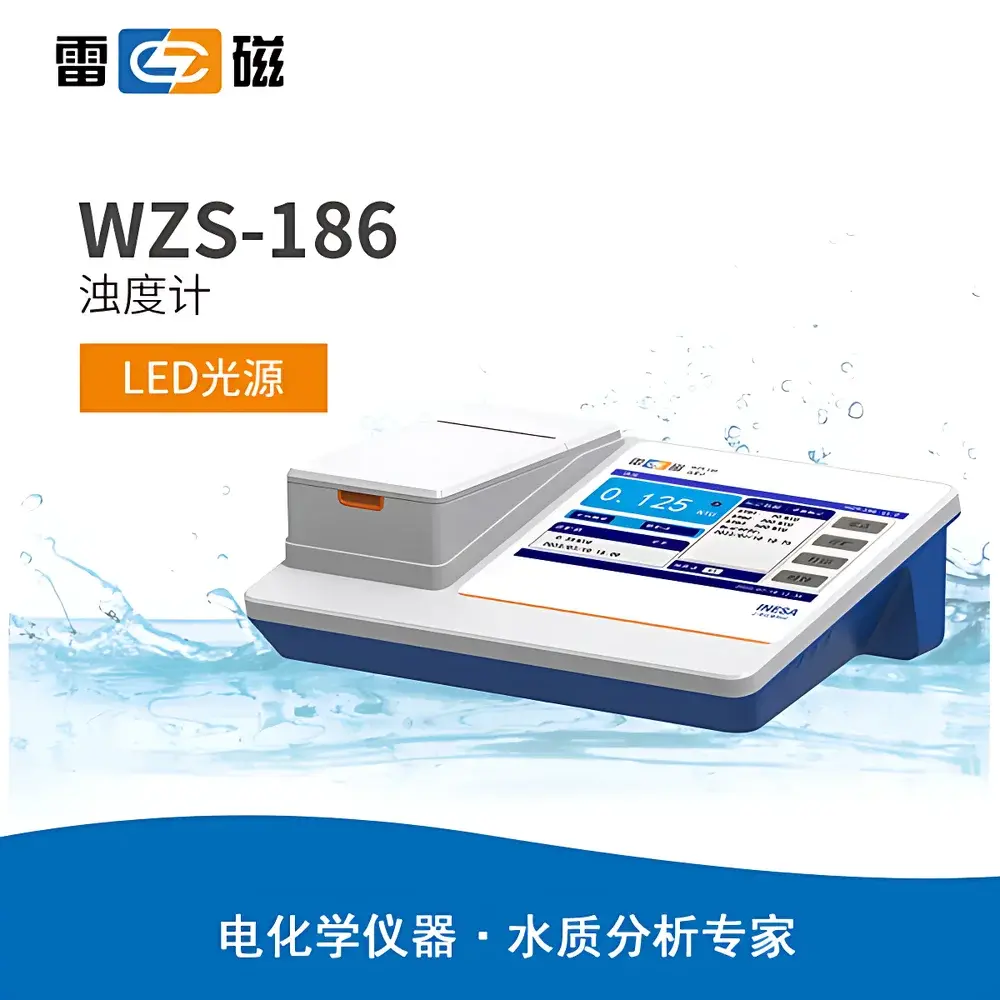
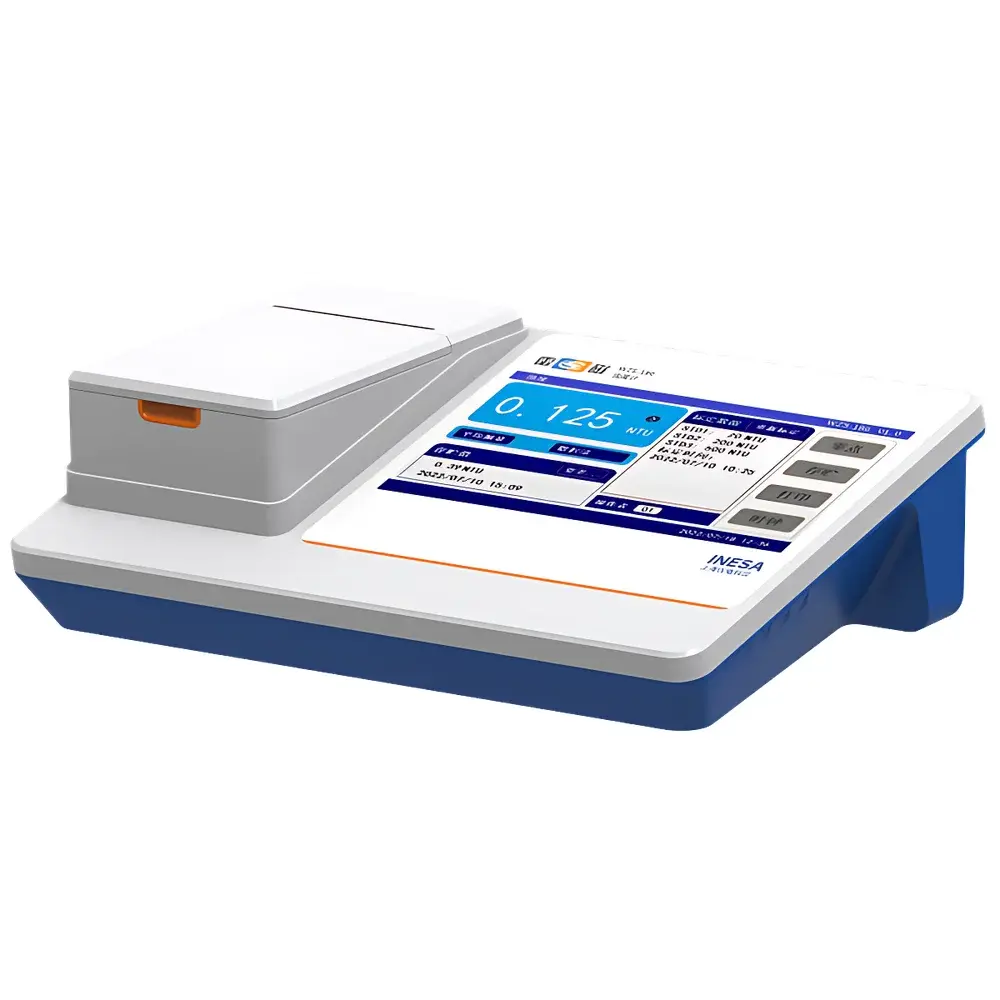
Leici WZS-186 Benchtop Turbidimeter
| Brand | Leici |
|---|---|
| Origin | Shanghai, China |
| Model | WZS-186 |
| Type | Benchtop Laboratory Turbidimeter |
| Measurement Range | 0.000–2000 NTU |
| Resolution | 0.001 NTU (at lowest range) |
| Operating Temperature | 5–35 °C |
| Accuracy | ±6% FS |
| Repeatability | ≤0.5% |
| Zero Drift | ±0.5% FS / 30 min |
| Stability | ±0.5% FS / 30 min |
| Calibration Points | Up to 7 points (2, 20, 50, 200, 500, 1000, 2000 NTU) |
| Data Storage Capacity | 2000 measurements |
| Display | 7-inch color TFT touchscreen |
| Protection Rating | IP54 |
| Interface | RS-232, USB |
| Power Supply | DC 24 V (AC 100–240 V input adapter) |
| Dimensions | 189 × 282 × 84 mm |
| Weight | ~1.5 kg |
Overview
The Leici WZS-186 Benchtop Turbidimeter is a precision optical instrument engineered for reliable, traceable turbidity measurement in environmental monitoring, drinking water quality control, wastewater treatment, and pharmaceutical process validation laboratories. It operates on the nephelometric principle—measuring the intensity of light scattered at 90° by suspended particles—as defined in ISO 7027:2016 and aligned with HJ 1075–2019 (China’s standard for water quality—turbidity determination). The instrument integrates an 860 nm infrared LED light source to minimize interference from sample coloration and absorbance, ensuring compliance with international method requirements for true turbidity quantification. Its dual-mode optical architecture supports both standard 90° scatter detection and combined scatter-transmission measurement, enabling robust performance across heterogeneous samples—from low-turbidity potable water (0.000 NTU) to highly turbid industrial effluents (up to 2000 NTU).
Key Features
- Infrared LED light source (860 nm) compliant with ISO 7027 and HJ 1075 for standardized, color-insensitive turbidity assessment
- Dual measurement modes: Nephelometric (90° scatter) and scatter-transmission hybrid mode for enhanced accuracy in colored or high-absorbance matrices
- Auto-ranging optical detection system with four dynamic ranges: 0.000–9.999 NTU, 10.00–99.99 NTU, 100.0–999.9 NTU, and 1000–2000 NTU
- 7-inch full-color capacitive touchscreen interface with intuitive icon-driven navigation and real-time graphical display
- Multi-unit support: NTU (Nephelometric Turbidity Units), FNU (Formazin Nephelometric Units), and EBC (European Brewery Convention units)
- Two operational modes: Standard single-shot measurement and averaging mode (configurable 3–9 readings) to mitigate stochastic fluctuations caused by particle settling or Brownian motion
- Comprehensive calibration suite: zero-point correction + up to seven-point calibration using certified formazin or equivalent standards (2, 20, 50, 200, 500, 1000, 2000 NTU)
- IP54-rated enclosure for dust resistance and limited water ingress protection—suitable for routine lab use near wet benches or sampling stations
- Built-in data integrity features: GLP-compliant timestamped storage (2000 records), audit-ready calibration history, and factory-reset capability for zero and calibration value restoration
Sample Compatibility & Compliance
The WZS-186 accommodates standard 25-mm round glass cuvettes (included) and is compatible with alternative sample cells meeting ISO 7027 geometric specifications. It delivers consistent performance across aqueous matrices including surface water, groundwater, filtered drinking water, secondary effluent, and clean-in-place (CIP) rinse solutions. All measurement protocols adhere to ISO/IEC 17025-relevant documentation practices. The instrument supports regulatory traceability through automatic logging of operator ID (user-defined), calibration date/time, standard lot numbers, and environmental conditions (temperature recorded at time of measurement). While not FDA 21 CFR Part 11-certified out-of-the-box, its data export functionality (via USB or RS-232) enables integration into validated LIMS or ELN systems where electronic signature and audit trail requirements are managed at the enterprise software layer.
Software & Data Management
Data transfer is facilitated via USB mass-storage mode or RS-232 serial interface using Leici’s proprietary PC communication software (Windows-compatible, no driver installation required). Exported files are saved in CSV format with structured headers—including measurement ID, date/time stamp, NTU/FNU/EBC value, measurement mode, calibration status, and temperature—ensuring seamless import into statistical analysis tools (e.g., JMP, Minitab) or laboratory information management systems. Internal memory retains full metadata for each entry: operator code, calibration reference values, instrument serial number, and firmware version. All stored data can be reviewed, selectively deleted, or cleared entirely via password-protected administrative access. Print output is supported through standard ESC/POS-compatible RS-232 thermal printers for immediate hard-copy documentation during field audits or QA inspections.
Applications
- Drinking water treatment plants: verification of filtration efficiency and final disinfection clarity per WHO and national regulatory thresholds
- Environmental monitoring labs: compliance testing against EPA Method 180.1 and GB/T 5750.4–2023
- Pharmaceutical water systems: monitoring of purified water (PW) and water for injection (WFI) per USP and EU Annex 1 expectations
- Food & beverage QC: consistency checks for brewing wort, juice clarification, and dairy processing streams
- Educational laboratories: hands-on instruction in optical scattering theory, calibration hierarchy, and metrological traceability
- Industrial pretreatment verification: influent screening prior to membrane filtration or ion exchange systems
FAQ
Does the WZS-186 comply with ISO 7027:2016?
Yes—the instrument uses an 860 nm infrared LED source and 90° scatter geometry as specified in ISO 7027:2016, and includes documented alignment verification procedures in the user manual.
Can it measure samples with strong coloration, such as wastewater or tea-colored surface water?
Yes; the 860 nm wavelength minimizes absorption artifacts, and the scatter-transmission mode provides compensation for path-length attenuation in chromatic samples.
Is multi-point calibration traceable to NIST or equivalent national standards?
The instrument accepts user-supplied, certified turbidity standards (e.g., formazin, AMCO AEPA, or StablCal). Traceability is established at the laboratory level through proper documentation of standard lot numbers, expiration dates, and certificate of analysis.
What is the recommended recalibration frequency under GLP conditions?
Daily zero-point verification is advised; full multi-point calibration should be performed at least once per shift when used in regulated environments, or per internal SOPs aligned with ISO/IEC 17025 clause 7.7.
Does the device support direct connection to Ethernet or Wi-Fi networks?
No—network connectivity is not built-in. Data export is limited to USB and RS-232 interfaces; integration with networked infrastructure requires external serial-to-Ethernet converters or host PC relay.



