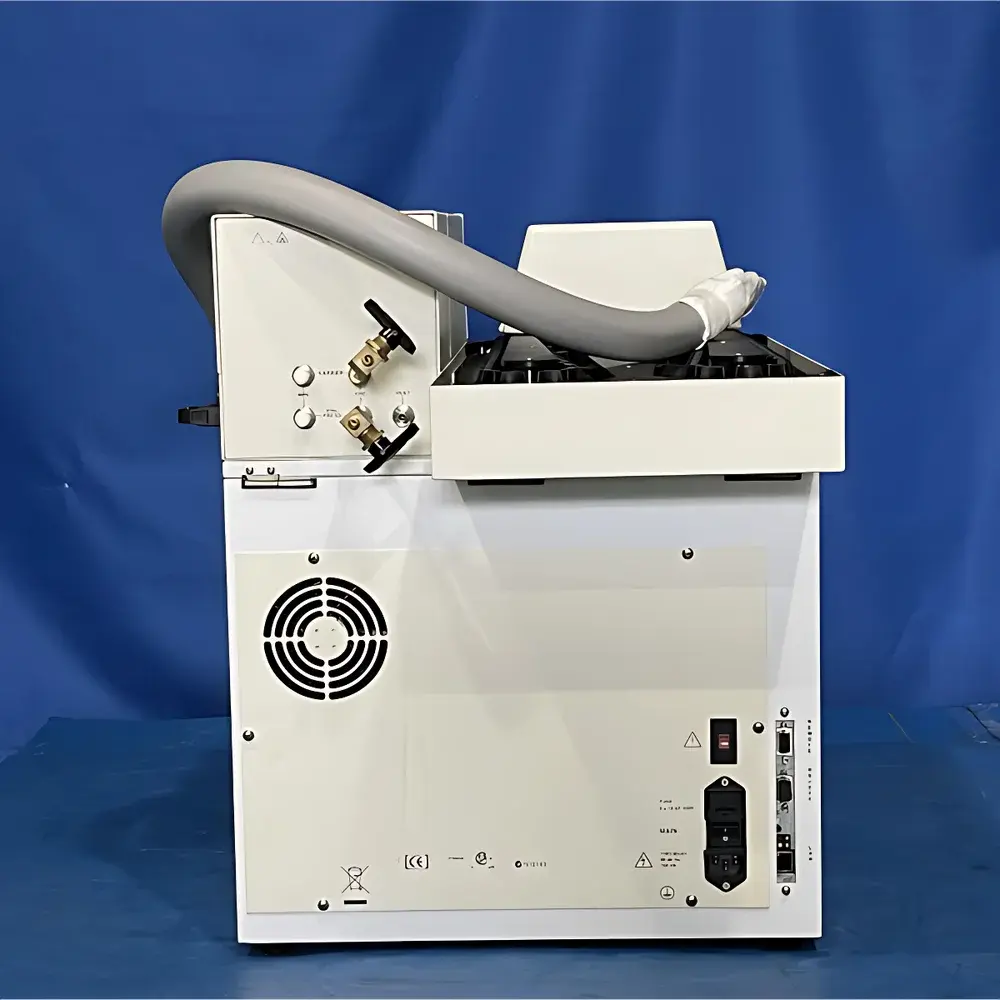
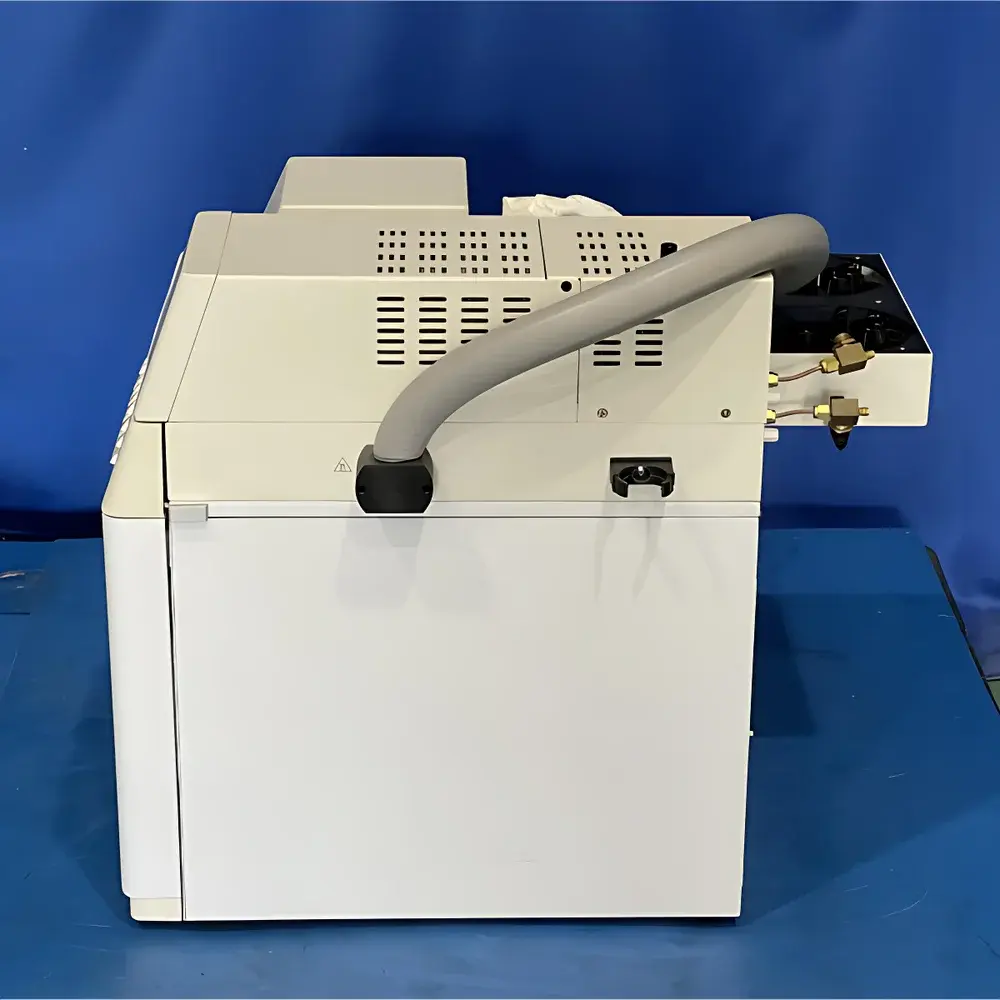
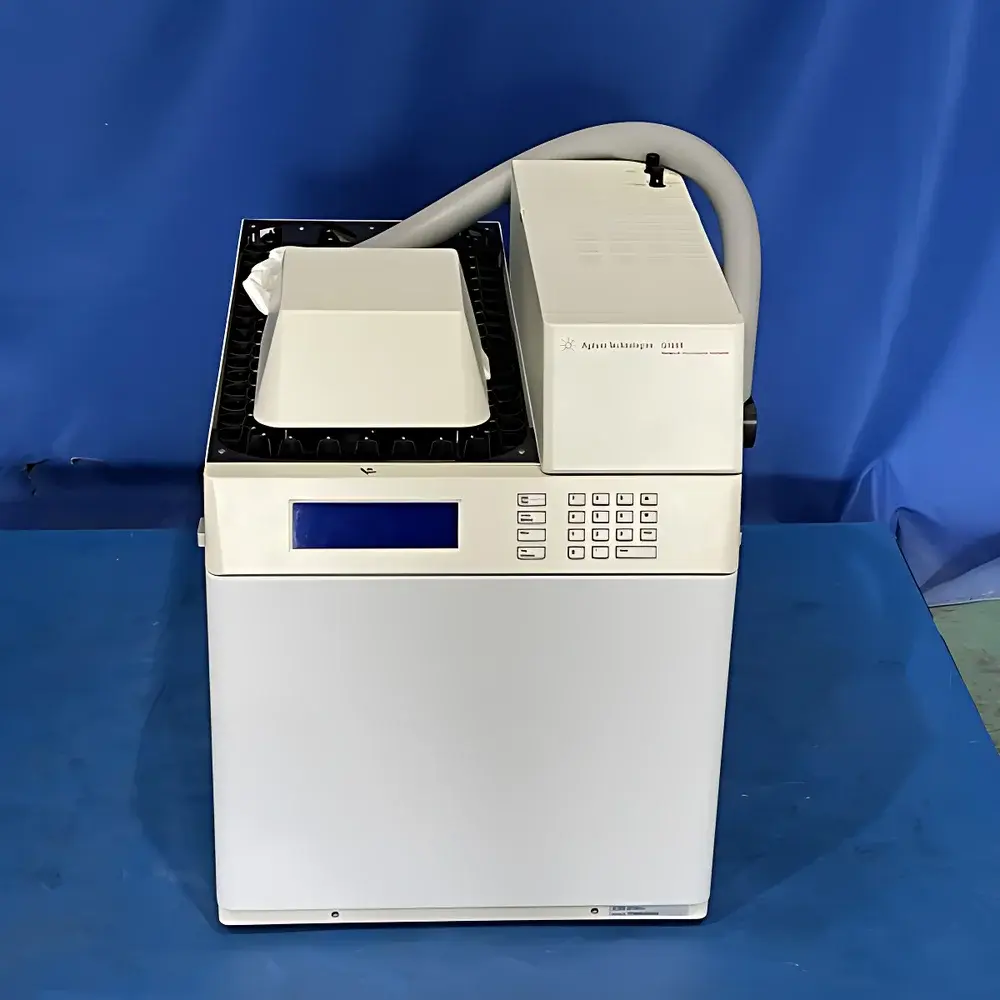
Agilent G1888 (70-Position) Used Headspace Sampler
| Brand | Agilent Technologies |
|---|---|
| Origin | USA |
| Model | G1888 (70-position) |
| Temperature Range | 40–230 °C |
| Sample Capacity | 70 vials |
| Heating Zones | 12 heated positions |
| Inert Flow Path | Standard deactivation from needle to transfer line |
| Compatibility | GC systems including Agilent 7890A and 6890N with inert volatile interface |
| MHE Modes | Concentration mode and multiple-puncture mode (up to 100 punctures per vial) |
| Software Control | GC ChemStation, MSD ChemStation (Enhanced & Security), Cerity NDS |
| Compliance Features | Supports audit trail, electronic signatures, and method validation workflows per FDA 21 CFR Part 11 and GLP/GMP requirements |
| Diagnostic Functions | Built-in power-on self-test, automated leak check, four preloaded chemical test methods |
Overview
The Agilent G1888 70-position headspace sampler is a precision-engineered, fully automated sample introduction system designed for quantitative volatile and semi-volatile organic compound analysis via gas chromatography (GC). Based on the principle of equilibrium headspace sampling—where analytes partition between a liquid or solid matrix and its overlying vapor phase—the G1888 enables reproducible, contamination-free transfer of headspace vapors into the GC inlet. Its architecture integrates thermally controlled vial incubation, precise syringe-based vapor extraction, and inert, deactivated transport pathways to minimize adsorption, degradation, or catalytic artifacts—critical for trace-level analysis of aldehydes, residual solvents, ethanol, environmental VOCs, and pharmaceutical impurities. As a factory-original Agilent instrument manufactured in the United States, the G1888 meets the mechanical and thermal specifications defined in Agilent’s original design documentation and supports full integration with Agilent GC platforms—including the 7890A and 6890N—when paired with the inert volatile interface kit.
Key Features
- 70-vial autosampler carousel with programmable tray rotation and barcode-ready positioning for high-throughput labs.
- Twelve independently controllable heated zones supporting simultaneous incubation of up to 12 vials at user-defined temperatures (40–230 °C), enabling gradient-based method development and overnight unattended operation.
- Standard deactivation of the entire vapor pathway—from the sampling needle through the transfer line—to ensure compatibility with reactive, polar, or thermally labile compounds such as formaldehyde, acetaldehyde, and low-molecular-weight amines.
- Dual-mode Multiple Headspace Extraction (MHE): concentration mode (sequential extractions from one vial, with cumulative quantitation) and multiple-puncture mode (up to 100 punctures per vial), essential for heterogeneous matrices like polymers, soils, or biological tissues.
- Thermal zone disable functionality allows ambient-temperature headspace analysis—ideal for thermolabile biologics, protein formulations, or live-cell extracts where heating would induce decomposition or volatilization artifacts.
- Integrated diagnostics suite including automatic leak detection, power-on self-test (POST), and four validated chemical test methods for routine performance verification.
Sample Compatibility & Compliance
The G1888 accommodates standard 10–22 mL headspace vials with crimp or screw caps and supports both aqueous and non-aqueous matrices—including pharmaceutical formulations, food homogenates, polymer extracts, wastewater, and soil slurries. Its temperature stability (±0.1 °C) and pressure-controlled vial pressurization ensure compliance with ASTM D7699, USP , ISO 11843, and ICH Q2(R2) guidelines for method validation. When operated under documented SOPs with Cerity NDS or ChemStation software configured for 21 CFR Part 11 compliance, the system supports audit trails, electronic signatures, and secure data archiving required for regulated QA/QC environments in pharmaceutical, clinical, and contract research laboratories.
Software & Data Management
Instrument control and sequence management are executed via Agilent’s native software ecosystem: GC ChemStation (for routine QC), MSD Enhanced ChemStation (for GC-MS workflows), MSD Security ChemStation (with role-based access and audit logging), or Cerity Network Data System (NDS) for enterprise-scale deployment in GxP settings. All software packages support method cloning, calibration curve generation, peak integration per USP/EP standards, and export of raw data in AIA (.cdf) format. Sequence files include embedded metadata (operator ID, timestamp, vial position, thermal profile), ensuring full traceability across analytical runs. Data integrity is reinforced by automatic backup, checksum validation, and write-protected archive directories.
Applications
- Residual solvent analysis in APIs and drug products per ICH Q3C guidelines.
- Alcohol quantification in beverages and forensic blood samples.
- VOC profiling in indoor air quality monitoring and environmental soil testing.
- Flavor and fragrance release kinetics in food packaging materials.
- Stability-indicating assays for oxidized lipids or degradants in biologics formulations.
- Quality control of monomer content in polymer manufacturing processes.
FAQ
Is this unit refurbished or certified pre-owned?
This G1888 is a professionally inspected, functionally verified used instrument. It undergoes full operational validation—including thermal accuracy verification, leak integrity testing, and sequence execution confirmation—prior to shipment. No factory refurbishment or warranty extension is included unless separately contracted.
Does it include the inert volatile interface for GC coupling?
The inert volatile interface is not bundled by default; it must be specified and sourced separately to achieve full system inertness when interfacing with Agilent 7890A or 6890N GCs.
Can it be integrated with third-party GC systems?
Yes—via analog or digital trigger signals—but full bidirectional communication, method synchronization, and status reporting are only guaranteed with Agilent GC platforms and native ChemStation/NDS software.
What documentation accompanies the instrument?
Shipment includes original Agilent hardware manuals, firmware version log, calibration verification report, and a certificate of operational testing. Regulatory documentation (e.g., IQ/OQ protocols) is available upon request and may require site-specific execution.
Is remote support available post-installation?
Basic troubleshooting guidance is provided via email or screen-sharing sessions. On-site technical support requires a separate service agreement and is subject to regional availability.
Related Products