
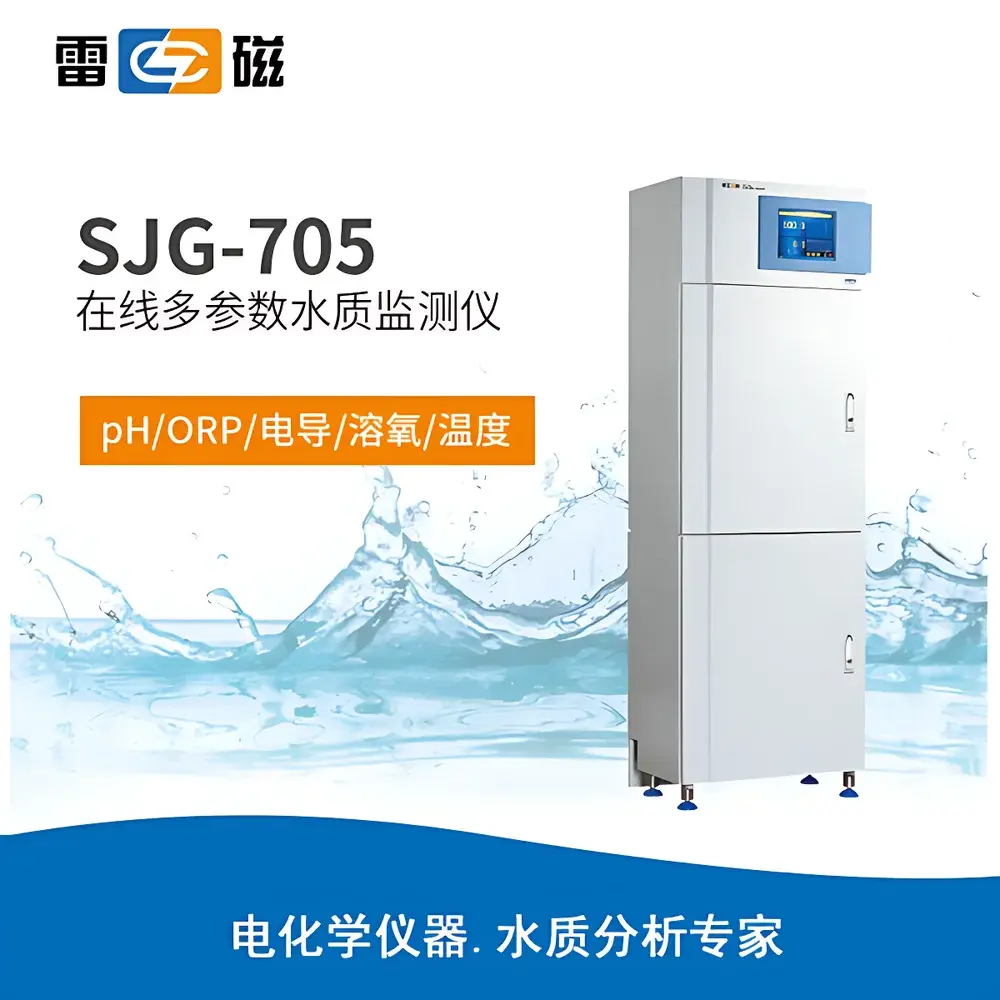
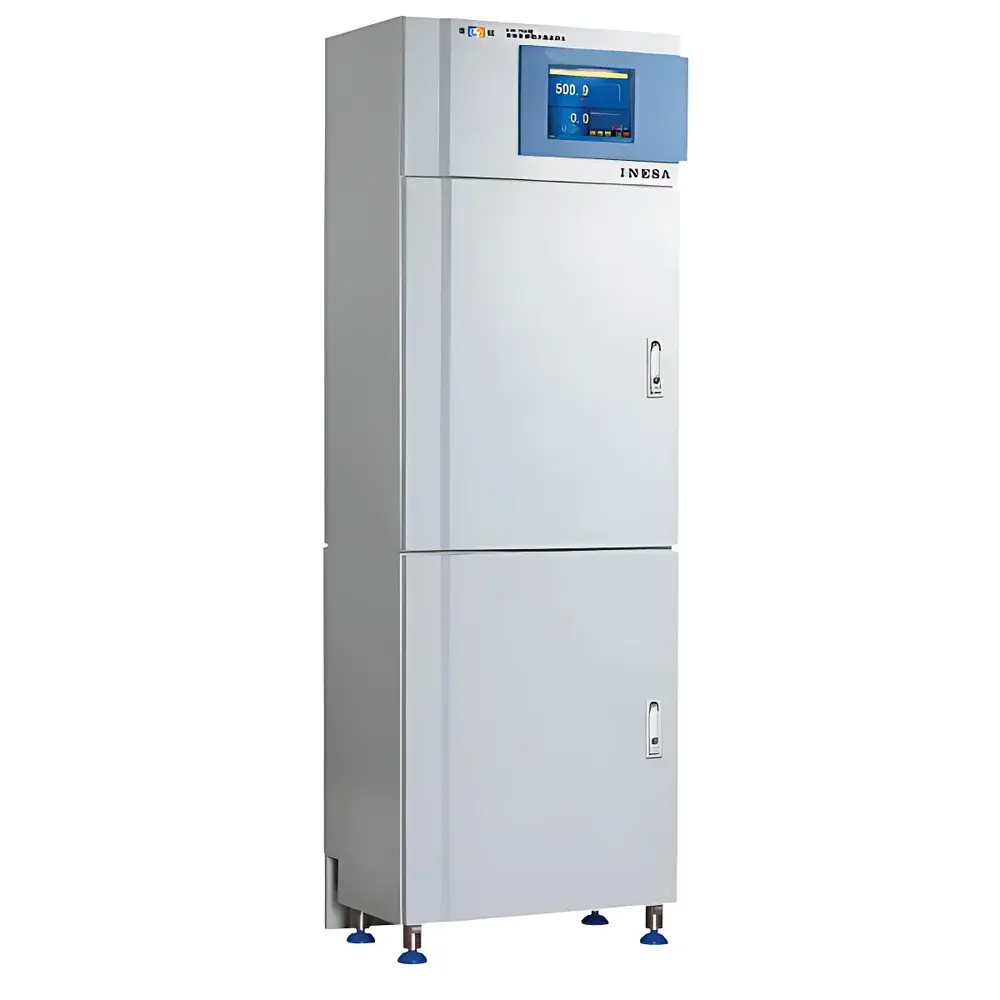
Leici SJG-705 Online Multi-Parameter Water Quality Monitor
| Brand | Leici |
|---|---|
| Origin | Shanghai, China |
| Model | SJG-705 |
| Instrument Type | Online |
| pH Range | 0.00–14.00 (Res: 0.01, Acc: ±0.05 pH ±1 digit) |
| ORP Range | ±1999 mV (Res: 1 mV, Acc: ±10 mV ±1 digit) |
| Conductivity | 0.000 µS/cm–19.9 mS/cm (Res: 0.1/1 µS/cm, 0.01 mS/cm |
| Acc | ±2.0% FS) |
| TDS | 0.000 mg/L–9.9 g/L (Res: 0.1 mg/L, 0.01 g/L) |
| Turbidity | 0.00–500.0 NTU (Res: 0.01 NTU, Acc: ±10%) |
| Dissolved Oxygen | 0.00–20.00 mg/L / 0.0–200.0% sat (Res: 0.01 mg/L, 0.1% |
| Acc | ±0.50 mg/L & ±10% sat) |
| Temperature | −10.0–120.0 °C (Res: 0.1 °C, Acc: ±0.5 °C ±1 digit @ 0–60 °C) |
| Communication | RS-232 / RS-485 / Ethernet (selectable) |
| Power | AC 220 V ±10%, 50 Hz |
| Dimensions | 560 × 400 × 1680 mm |
| Weight | 50 kg |
Overview
The Leici SJG-705 Online Multi-Parameter Water Quality Monitor is an industrial-grade, fixed-installation analyzer engineered for continuous, unattended measurement of five conventional water quality parameters—pH, oxidation-reduction potential (ORP), conductivity (and derived TDS), turbidity, and dissolved oxygen—alongside temperature compensation. Designed in accordance with core principles of electrochemical sensing, optical nephelometry, and thermal resistance measurement, the SJG-705 delivers stable, traceable data under variable hydraulic and environmental conditions typical of surface water bodies, groundwater abstraction points, drinking water distribution networks, wastewater treatment influent/effluent streams, aquaculture systems, and industrial process water loops. Its architecture complies with fundamental requirements for long-term field deployment, including IP65-rated front-panel ingress protection, robust internal thermal management, and dual-stage signal conditioning to minimize drift and noise interference.
Key Features
- Modular sensor architecture enabling flexible configuration: users may select and integrate individual probe modules (e.g., pH/ORP combo, conductivity/turbidity/D.O. tri-sensor) based on site-specific monitoring objectives and regulatory reporting needs.
- 7-inch full-color capacitive touchscreen display with intuitive Chinese-language UI—designed for rapid operator interaction without external PC dependency; supports real-time trend graphs, alarm status visualization, and on-device calibration prompts.
- Dual operational modes: continuous real-time acquisition (default) or programmable interval sampling (1 min to 24 h), configurable per parameter to balance data resolution with storage longevity.
- Integrated data logging system with non-volatile flash memory capable of storing ≥1 million timestamped records; automatic backup of calibration events, sensor diagnostics, and maintenance logs.
- Standardized communication interfaces: user-selectable RS-232, RS-485 (Modbus RTU), or Ethernet (TCP/IP + Modbus TCP), facilitating integration into SCADA, DCS, or centralized EMS platforms without protocol translation hardware.
- Optional automatic cleaning module compatible with ultrasonic vibration or mechanical wiper actuation—designed to maintain optical window clarity and electrode surface integrity in high-fouling environments such as algal blooms or suspended solids-rich effluents.
Sample Compatibility & Compliance
The SJG-705 is validated for use across natural and engineered aqueous matrices, including freshwater (rivers, lakes, reservoirs), groundwater (well outflows), potable water (post-chlorination, post-filtration), municipal and industrial wastewater (primary through tertiary stages), and recirculating aquaculture systems. It meets essential functional requirements outlined in ISO 5667-22 (water quality—sampling—guidance on field instrumentation), ASTM D1293 (pH of water), ASTM D3370 (conductivity), and EPA Method 180.1 (turbidity). While not certified to IEC 61508 or SIL-2 for safety-critical applications, its firmware implements watchdog timers, sensor self-diagnostics (open-circuit, short-circuit, response time verification), and configurable alarm thresholds aligned with GLP-aligned operational practices.
Software & Data Management
Data export is supported via USB mass storage mode (CSV format) or network transfer using FTP or HTTP POST. The embedded firmware includes audit-trail functionality: all configuration changes, calibration actions, and manual overrides are timestamped and attributed to operator ID (if enabled via optional LDAP integration). Remote firmware updates are performed over secure HTTPS with SHA-256 signature verification. For enterprise deployments, Leici provides optional LeiciLink™ software—a Windows-based desktop application supporting multi-station dashboarding, statistical process control (SPC) charting, automated report generation (PDF/Excel), and alignment with 21 CFR Part 11 requirements when deployed with digital certificate authentication and electronic signature workflows.
Applications
- Drinking water utilities: compliance monitoring at intake, treatment stages, and distribution points per national standards (e.g., China’s GB 5749-2022, US EPA Safe Drinking Water Act).
- Environmental agencies: long-term trend analysis of eutrophication indicators (D.O., turbidity, conductivity) in watershed management programs.
- Wastewater treatment plants: real-time feedback control of aeration basins (via D.O.) and coagulation dosing (via turbidity/pH).
- Aquaculture facilities: maintaining optimal dissolved oxygen and pH ranges to support fish health and feed conversion efficiency.
- Industrial cooling towers and boiler feedwater systems: early detection of scaling potential (via conductivity/TDS) and microbiological activity (via turbidity spikes).
FAQ
What is the recommended calibration frequency for the SJG-705 in continuous operation?
Calibration intervals depend on matrix fouling potential and regulatory requirements; typical practice is daily zero/span checks for turbidity and DO, weekly 2-point pH calibration, and monthly conductivity verification using NIST-traceable KCl standards.
Can the SJG-705 operate in sub-zero ambient temperatures?
The analyzer’s electronics cabinet is rated for −10 °C to 50 °C ambient; however, sensor probes require active thermal management below 0 °C—optional heated flow cells or insulated housing kits are available for freeze-prone installations.
Is Modbus TCP mapping documentation publicly available?
Yes—Leici publishes a complete register map (holding/input registers) and object dictionary for SJG-705 in English, including scaling factors, engineering units, and alarm bit definitions, accessible via registered download from Leici’s technical support portal.
Does the system support redundant power input or UPS handover?
The SJG-705 accepts single-phase AC input only; seamless transition during mains failure requires external uninterruptible power supply (UPS) with pure sine wave output and ≥10-minute hold-up time.
How is sensor drift compensated during extended unattended operation?
The firmware applies adaptive baseline correction algorithms for turbidity and DO sensors, and supports automatic temperature-compensated slope validation for pH and conductivity—triggered by scheduled or event-driven calibration routines.
Related Products







