
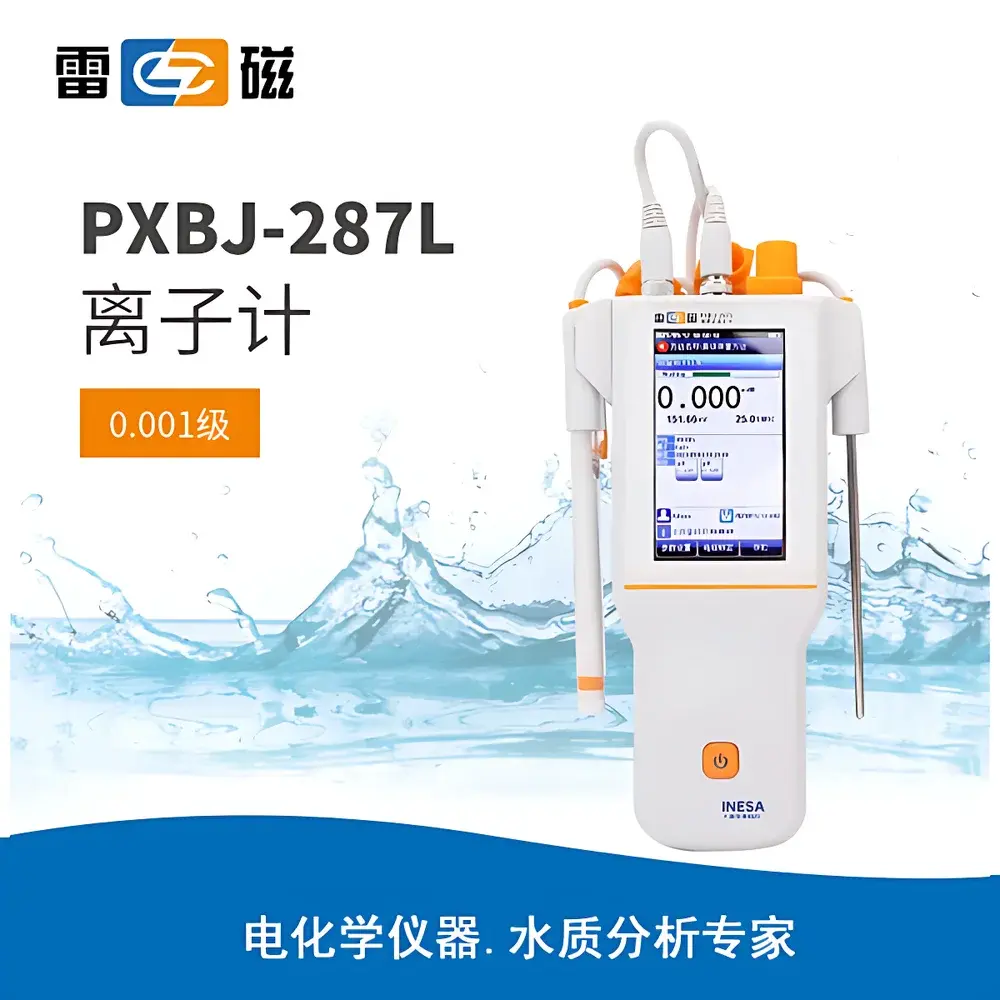
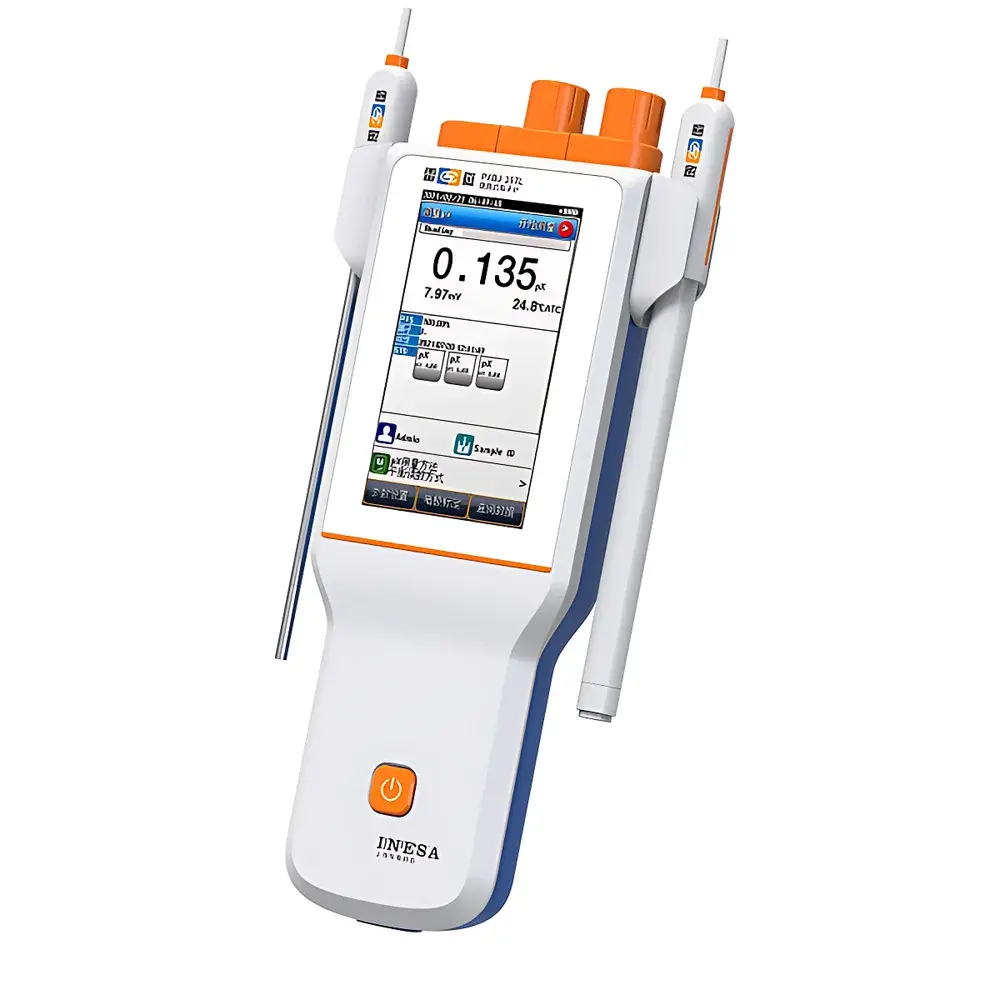
Leici PXBJ-287L Portable Ion Meter
| Brand | Leici |
|---|---|
| Origin | Shanghai, China |
| Model | PXBJ-287L |
| Instrument Type | Portable |
| Ion Measurement Range | (−2.000 to 20.000) pX |
| Resolution | 0.001 pX |
| Temperature Range | (−10.0 to 135.0) °C / (14.0 to 275.0) °F |
| pH Range | (−2.000 to 20.000) pH |
| mV Range | (−2000.00 to 2000.00) mV |
| Resolution (mV) | 0.01 mV |
| Accuracy (pH/pX) | ±0.002 pH/pX |
| Accuracy (mV) | ±0.03% or ±0.1 mV |
| Accuracy (Temperature) | ±0.1 °C |
| IP Rating | IP65 |
| Battery | Rechargeable Li-ion |
| Dimensions | 90 × 255 × 40 mm |
| Weight | 0.5 kg |
Overview
The Leici PXBJ-287L Portable Ion Meter is a high-precision, field-deployable electrochemical analyzer engineered for quantitative determination of specific ion activities in aqueous solutions using potentiometric measurement principles. Based on the Nernst equation, the instrument measures the potential difference between an ion-selective electrode (ISE) and a reference electrode, converting it into logarithmic concentration units (pX) with traceable accuracy. Designed for environmental monitoring, water quality assessment, and field-based regulatory compliance testing, the PXBJ-287L supports multi-ion analysis—including F⁻, Cl⁻, NH₄⁺, K⁺, and Na⁺—without requiring laboratory infrastructure. Its robust architecture, integrated temperature compensation, and dual-unit capability (°C/°F) ensure reliable operation across diverse climatic and logistical conditions—from municipal wastewater sampling to remote groundwater surveys.
Key Features
- High-resolution 4.3-inch color TFT touchscreen with intuitive icon-driven interface supporting both English and Chinese language modes
- Selectable resolution settings: 0.001/0.01/0.1 pX and 0.01/0.1/1 mV to match analytical rigor with workflow requirements
- IP65-rated enclosure for dust resistance and protection against low-pressure water jets—suitable for outdoor deployment and humid environments
- Intelligent endpoint detection with configurable reading modes: auto-read, timed read, interval read, and manual capture
- Comprehensive electrode management system including automatic ISE recognition, calibration history logging, and electrode health diagnostics
- Eight-point pX/pH calibration support with automatic buffer recognition for GB, DIN, NIST, USA, MERK, and JIS standard solutions
- Onboard firmware upgradability via USB or Bluetooth, enabling future protocol expansion and method customization
- Built-in rechargeable lithium-ion battery with real-time charge status indicator, low-voltage warning, and USB-C compatibility for power bank or PC charging
Sample Compatibility & Compliance
The PXBJ-287L is validated for direct measurement of liquid samples within the specified temperature range (−10.0 to 135.0 °C), accommodating raw surface water, treated effluent, drinking water, and industrial process streams. It accepts standard combination ISEs and single-ion electrodes compatible with Leici’s proprietary BNC and mini-DIN connectors. All measurement functions comply with ISO 10523 (water quality — determination of pH), ISO 10304-1 (determination of anions by ion chromatography—part 1: general principles), and ASTM D1293 (standard test methods for pH of water). Data integrity adheres to GLP (Good Laboratory Practice) and supports audit-ready documentation through timestamped calibration logs, user authentication, and electronic signature-capable data export. While not FDA 21 CFR Part 11–certified out-of-the-box, its password-protected user hierarchy (administrator/operator/analyst tiers) and immutable data storage provide foundational controls for regulated environments.
Software & Data Management
The instrument stores up to 1,000 complete measurement records—including sample ID, electrode type, calibration parameters, temperature, measured value, unit, operator ID, and timestamp—in non-volatile memory. Data export is supported via USB-A port (to PC using Leici’s dedicated communication software), micro-USB-to-UVC adapter (for U-disk read/write), or Bluetooth 4.2 BLE (to mobile devices or Windows/Linux hosts). Scanning gun integration enables rapid barcode-based sample identification. The embedded database supports statistical analysis (mean, SD, CV%), trend visualization, and customizable report generation. All data files are saved in CSV and XML formats compliant with LIMS interoperability standards. Firmware updates preserve existing calibration profiles and user-defined methods during installation.
Applications
- Field-based monitoring of fluoride in drinking water supplies per WHO guideline values (1.5 mg/L) and EPA Method 300.0
- Real-time chloride ion quantification in cooling tower water to assess corrosion risk under ASTM D4582
- Ammonium nitrogen tracking in wastewater influent and effluent for nutrient load modeling
- Soil leachate analysis for nitrate and potassium in agricultural runoff studies
- Calibration verification of online ISE sensors in municipal water treatment plants
- Educational use in university environmental chemistry labs for potentiometric titration and selectivity coefficient experiments
FAQ
Does the PXBJ-287L support GLP-compliant data handling?
Yes—it maintains full traceability with user login, calibration event logs, electronic timestamps, and immutable storage. Exported data includes metadata required for GLP audits.
Can custom ion modes be defined beyond the preloaded Na⁺, K⁺, and F⁻ options?
Yes. Users may configure new ion types by entering slope (mV/pX), detection limit, and selectivity coefficients via the method editor.
What is the expected battery life under continuous operation?
Approximately 100 hours at ambient temperature with backlight set to medium brightness and Bluetooth disabled.
Is temperature compensation fully automatic during ion measurements?
Yes—using either the built-in thermistor or an external Pt1000 sensor, with selectable linear or non-linear compensation models.
Are calibration solutions included with the standard kit?
Yes—the package includes fluorine ISE calibration standards (10⁻¹ to 10⁻⁵ mol/L), TISAB II buffer, and reference electrode filling solution.
Related Products







