
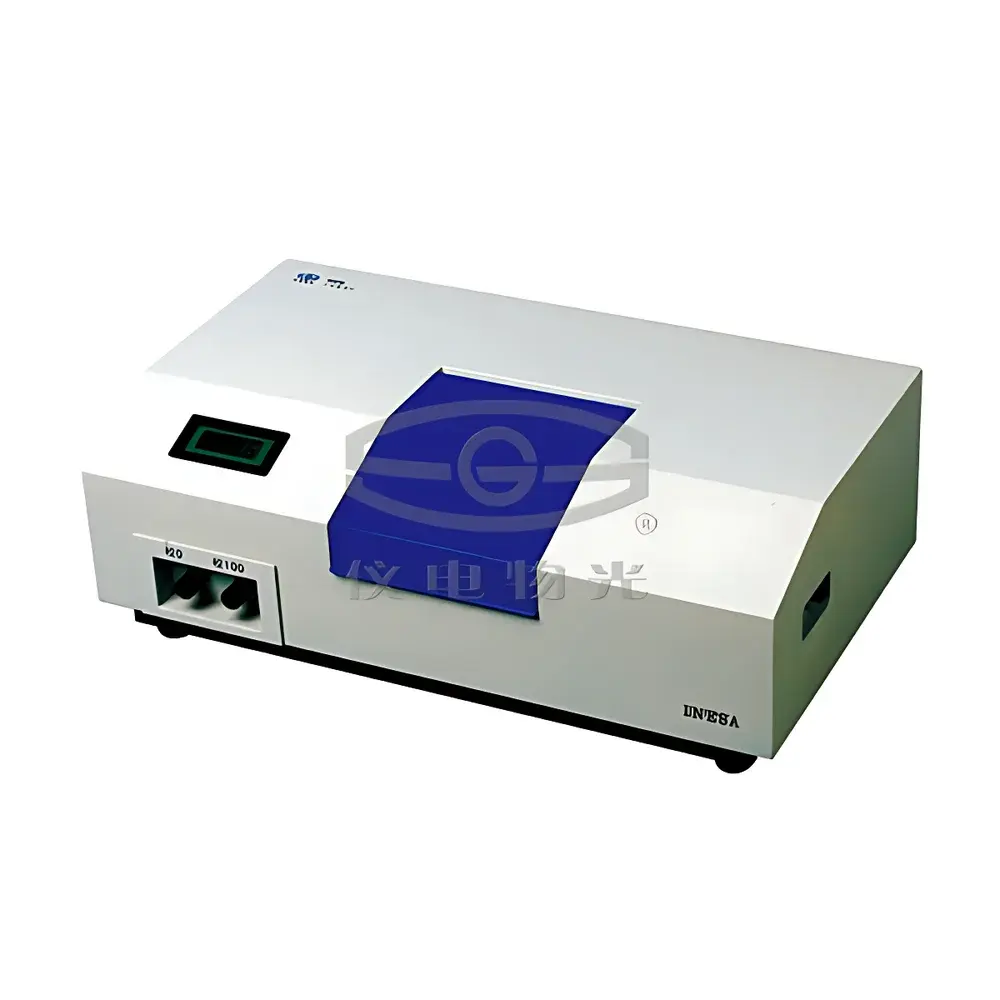
Yidian Wuguang WGW Photoelectric Haze Meter
| Brand | Yidian Wuguang (YDWG) |
|---|---|
| Origin | Shanghai, China |
| Model | WGW |
| Type | Manual Operation |
| Haze Range | 0–30% |
| Transmittance Range | 0–100% |
| Haze Repeatability | ≤0.2% |
| Transmittance Repeatability | ≤0.5% |
| Light Source | C-illuminant (6774 K) |
| Minimum Display Resolution | 0.1% (both haze and transmittance) |
| Accuracy | ±0.5% (haze), ±1.5% (transmittance) |
| Sample Chamber | Closed-type, 50 mm × 50 mm max sample size |
| Dimensions | 470 mm × 270 mm × 160 mm |
| Net Weight | 7 kg |
| Power Supply | 220 V ± 22 V, 50 Hz ± 1 Hz, 30 W |
| Display | LCD, 3½-digit |
Overview
The Yidian Wuguang WGW Photoelectric Haze Meter is a precision optical instrument engineered for the quantitative measurement of haze and total transmittance in transparent and semi-transparent planar materials—including plastic films, rigid plastics, glass substrates, and laminated sheets. It operates on the principle of collimated beam transmission and diffuse light scattering detection, conforming to the fundamental photometric definitions specified in ISO 14782, ASTM D1003–20, GB/T 2410–2008, and JIS K7105–1981. The instrument employs a standardized C-illuminant (6774 K color temperature) to ensure spectral consistency with daylight-weighted human visual response, enabling metrologically traceable comparisons across laboratories and production lines. Designed as a manual-operated benchtop system, the WGW delivers stable baseline performance for routine quality control in R&D labs, incoming inspection stations, and manufacturing QA environments where high-throughput automation is not required.
Key Features
- Compliant optical geometry per ASTM D1003 Annex A1 (integrating sphere configuration with defined port ratios and baffling to minimize stray light)
- Stable C-illuminant tungsten-halogen source with thermal regulation to maintain chromaticity stability over extended operation cycles
- Closed-sample chamber with precisely dimensioned 50 mm × 50 mm aperture, minimizing ambient light intrusion and ensuring repeatable sample positioning
- High-resolution 3½-digit LCD display with independent dual-channel readout for simultaneous haze (%) and transmittance (%) values
- Manual zero and calibration adjustment via front-panel controls—no software dependency or PC interface required
- Robust mechanical architecture with aluminum alloy housing and vibration-damped base, optimized for long-term dimensional stability in non-climate-controlled industrial settings
Sample Compatibility & Compliance
The WGW accommodates flat, parallel-faced specimens up to 50 mm × 50 mm in lateral dimension and ≤15 mm in thickness. It is validated for use with isotropic polymer films (e.g., PET, PP, PC), acrylic sheets, tempered glass, coated optical substrates, and laminated safety glazing. All measurement protocols align with regulatory test requirements under ISO 14782 (optical properties of plastics), ASTM D1003–20 (standard test method for haze and luminous transmittance), and Chinese national standard GB/T 2410–2008. While not equipped with electronic audit trail or user authentication, the instrument supports GLP-aligned documentation when paired with laboratory notebooks and controlled calibration logs. Its manual operation mode satisfies basic GMP-relevant verification workflows where electronic data integrity (e.g., FDA 21 CFR Part 11) is not mandated.
Software & Data Management
The WGW operates as a standalone hardware meter without embedded firmware-based data logging or USB/RS-232 connectivity. Measurement results are displayed in real time and must be manually recorded. For laboratories requiring digital traceability, integration with external data acquisition systems (e.g., LabVIEW, custom Excel macros, or LIMS platforms) is achievable via optional analog voltage output modules (not included). Calibration certificates—including reference standard traceability to NIM (National Institute of Metrology, China) or NIST-traceable secondary standards—can be supplied upon request. Instrument validation documentation (IQ/OQ templates) is available to support installation and operational qualification under ISO/IEC 17025 frameworks.
Applications
- Quality assurance of extruded and cast plastic films used in packaging, displays, and medical device barriers
- Batch-to-batch consistency evaluation of anti-glare and anti-fog coatings on automotive glazing
- Raw material screening of optical-grade polycarbonate and PMMA sheets prior to machining or thermoforming
- Process development monitoring during solvent casting, co-extrusion, or surface texturing of transparent polymers
- Educational demonstrations of light scattering theory, Beer–Lambert law deviations, and surface vs. bulk scattering contributions
- Regulatory submission support for ISO 10993-compliant biocompatibility testing of transparent implantable device housings
FAQ
What standards does the WGW comply with?
ASTM D1003–20, ISO 14782, GB/T 2410–2008, and JIS K7105–1981.
Can the WGW measure curved or non-planar samples?
No—it requires flat, parallel-faced specimens with uniform thickness; curvature introduces measurement bias due to beam divergence and internal reflection artifacts.
Is the C-illuminant source replaceable by the user?
Yes—the tungsten-halogen lamp is field-replaceable using manufacturer-specified part number YDWG-LAMP-C1; recalibration is recommended after lamp replacement.
Does the instrument include NIST-traceable calibration standards?
Standard delivery includes factory-calibrated reference tiles; NIST-traceable certified standards (e.g., haze 10%, 20%, transmittance 50%, 90%) are available as optional accessories.
What is the warm-up time before stable readings are achieved?
Minimum 30 minutes for thermal equilibrium of the optical path and detector electronics; optimal repeatability is attained after 45 minutes of continuous operation.






