
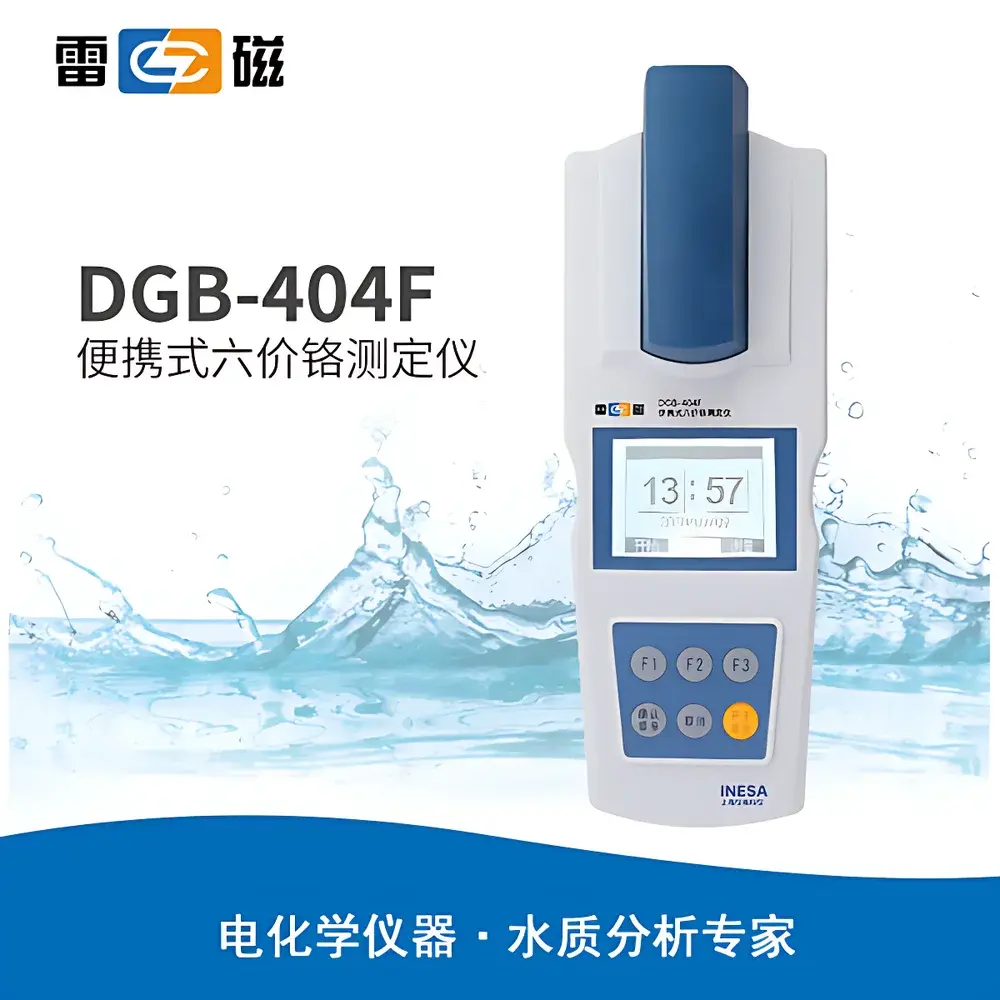
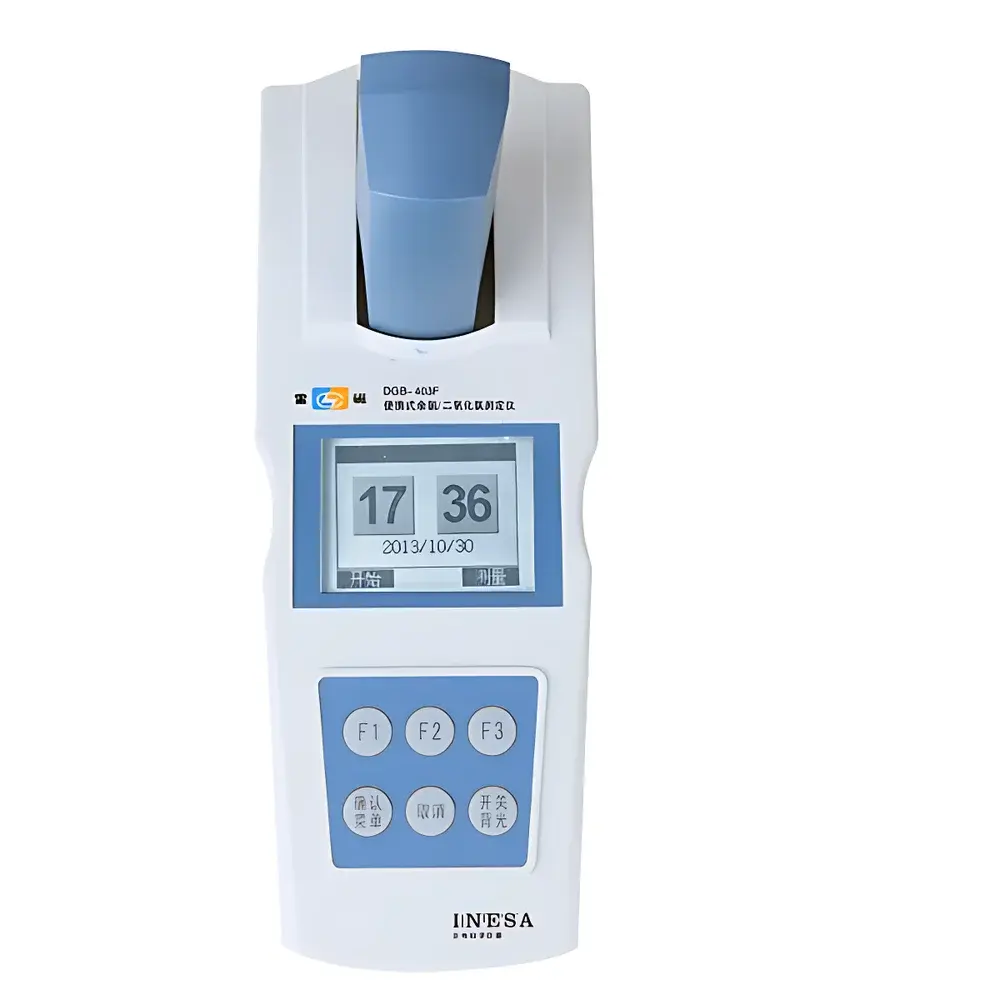
Leici DGB-404F Portable Hexavalent Chromium (Cr(VI)) Analyzer
| Brand | Leici |
|---|---|
| Origin | Shanghai, China |
| Model | DGB-404F |
| Instrument Type | Portable/Handheld Colorimetric Water Quality Analyzer |
| Measurement Principle | DPD (N,N-Diethyl-p-phenylenediamine) Colorimetric Method |
| Wavelength | 545 nm LED Source |
| Measurement Range | 0.00–2.00 mg/L Cr(VI) |
| Accuracy | ±0.05 mg/L (≤1 mg/L) |
| Detection Limit | ≤0.02 mg/L |
| Calibration Points | Up to 5-point user-defined calibration |
| Data Storage | 200 measurement records with timestamp, operator ID, and calibration metadata |
| Cuvette Format | 16 mm round glass or plastic tubes |
| Power Supply | 4 × AA alkaline batteries (1.5 V) or USB 5 V DC |
| IP Rating | IP65 |
| Dimensions (L×W×H) | 230 × 85 × 50 mm |
| Weight | ~0.4 kg |
| Compliance | Supports GLP data integrity requirements (audit trail-capable storage, user authentication via ID entry) |
Overview
The Leici DGB-404F Portable Hexavalent Chromium (Cr(VI)) Analyzer is a dedicated field-deployable photometric instrument engineered for rapid, on-site quantification of hexavalent chromium in aqueous matrices. It operates on the standardized DPD (N,N-diethyl-p-phenylenediamine) colorimetric method—fully aligned with GB/T 5750.6–2023 (Standard Methods for Examination of Drinking Water – Metals), HJ 694–2014 (Environmental Monitoring Technical Specification for Water and Wastewater – Determination of Arsenic, Selenium, Mercury, Bismuth, Antimony and Thallium by Hydride Generation-Atomic Fluorescence Spectrometry), and equivalent ISO 11969 and ASTM D515-22 protocols for Cr(VI) analysis. The system employs a stable, narrow-band 545 nm LED optical source coupled with a precision photodiode detector, eliminating drift associated with tungsten-halogen lamps and enabling high reproducibility across variable ambient conditions. Designed for regulatory-compliant monitoring, the DGB-404F delivers trace-level sensitivity (LOD ≤ 0.02 mg/L) and metrological traceability without requiring laboratory infrastructure.
Key Features
- Fixed-wavelength photometer optimized at 545 nm for maximum specificity to the DPD–Cr(VI) azo dye complex (ε ≈ 2.5 × 10⁴ L·mol⁻¹·cm⁻¹)
- Embedded low-power microcontroller architecture with graphical LCD interface, supporting real-time absorbance display, concentration readout, and status prompts in English
- Multi-point calibration capability (up to five standards) with linear and non-linear (quadratic) curve fitting; user-editable calibration parameters stored with date/time stamp
- GLP-compliant data management: each stored record includes sample ID, operator code, calibration ID, measurement time, ambient temperature (via internal sensor), and raw absorbance values
- Dual power operation: 4 × AA alkaline batteries (typical >10,000 measurements per set) or regulated 5 V USB power input; intelligent power management enables auto-shutdown of LED source after 2 min idle and full device sleep after 10 min
- Ruggedized housing rated IP65—dust-tight and protected against low-pressure water jets—validated for field use in wastewater treatment plants, industrial discharge points, and emergency response scenarios
- Firmware-upgradable architecture via USB connection; future protocol expansions (e.g., Cr(VI) speciation with masking agents, interference correction algorithms) supported through authenticated firmware updates
Sample Compatibility & Compliance
The DGB-404F is validated for direct analysis of unfiltered, clarified, or centrifuged samples from surface water, groundwater, municipal drinking water, swimming pool water, aquaculture effluent, and industrial process streams. Sample pretreatment follows standard EPA Method 7196A and ISO 11969:2018 guidelines—including pH adjustment to 1.8–2.2 with sulfuric acid, addition of DPD reagent under controlled timing (≤30 s), and immediate measurement within 2 minutes post-reaction. Interference mitigation is achieved via built-in correction logic for common ions (e.g., Fe³⁺, Mn²⁺, NO₂⁻) when used with optional reagent kits. Data output meets GLP documentation requirements, including electronic signatures (via operator ID entry), immutable timestamps, and exportable CSV files compatible with LIMS integration. While not FDA 21 CFR Part 11-certified out-of-the-box, audit-trail functionality satisfies preliminary GMP-aligned environmental QA/QC workflows.
Software & Data Management
USB connectivity enables bidirectional communication with Windows-based desktop software (Leici DataLink v3.x, included). The software supports batch download of all 200 stored records, spectral review of calibration curves, outlier flagging based on residual error thresholds, and PDF report generation compliant with ISO/IEC 17025 clause 7.8. All exported datasets contain embedded metadata required for chain-of-custody documentation. No cloud dependency or vendor-hosted platform is required—data remains fully resident on the user’s local system. Firmware updates are delivered as signed binary packages with SHA-256 checksum verification.
Applications
- Regulatory compliance monitoring for Cr(VI) discharge limits per China’s GB 8978–1996 and EU REACH Annex XVII
- Drinking water safety verification in rural distribution networks and emergency response (e.g., post-industrial spill events)
- Process control in electroplating, leather tanning, and pigment manufacturing facilities
- Environmental impact assessment (EIA) field screening during site investigations
- Educational laboratories requiring robust, low-maintenance instrumentation for undergraduate water chemistry modules
FAQ
What sample volume is required for one measurement?
A minimum of 10 mL of well-mixed sample is recommended; 16 mm diameter cuvettes accommodate standard 10–15 mL volumes.
Can the instrument measure total chromium, or only Cr(VI)?
The DGB-404F measures only hexavalent chromium via selective DPD oxidation; total chromium requires separate digestion and reduction steps not supported by this platform.
Is reagent blank subtraction automated?
Yes—the instrument performs automatic zeroing using a reagent-only blank prior to sample measurement, and stores blank absorbance values for traceability.
Does it support external barcode scanning for sample ID entry?
No native barcode scanner interface is integrated; sample IDs must be entered manually or imported via CSV during PC synchronization.
How often does the LED light source require recalibration or replacement?
The 545 nm LED is rated for >100,000 hours of operation; no routine recalibration is needed—only periodic verification using NIST-traceable Cr(VI) standards every 6 months or per internal QA schedule.
Related Products







