
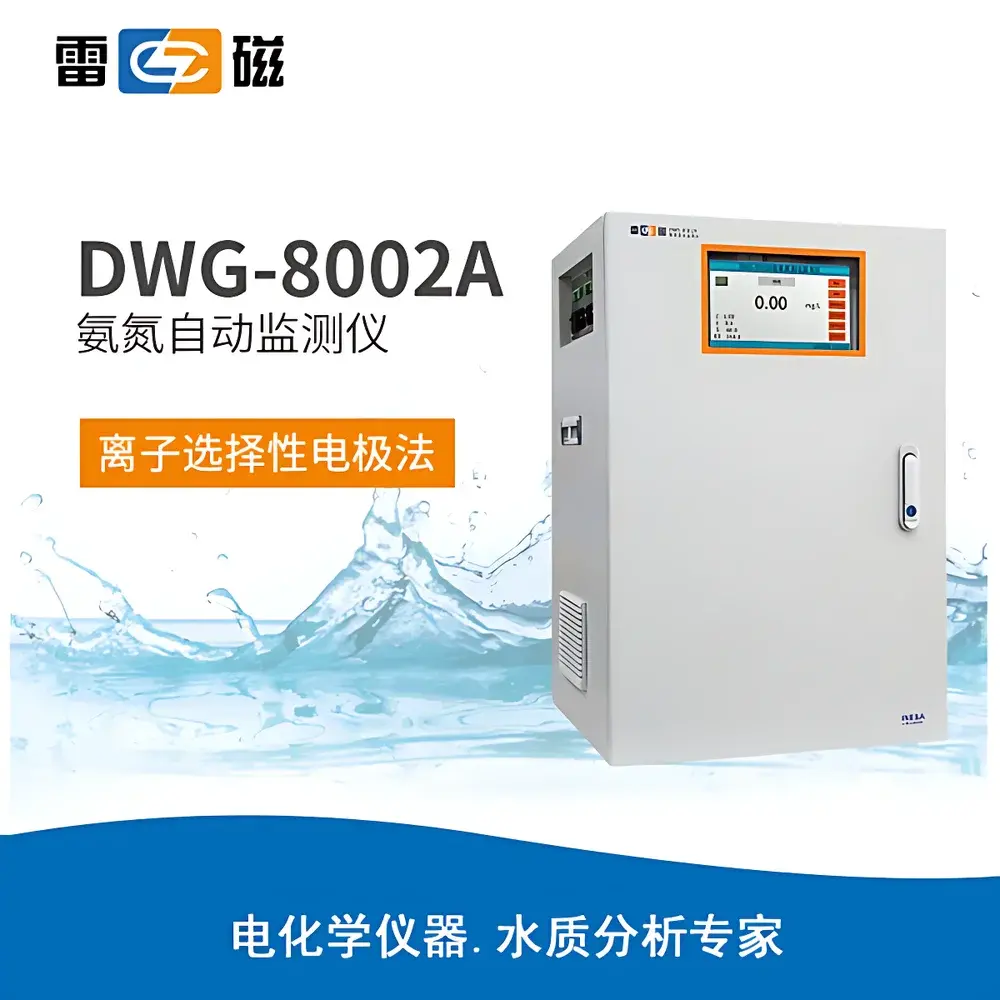
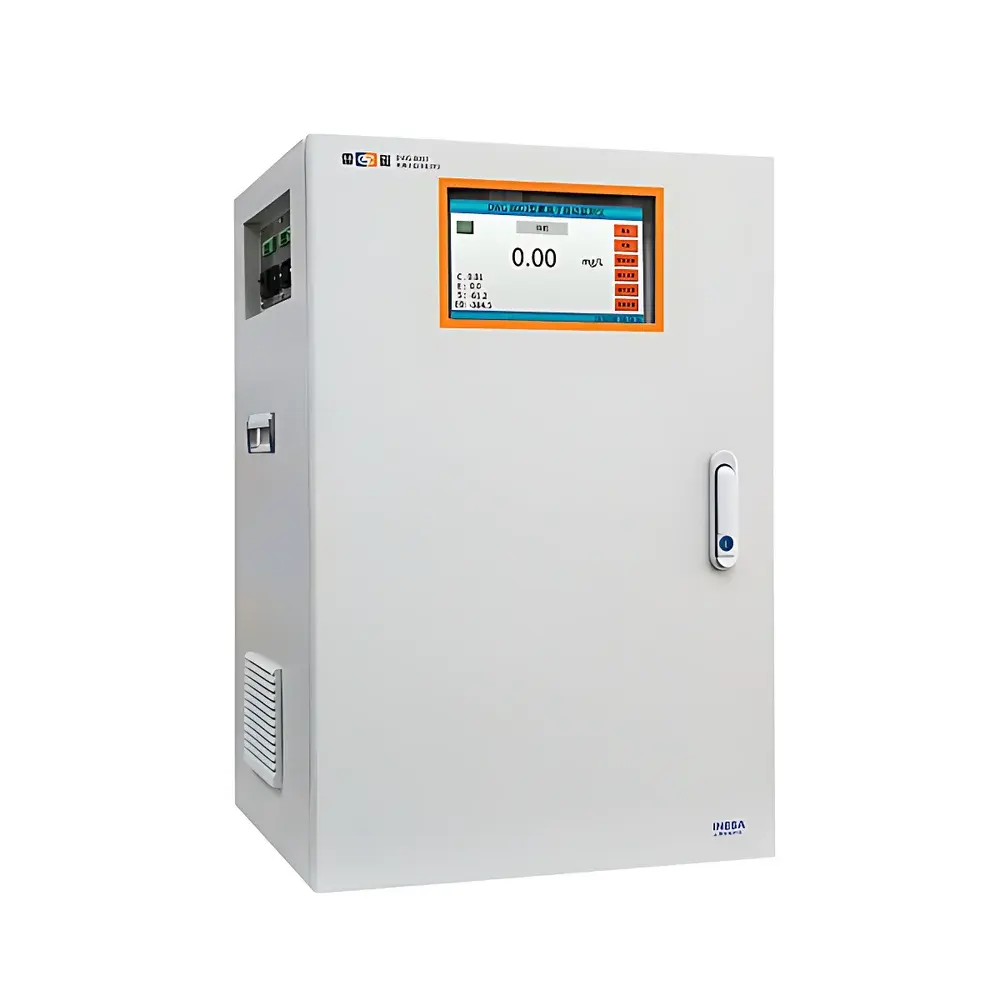
Leici DWG-8002A Ammonia Nitrogen Online Analyzer
| Brand | Leici |
|---|---|
| Origin | Shanghai, China |
| Model | DWG-8002A |
| Instrument Type | Online Analyzer |
| Measurement Principle | Ammonia Gas-Sensing Electrode Method |
| Measurement Range | 0.05–1000.00 mg/L NH₃–N |
| Accuracy | ±0.2 mg/L (≤2.00 mg/L) |
| Repeatability | ≤2.0% (0.10–10.00 mg/L), ≤5.0% (10.00–1000.00 mg/L) |
| Drift (24 h) | ≤0.02 mg/L (low range), ≤2% (high range) |
| Minimum Detection Limit | ≤0.15 mg/L |
| Output Signal | Isolated 4–20 mA DC (max load 600 Ω), RS-485 |
| Data Storage | 4000 measurement records + 500 calibration logs |
| Power Supply | AC 220 V ±10%, 50 Hz |
| Dimensions | 470 × 325 × 700 mm (L×W×H) |
| Weight | ~32 kg (dry) |
Overview
The Leici DWG-8002A Ammonia Nitrogen Online Analyzer is an industrial-grade, continuous monitoring system engineered for reliable, reagent-free quantification of ammonia nitrogen (NH₃–N) in aqueous matrices. It operates on the selective potentiometric principle using a solid-state ammonia gas-sensing electrode—eliminating dependence on hazardous reagents such as Nessler’s reagent or mercury-containing compounds. This electrochemical detection method leverages the diffusion of dissolved ammonia across a hydrophobic membrane into a pH-buffered internal electrolyte, where a pH-sensitive glass electrode measures the resulting pH shift proportional to NH₃ concentration. Designed for unattended operation in demanding environmental and municipal settings, the DWG-8002A meets the stringent performance requirements of China’s HJ/T 101–2019 standard for online ammonia nitrogen analyzers and supports long-term stability with minimal maintenance intervals (≥168 hours between service cycles).
Key Features
- Compliance with HJ/T 101–2019: Fully validated against China’s national technical specification for ammonia nitrogen online analyzers—including accuracy, drift, repeatability, memory effect, and data validity rate (≥90%).
- Reagent-Free Operation: Eliminates handling, storage, and disposal risks associated with mercury-based colorimetric methods; reduces operational cost and regulatory burden.
- Multi-Range Adaptive Measurement: Three programmable ranges—Basic (0.10–10.00 mg/L), Extended I (10.00–150.00 mg/L), and Extended II (150.00–1000.00 mg/L)—enable high-resolution low-concentration detection and robust high-range linearity.
- Intelligent Onboard Management: Automatic electrode cleaning, multi-point calibration, blank potential tracking, slope verification, and scheduled standard checks ensure metrological traceability without manual intervention.
- Industrial-Grade I/O Architecture: Isolated 4–20 mA analog output (configurable upper/lower limits), RS-485 Modbus RTU interface, and dual relay outputs (2.5 A / 250 V AC) support integration into SCADA, DCS, and PLC systems.
- Robust Environmental Resilience: Rated for ambient temperatures from 0–40 °C and relative humidity ≤90% RH; wall-mount or freestanding installation; IP54-rated enclosure for indoor deployment in pump stations, treatment plants, and monitoring kiosks.
Sample Compatibility & Compliance
The DWG-8002A is optimized for real-world water samples across diverse regulatory and operational contexts. It accepts influent and effluent streams with pH 5–9, flow rates of 5–10 m³/h, and inlet pressure <0.05 MPa. Its electrochemical sensor demonstrates low cross-sensitivity to common interferents including chloride (<5000 mg/L), sodium (<2000 mg/L), and calcium (<500 mg/L), with documented pH influence ≤±6% and temperature influence ≤±5% over its operating range. The analyzer satisfies data integrity requirements aligned with GLP principles: all measurements, calibrations, alarms, and system events are time-stamped and stored locally with non-volatile memory. While not FDA 21 CFR Part 11–certified out-of-the-box, its audit trail structure (including operator ID, action type, timestamp, and pre/post-values) provides foundational support for regulated water quality reporting under ISO/IEC 17025 or local environmental authority mandates.
Software & Data Management
The DWG-8002A features an embedded Linux-based controller with a 7-inch full-color capacitive touchscreen running a localized Chinese GUI—designed for intuitive navigation by field technicians and plant operators. All operational parameters—including sampling interval (user-defined), calibration frequency, alarm thresholds, and data logging duration—are configurable via the interface. Measurement data (up to 4000 records) and calibration logs (500 entries) are retained with automatic overwrite protection and timestamped metadata. Export options include USB flash drive dump (CSV format) and real-time streaming via RS-485 to central data acquisition systems. Built-in diagnostics monitor electrode response time, membrane integrity, and electrolyte depletion; predictive alerts notify users of impending maintenance needs before performance degradation affects data validity. The system retains configuration and last valid reading during power loss, resuming operation automatically upon restoration per IEC 61000-4-29 compliance.
Applications
- Surface Water & Drinking Water Sources: Continuous surveillance of rivers, lakes, reservoirs, and intake points to detect agricultural runoff or wastewater intrusion.
- Drinking Water Distribution Systems: Monitoring for nitrification-related ammonia spikes post-chloramination, supporting disinfection by-product control strategies.
- Aquaculture & Hatchery Operations: Real-time feedback for biofilter management in recirculating aquaculture systems (RAS), where sub-ppm NH₃–N fluctuations directly impact fish health.
- Municipal Wastewater Treatment Plants: Process control at bioreactor inlets/outlets, tertiary polishing stages, and discharge compliance verification—particularly under China’s GB 18918–2002 Class I-A effluent limits.
- Industrial Effluent Monitoring: Regulatory reporting for fertilizer plants, food processing facilities, petrochemical refineries, and pharmaceutical manufacturing sites subject to local discharge permits.
FAQ
What measurement principle does the DWG-8002A use, and why is it preferred over colorimetric methods?
It employs a potentiometric ammonia gas-sensing electrode. Unlike Nessler-based assays, it avoids mercury toxicity, reagent instability, and spectral interferences—delivering stable baseline performance in turbid or colored waters.
Can the analyzer operate continuously without manual intervention?
Yes. With automatic cleaning, calibration, and error recovery functions, it supports ≥168-hour maintenance-free operation—typically one 30-minute service cycle per month.
How is data integrity ensured during power failure or communication outage?
All measurements and events are written to non-volatile memory prior to transmission; the system retains configuration, last valid reading, and clock synchronization after reboot.
Does the DWG-8002A support remote diagnostics or cloud connectivity?
It provides native RS-485 Modbus RTU for integration with third-party telemetry gateways; cloud upload requires external edge device or SCADA middleware.
Is the instrument suitable for seawater or high-salinity brackish water applications?
While validated for freshwater and secondary-treated effluents, extended exposure to salinity >10,000 µS/cm may accelerate electrode drift; optional salinity compensation firmware or dedicated marine-grade electrode modules are recommended for such use cases.







