
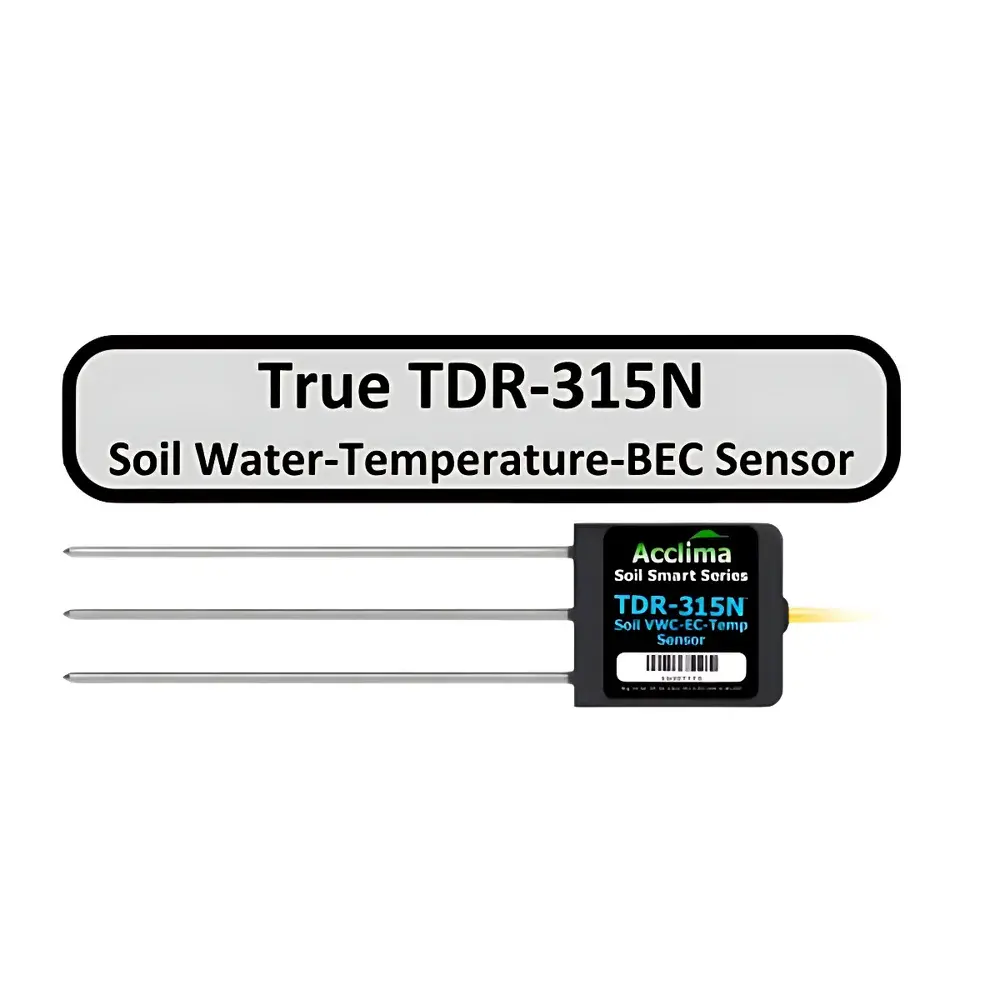
Acclima TDR-315N Integrated Soil Moisture, Temperature, and Electrical Conductivity Sensor
| Brand | Acclima |
|---|---|
| Origin | USA |
| Model | TDR-315N |
| Measurement Principle | Time-Domain Reflectometry (TDR) |
| Output Interface | SDI-12 |
| Probe Length | 15 cm |
| Waveform Rise Time (20–80%) | 300 ps |
| Timebase Resolution | 5 ps |
| Incident Pulse Amplitude | 2.3 V |
| Volumetric Water Content Range | 0–100% VWC |
| VWC Accuracy | ±2% FS |
| Dielectric Constant Range | 1–100 |
| EC Range (Bulk) | 0–6000 µS/cm |
| EC Accuracy | ±25 µS/cm (0–1000 µS/cm), ±2.5% (1000–2000 µS/cm), ±5% (2000–5000 µS/cm) |
| Temperature Range | −40 to +60 °C |
| Temp Accuracy | ±0.25 °C (5–35 °C), ±0.5 °C (−15 to +50 °C) |
| Housing | Waterproof Epoxy-Filled Enclosure |
| Cable | 5 m, 3-conductor, IP68-rated |
| Power Supply | 6.5–15 V DC |
| Quiescent Current | 10 µA |
| Active Current | 118 mA @ 12 V DC |
| Dimensions (Sensor Body) | 210 × 53 × 20 mm |
| Probe Diameter | 3.5 mm |
| Mass (Sensor Only) | 105 g |
Overview
The Acclima TDR-315N is a fully integrated, high-fidelity time-domain reflectometry (TDR) sensor engineered for simultaneous, in-situ measurement of volumetric water content (VWC), bulk electrical conductivity (EC), and soil temperature. Unlike conventional capacitance-based or single-parameter probes, the TDR-315N generates and digitizes ultrafast electromagnetic pulses—featuring a 300 ps rise time and 5 ps timebase resolution—to resolve the complete dielectric waveform propagating through soil. This enables true time-domain analysis of signal reflection, transmission, and attenuation, supporting robust quantification of soil dielectric permittivity (εr = 1–100), from which VWC is derived using established calibration models (e.g., Topp equation, Hilhorst correction). Its advanced firmware implements real-time waveform deconvolution and noise suppression algorithms, ensuring high reproducibility (<0.07% RMS deviation for VWC and εr) across diverse mineral soil textures—including clay-rich, saline, and low-permittivity substrates—where traditional TDR sensors often exhibit signal distortion or measurement saturation.
Key Features
- True TDR architecture with integrated 2.3 V incident pulse generation and high-speed waveform digitization (5 ps resolution)
- Three-element, 15 cm stainless-steel waveguide optimized for shallow horizontal installation (e.g., in root zones, turf, or layered soil profiles)
- SDI-12 digital interface compliant with ANSI/TIA-568 and ISO/IEC 11801 standards—enabling direct integration into industry-standard environmental data loggers (e.g., Campbell Scientific CR1000X, Onset HOBO RX3000)
- Waterproof epoxy-filled housing rated IP68, validated for continuous burial in saturated, freeze-thaw, and chemically aggressive soils
- Low-power design: 10 µA quiescent current; 118 mA peak draw only during active measurement cycles (typ. <100 ms duration)
- Simultaneous output of calibrated VWC (%), bulk EC (µS/cm), pore-water EC (µS/cm, via Hilhorst model), dielectric constant (εr), and temperature (°C) over a single SDI-12 command sequence
Sample Compatibility & Compliance
The TDR-315N is validated for use in all common mineral soils—including sand, loam, silt, clay, and volcanic ash—without field recalibration. Its high-voltage pulse output ensures reliable waveform capture in soils with elevated salinity (up to 3000 µS/cm bulk EC), where lower-energy TDR systems fail to resolve reflection endpoints. The sensor complies with ASTM D5778 (Standard Test Method for Electronic Friction Cone and Piezocone Penetration Testing), supports GLP-aligned data integrity through deterministic SDI-12 timing and CRC-checked command-response protocols, and meets IEC 61326-1 requirements for electromagnetic compatibility in industrial environments. It is routinely deployed in USDA ARS long-term soil moisture networks, NSF-funded biogeochemical flux studies, and EPA-regulated landfill cover monitoring programs.
Software & Data Management
Data acquisition is natively supported via Acclima’s free SoilSmart™ Desktop Utility (Windows/macOS) and third-party platforms including LoggerNet (Campbell Scientific), ShortCut (Onset), and custom Python-based DAQ systems leveraging PySDI12. All measurements include embedded timestamping, sensor serial identification, and diagnostic flags (e.g., waveform SNR, cable impedance match status). Raw waveform data (optional export) enables post-acquisition reprocessing using TDR-specific algorithms (e.g., leading-edge detection, travel-time fitting, dispersion correction). The sensor does not require proprietary cloud services or subscription licensing—data remains under full user control and is compatible with FAIR data principles (Findable, Accessible, Interoperable, Reusable).
Applications
- Long-term agricultural irrigation scheduling and deficit irrigation optimization
- Soil carbon flux modeling requiring high-temporal-resolution VWC and temperature co-variates
- Landfill leachate plume tracking via spatial EC gradients
- Ecological research on plant–soil–atmosphere continuum dynamics
- Calibration and validation of satellite-based soil moisture products (e.g., SMAP, Sentinel-1)
- Urban green infrastructure performance assessment (bioswales, rain gardens, green roofs)
FAQ
What distinguishes the TDR-315N from capacitance-based soil moisture sensors?
Unlike capacitance sensors—which infer VWC from frequency shifts in an oscillating circuit and suffer from salinity-induced drift—the TDR-315N directly measures electromagnetic wave propagation velocity and attenuation, providing physics-based, salinity-resistant VWC estimation.
Can the TDR-315N be used in frozen soil?
Yes. Its wide operating temperature range (−40 to +60 °C) and robust epoxy encapsulation allow deployment in seasonally frozen ground; however, VWC interpretation below 0 °C requires phase-state-aware dielectric mixing models.
Is SDI-12 addressing supported?
Yes. The sensor supports standard SDI-12 address assignment (0–99) and responds to multi-sensor polling commands without external multiplexers.
How is pore-water EC calculated?
Using the Hilhorst model, which relates bulk EC and dielectric permittivity to estimate pore-water conductivity—critical for salinity stress assessment in agronomic and ecological applications.
What cable length options are available beyond the standard 5 m?
Custom lengths up to 100 m are available; for >10 m installations, twisted-pair shielded cable and termination resistors are recommended to maintain signal fidelity.







