
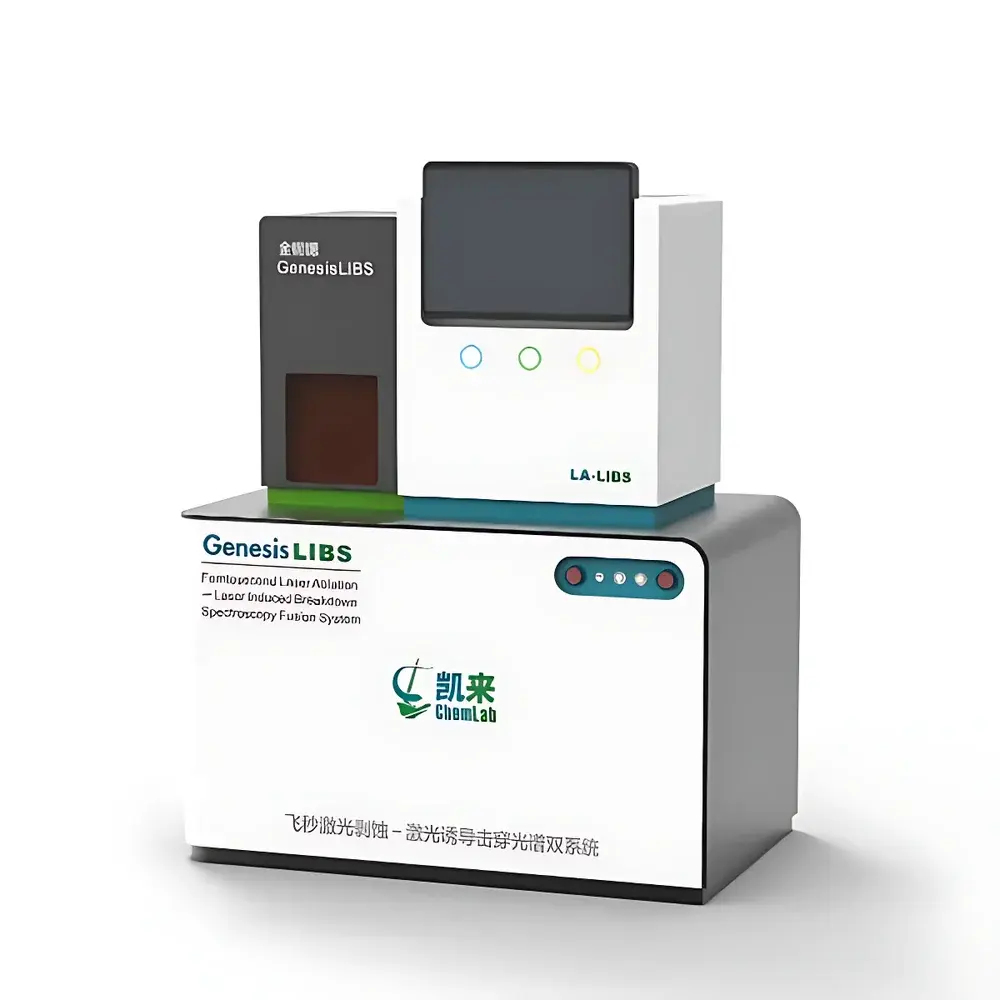
Shanghai Chemlab GenesisLIBS Dual-Mode Femtosecond Laser Ablation – Laser Induced Breakdown Spectroscopy System
| Brand | Chemlab |
|---|---|
| Origin | Shanghai, China |
| Manufacturer Type | Original Equipment Manufacturer (OEM) |
| Regional Classification | Domestic (PRC) |
| Model | GenesisLIBS |
| Instrument Type | Benchtop |
| Integration Level | Fully Integrated System |
| Price Range | USD 840,000 – 980,000 (based on current exchange rate) |
Overview
The Shanghai Chemlab GenesisLIBS is a benchtop dual-mode analytical platform that unifies femtosecond laser ablation (LA) and laser-induced breakdown spectroscopy (LIBS) within a single, co-axial optical architecture. Engineered for high-fidelity microanalysis, it leverages ultrafast 343 nm laser pulses—tunable from 350 fs to 1 ps (upgradable to 1 ns)—to achieve cold ablation with minimal thermal diffusion, suppressed plasma shielding, and negligible heat-affected zones. Unlike conventional nanosecond-LIBS systems, GenesisLIBS captures the full temporal evolution of laser-generated plasma via synchronized picosecond-gated detection and high-resolution echelle spectrometry, enabling direct correlation between ablation dynamics and spectral emission. This physical synergy allows simultaneous acquisition of LA-derived aerosol for downstream mass spectrometry (e.g., ICP-MS coupling) and LIBS-emitted photons for real-time elemental fingerprinting—covering the full periodic table, including light elements (Li, Be, B, C, N, O, F) and volatile species traditionally inaccessible to LA-ICP-MS alone.
Key Features
- Femtosecond dual-pulse architecture: Single laser source serves both ablation and plasma excitation functions, eliminating inter-system timing drift and hardware redundancy.
- Matrix-independent quantification: Combined temporal plasma stabilization (via MHz–GHz burst mode) and spatially resolved point-matrix scanning mitigate self-absorption, plasma temperature fluctuations, and substrate-dependent fractionation—reducing quantitative RSD to <5% across heterogeneous samples.
- Sub-micron spatial resolution: Motorized beam-shaping optics enable continuous spot-size tuning from 1 µm to 500 µm; sub-1 µm effective resolution achieved under optimized vacuum/ambient gas conditions.
- Integrated echelle spectrometer with intensified sCMOS detector: High-throughput optical path delivers broad spectral coverage (190–900 nm), single-photon sensitivity, and >10⁵ dynamic range per acquisition.
- No external dust removal required: Cold femtosecond ablation produces monodisperse, non-agglomerated aerosols compatible with direct transport to ICP-MS or time-of-flight mass analyzers—extending chamber mirror lifetime and reducing maintenance intervals.
- Unified control software: Single GUI manages laser parameters, stage motion, spectral acquisition, and data fusion algorithms—ensuring traceable, audit-ready workflows compliant with GLP/GMP documentation standards.
Sample Compatibility & Compliance
GenesisLIBS supports solid, conductive and non-conductive materials—including geological thin sections, metallurgical alloys, ceramic composites, biological tissues, and environmental particulates—without conductive coating. Its ablation efficiency remains stable across wide bandgap insulators (e.g., quartz, zircon, borosilicate glass) and low-melting-point organics. The system conforms to ISO/IEC 17025 calibration traceability requirements for elemental analysis instrumentation. Data acquisition logs include timestamped metadata (laser energy, pulse count, ambient pressure, detector gain), satisfying FDA 21 CFR Part 11 electronic record integrity criteria when deployed in regulated laboratories. Optional integration with certified reference material (CRM) libraries enables ASTM E2926-compliant calibration protocols for geological and industrial QA/QC applications.
Software & Data Management
The GenesisControl Suite provides real-time spectral visualization, automated peak identification using NIST Atomic Spectra Database (ASD) v2023, and multivariate regression models (PLS, PCA) for matrix-matched quantification. All raw spectra, ablation maps, and metadata are stored in HDF5 format—enabling interoperability with Python-based scientific computing environments (e.g., SciPy, scikit-learn). Audit trails record every parameter change, user login event, and instrument state transition, supporting ISO 9001 quality management system audits. Batch processing modules allow parallel analysis of multi-sample trays with auto-alignment correction based on fiducial markers—critical for high-throughput geochemical surveying or semiconductor wafer mapping.
Applications
- Earth sciences: In situ U–Pb geochronology of zircon with concurrent light-element (O, Li) isotopic proxy analysis; melt inclusion volatile budgeting without secondary ionization bias.
- Materials science: Depth-resolved dopant profiling in III–V semiconductors; oxidation state mapping of transition metals in battery cathodes via LIBS line-ratio thermometry.
- Environmental forensics: Sub-10 µm particle source attribution in PM₂.₅ filters using combined elemental + molecular fragment signatures (CN, C₂, NH).
- Biomedical research: Calcium/phosphorus stoichiometry mapping in bone cross-sections; trace metal distribution (Fe, Cu, Zn) in neurodegenerative tissue sections without staining artifacts.
- Industrial QA: Rapid screening of coating homogeneity on aerospace turbine blades; verification of rare-earth element partitioning in permanent magnets.
FAQ
Can GenesisLIBS be coupled with ICP-MS?
Yes—its cold ablation aerosol output is fully compatible with standard ICP-MS sample introduction systems, including desolvating nebulizers and aerosol dilution modules.
Does it require vacuum operation for LIBS mode?
No—LIBS measurements can be performed under controlled Ar, He, or ambient air; vacuum is optional for enhanced UV spectral transmission below 200 nm.
How is calibration performed for quantitative analysis?
Calibration uses matrix-matched solid standards (e.g., NIST SRM 610, USGS GSE-1G) with internal standard normalization (e.g., Ca for silicates, Fe for steels); software supports custom CRM library import and drift correction via reference line monitoring.
What is the minimum detectable concentration for lithium in silicate glass?
Under optimized He atmosphere and gated detection, the 3σ detection limit is 0.01 ppm (mass fraction) with 10 µm spot size and 100-shot accumulation.
Is remote operation supported?
Yes—GenesisControl Suite includes secure TLS-encrypted web interface for off-site monitoring, script-based batch execution, and real-time spectral streaming to central LIMS servers.




