
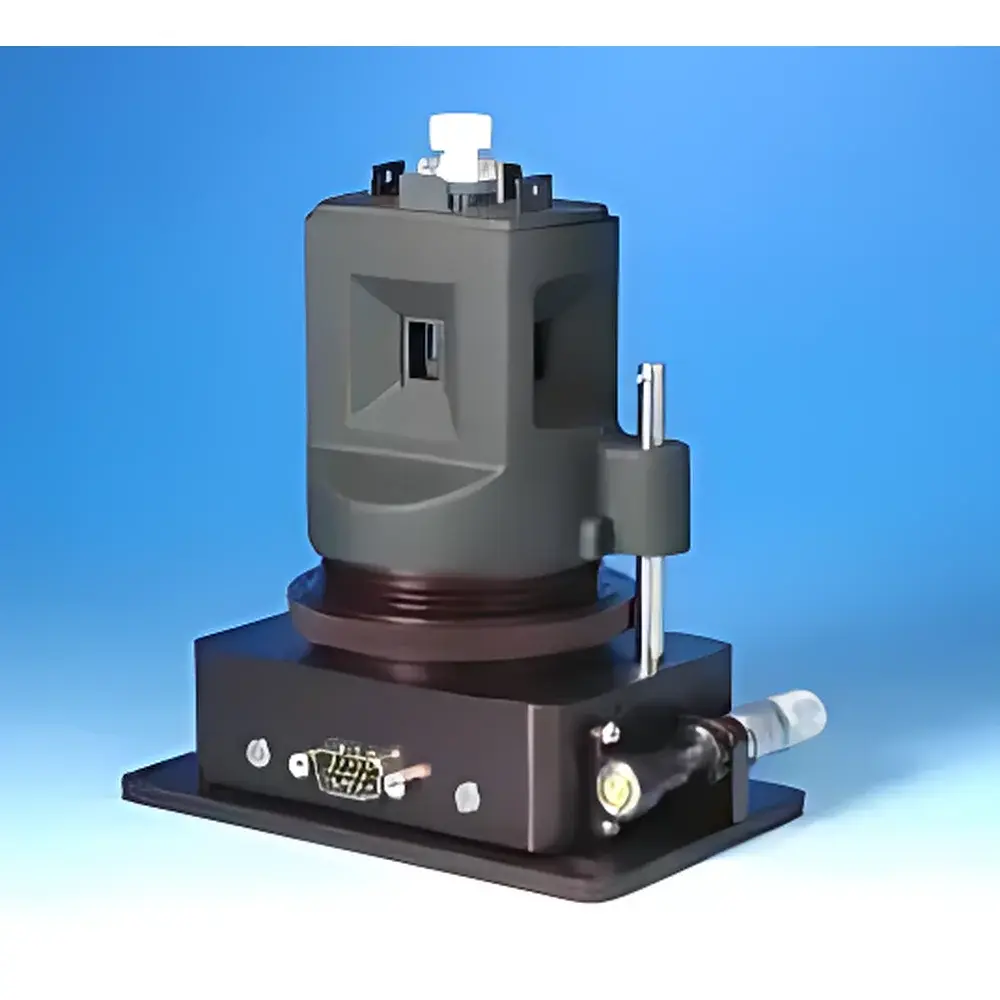
Quantum Northwest FLASH300 Precision Temperature-Controlled Cuvette Holder
| Brand | Quantum Northwest |
|---|---|
| Origin | South Korea |
| Model | FLASH300 Cuvette Holder |
| Temperature Range (Standard) | −40.00 to +110.00 °C |
| Temperature Range (Extended) | −50.00 to +150.00 °C |
| Temperature Accuracy | ±0.02 °C |
| Control Method | Peltier-based |
| Temperature Sensing | Integrated thermistor |
| Optical Ports | 4 side-mounted collinear ports |
| Vertical Adjustment | Micrometer-driven height alignment |
| Horizontal Translation | Micrometer-driven X-axis positioning |
| Sample Agitation | Adjustable-speed magnetic stirring |
| Optional Accessories | Thermal insulation shield, custom cuvette adapters, script-controlled temperature ramping |
Overview
The Quantum Northwest FLASH300 Precision Temperature-Controlled Cuvette Holder is an engineered optical component designed for high-fidelity spectroscopic measurements requiring strict thermal regulation of liquid or solid-state samples. Built upon a robust Peltier thermoelectric architecture, the FLASH300 delivers rapid, bidirectional temperature control across an industry-leading range—from −50.00 °C to +150.00 °C—with stability and accuracy of ±0.02 °C under steady-state conditions. Its core function is to maintain precise thermal equilibrium within standard and custom cuvettes while preserving optical access for collinear beam paths. Unlike passive thermal blocks or bath-based systems, the FLASH300 integrates active feedback control via an embedded thermistor sensor placed in direct thermal proximity to the sample chamber, enabling real-time closed-loop regulation. This makes it particularly suitable for time-resolved techniques—such as transient absorption, flash photolysis, and time-correlated single-photon counting—where thermal drift can introduce systematic artifacts into kinetic or spectral datasets.
Key Features
- Peltier-driven temperature control with programmable ramp rates and hold profiles, supporting both heating and cooling without external chillers or cryogens
- Four orthogonal, anti-reflective coated optical ports aligned to a common axis—enabling simultaneous excitation, detection, reference, and probe beam access
- Micrometer-actuated vertical adjustment (±10 mm range) and horizontal translation (±5 mm) for sub-50 µm beam alignment repeatability
- Integrated magnetic stirrer with continuously adjustable rotation speed (0–1200 rpm), ensuring homogeneous temperature distribution across viscous or layered samples
- Modular thermal shielding option for low-temperature operation (<−30 °C), minimizing condensation and ambient heat load
- Native support for LabVIEW, Python (via RS-232/USB-VCP), and MATLAB scripting interfaces—enabling synchronized temperature sweeps with data acquisition hardware
Sample Compatibility & Compliance
The FLASH300 accommodates standard 10 × 10 mm square cuvettes, 12.5 × 12.5 mm quartz cells, and custom-machined sample holders up to 25 mm in cross-section. It is compatible with UV-Vis, fluorescence, CD, Raman, NIR, and ultrafast laser-based configurations—including pump-probe geometries requiring orthogonal or co-linear beam routing. All internal wetted surfaces are chemically inert (anodized aluminum and PTFE-sealed gaskets), supporting aqueous, organic, and mildly corrosive solvents. The device complies with IEC 61010-1 for laboratory electrical safety and meets electromagnetic compatibility requirements per EN 61326-1. While not certified for GLP/GMP environments out-of-the-box, its deterministic thermal response, audit-ready logging capability (when used with QNW’s optional software suite), and traceable calibration path align with ISO/IEC 17025 documentation expectations for method validation.
Software & Data Management
The FLASH300 operates natively with Quantum Northwest’s QWin software, which provides full graphical control of temperature setpoints, ramp rates, dwell times, and stirring parameters. Real-time thermistor voltage and calculated temperature values are logged at user-defined intervals (down to 10 Hz) and exported in CSV or HDF5 format. For integration into automated workflows, the instrument supports SCPI-like ASCII command sets over USB virtual COM port or RS-232, allowing interoperability with third-party platforms including National Instruments DAQ systems, Thorlabs Kinesis, and Ocean Insight spectrometer SDKs. All temperature logs include UTC timestamps and firmware version metadata—supporting traceability in regulated environments where 21 CFR Part 11 electronic record integrity is required.
Applications
- Temperature-dependent UV-Vis absorption edge analysis in semiconductor nanomaterials
- Variable-temperature fluorescence quantum yield determination (e.g., per ASTM E2658)
- Enzyme kinetics studies requiring precise thermal initiation (e.g., stopped-flow coupling)
- Circular dichroism measurements of protein folding/unfolding transitions
- Transient absorption spectroscopy of photoactive complexes under controlled thermal quenching
- Raman spectral mapping of phase transitions in polymorphic crystals
- Calibration reference for IR thermography systems using blackbody-equivalent liquid standards
FAQ
What is the minimum temperature stabilization time from ambient to −40 °C?
Typical stabilization time is ≤12 minutes when operating at maximum cooling power with a 3.5 mL water-filled quartz cuvette.
Can the FLASH300 be integrated into a vacuum-compatible optical setup?
No—the unit is not vacuum-rated; its Peltier modules and thermistor wiring require atmospheric pressure for thermal interface integrity.
Is NIST-traceable calibration available?
Yes—Quantum Northwest offers factory calibration against a Fluke 1524 thermometer with uncertainty ≤±0.015 °C (k=2) across the full operational range.
Does the magnetic stirrer function below 0 °C?
Yes, provided the sample viscosity remains below 500 cP; performance may degrade in highly viscous cryosolvents such as ethylene glycol/water mixtures below −20 °C.
How is thermal uniformity across the cuvette verified?
Uniformity is characterized using micro-thermocouple mapping; axial gradients remain <±0.05 °C over 10 mm pathlengths under static conditions, and <±0.15 °C during active stirring at 800 rpm.




