Microarea In-situ Major and Trace Element Analysis Service
| Brand | Chemlab Pro |
|---|---|
| Origin | Shanghai, China |
| Manufacturer Type | Authorized Distributor |
| Country of Origin | China |
| Model | Microarea In-situ Major and Trace Element Analysis |
| Quotation | Available upon Request |
| Service Experience | 3–5 Years |
Overview
This service provides high-spatial-resolution, in-situ quantitative analysis of major, minor, and trace elements in solid heterogeneous samples using laser ablation inductively coupled plasma mass spectrometry (LA-ICP-MS) and micro X-ray fluorescence (μXRF) mapping. The methodology is grounded in time-of-flight or quadrupole-based ICP-MS detection coupled with calibrated excimer or Nd:YAG laser ablation systems (typically 193 nm or 213 nm), enabling spot analysis down to ~5–20 µm lateral resolution and depth profiling with sub-micron layer resolution. LA-ICP-(TOF)MS delivers full elemental coverage (Li–U) in a single acquisition, while LA-ICP-MS quantification for major and trace elements relies on matrix-matched reference materials and internal standardization (e.g., 43Ca, 29Si, or 13C). μXRF complements this by providing rapid, non-destructive 2D elemental distribution maps at ~10–50 µm resolution. The technique is widely applied in geochemistry, metallurgy, biomedical research, and materials science where spatial context and elemental heterogeneity are critical.
Key Features
- In-situ analysis without bulk dissolution—preserves sample integrity and spatial relationships
- Simultaneous detection of >70 elements (including light elements Li, Be, B, and refractory species Zr, Hf, Ta, U) via LA-ICP-(TOF)MS
- Quantitative accuracy validated against NIST SRMs (610, 612, 614, 1486) and geological reference glasses (BCR-2-NP, BIR-2-NP, FK-N-NP)
- Internal standard correction supported by secondary electron imaging (SEM-BSE), cathodoluminescence (CL), and transmitted/reflected light microscopy
- Standardized data reduction using Iolite v4 or GLITTER software with offline integration of background subtraction, drift correction, and oxide/hydroxide interference modeling
- Compliance-ready reporting including raw signal files (.raw/.csv), processed concentration tables (ppm–wt%), and coordinate-referenced element maps
Sample Compatibility & Compliance
Suitable for polished thin sections, thick sections, metallographic mounts, and epoxy-embedded biological tissue sections. Sample dimensions must not exceed 90 × 90 × 8 mm; surface flatness must be ≤0.5 µm RMS over the analyzed area. All samples require pre-analysis documentation: high-resolution reflected-light photomicrographs with annotated regions of interest (ROIs), CL or transmitted-light images where applicable, and a detailed sample preparation log (e.g., polishing protocol, carbon coating thickness, dehydration method for tissues). Biological specimens must be formalin-fixed, paraffin- or OCT-embedded, sectioned at 5–20 µm, and deparaffinized prior to analysis. The workflow adheres to ISO/IEC 17025:2017 requirements for testing laboratories, with documented uncertainty budgets per element and traceable calibration chains. Data packages support GLP/GMP audit trails when requested.
Software & Data Management
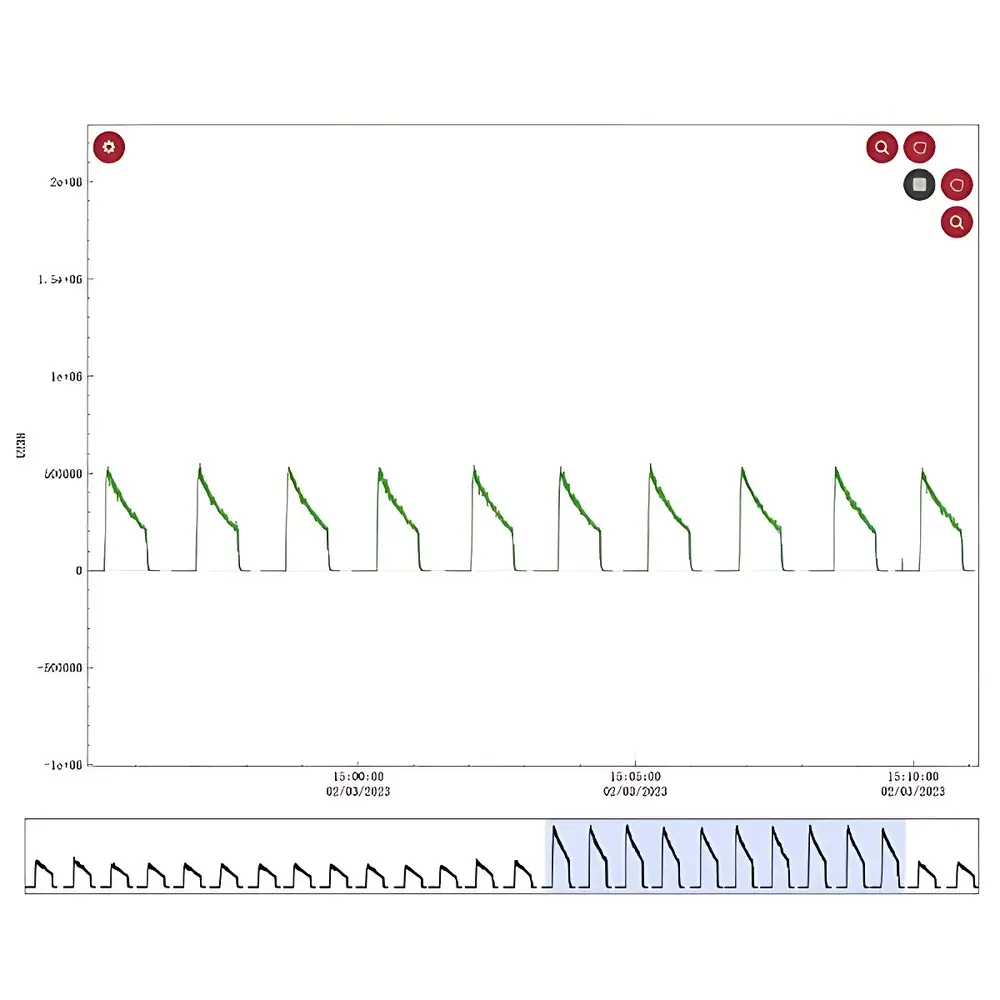
Data acquisition is performed using Thermo Fisher Qtegra ISDS or Elemental Scientific Lasers’ NWRControl software, synchronized with ICP-MS instrument control. Quantitative processing follows peer-reviewed protocols implemented in Iolite v4 (v4.5+), including the “Time Resolved Analysis” (TRA) and “Common Lead Correction” modules. All datasets include timestamped metadata (laser fluence, repetition rate, dwell time, carrier gas flow), raw intensity time-series, and standardized concentration outputs in SI-compliant units (mg/kg, wt%, µg/g). Clients receive encrypted ZIP archives containing ASCII-formatted results, GeoPIXE-compatible .map files for μXRF, and PDF reports with analytical conditions, detection limits (3σ blank), and certified reference material recovery statistics (typically 92–108% for elements ≥10 ppb).
Applications
- Geochemical zonation studies in zircon, apatite, and garnet for petrogenetic and geochronological interpretation
- Trace element partitioning across phase boundaries in igneous and metamorphic rocks
- Distribution mapping of alloying elements (e.g., Al, Cr, Ni, Mo) and impurities (S, P, O) in aerospace-grade superalloys and additive-manufactured metals
- Metallomic profiling of calcified plaques, tumor margins, and neuronal tissue sections to correlate elemental dysregulation with histopathology
- Authentication and provenance assessment of archaeological ceramics and pigments via rare earth element (REE) fingerprinting
FAQ
What is the typical detection limit for trace elements using LA-ICP-MS in this service?
Detection limits range from 0.01–0.5 ng/g (mass fraction), depending on element mass, ionization efficiency, and matrix composition. Limits are empirically determined per session using NIST 612 blanks and reported in the final certificate.
Can you analyze hydrated or volatile-rich samples such as fluid inclusions or hydrous minerals?
Yes—cryo-LA protocols are available upon request, utilizing liquid nitrogen-cooled sample chambers and low-fluence ablation to minimize volatile loss. Additional validation with synthetic inclusion standards is recommended.
Is it possible to co-register LA-ICP-MS data with SEM-EDS or Raman maps?
Yes. Coordinate alignment is performed using fiducial markers (e.g., Pt deposition or scribed crosshairs) and affine transformation in Fiji/ImageJ. Full multimodal overlay is delivered as layered TIFF or GeoTIFF.
Do you provide method validation documentation for regulatory submissions?
Upon request, we supply analytical method validation packages compliant with ICH Q2(R2), including specificity, linearity (R² ≥0.999), precision (RSD ≤5% intra-run, ≤8% inter-run), and accuracy (CRM recovery ±10%).
How is data confidentiality handled for proprietary or publication-sensitive projects?
All projects are governed by a bilateral NDA. Raw data remains the client’s intellectual property; processed outputs are retained for 5 years per ISO/IEC 17025 and purged thereafter unless extended archiving is contracted.
Related Products