
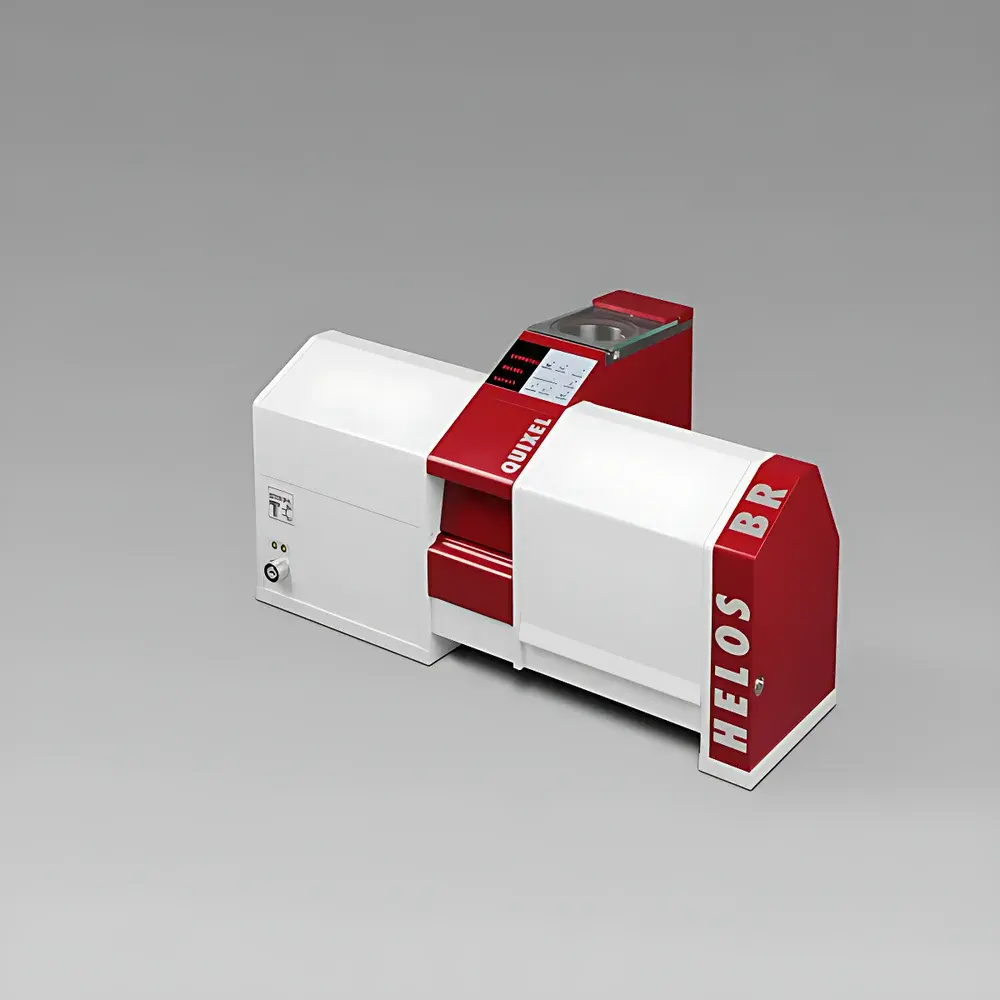
SYMPATEC HELOS & QUIXEL Automated Wet-Dispersion Laser Diffraction Particle Size Analyzer
| Brand | SYMPATEC |
|---|---|
| Origin | Germany |
| Manufacturer | SYMPATEC GmbH |
| Type | Laboratory Laser Diffraction Analyzer |
| Measurement Range | 0.1–3500 µm |
| Repeatability | ≤0.04% RSD |
| Measurement Time | 10 s |
| Dispersion Method | Wet Dispersion |
| Housing Material | Stainless Steel |
| Optional Accessories | Heated Circulation Module (up to 100 °C), Temperature-Controlled Jacketed Flow Cell, Multiple Flow Cell Options (2 mm and 6 mm path lengths), Integrated Ultrasonic Dispersion (0–60 W, continuously adjustable) |
Overview
The SYMPATEC HELOS & QUIXEL is a fully automated, high-precision wet-dispersion laser diffraction particle size analyzer engineered for rigorous laboratory and process-support applications. It operates on the fundamental principle of Fraunhofer diffraction and Mie theory—measuring angular intensity distribution of light scattered by particles suspended in a liquid medium. Larger particles produce smaller scattering angles; smaller particles generate wider-angle diffraction patterns. A high-resolution multi-element photodetector array captures the full far-field scattering profile, enabling robust size distribution calculation across a dynamic range of 0.1 to 3500 µm. Unlike conventional systems reliant on flexible tubing and external ultrasonication baths, the QUIXEL dispersion module features a tubeless, all-stainless-steel fluidic architecture with an integrated centrifugal pump capable of recirculating dense suspensions—including particles up to 3 mm in diameter—without requiring high-viscosity carrier liquids. This eliminates cross-contamination risks, reduces maintenance, and ensures hydraulic stability essential for regulatory-compliant operation.
Key Features
- Tubeless stainless-steel circulation system with corrosion-resistant wetted parts, compatible with aqueous and organic dispersants (e.g., isopropanol, xylene, ethylene glycol)
- High-torque centrifugal pump with ceramic bearings, rated for continuous operation with abrasive or high-density slurries (e.g., SiC, tungsten carbide, metal oxides)
- Integrated ultrasonic transducer (0–60 W, continuously variable) mounted directly on the flow cell housing—enabling real-time, energy-optimized deagglomeration without external bath coupling
- Dual-level capacitive liquid sensing (300 mL and 1000 mL thresholds) for automatic media volume monitoring and intelligent refill triggering
- Modular flow cell options: 2 mm path length for high-concentration samples; 6 mm for low-absorbance or highly transparent media
- Optional thermostatic jacketing and Peltier-heated circulation unit (operable from 5 °C to 100 °C), supporting temperature-dependent stability studies and ISO 13320-compliant thermal ramp protocols
- Full 316L stainless-steel construction of optical bench, pump housing, and fluid path—certified for IP54 environmental rating and compliant with EHEDG hygienic design guidelines
Sample Compatibility & Compliance
The HELOS & QUIXEL accommodates a broad spectrum of sample types: stable colloids, shear-sensitive biopolymers, high-solids-content battery cathode slurries (e.g., NMC, LFP), mineral suspensions (kaolin, talc), pharmaceutical nanosuspensions, and pigment dispersions. Its dispersion robustness enables reproducible analysis of materials traditionally challenging for laser diffraction—including agglomerated metal powders, hydrophobic nanoparticles, and thermally labile proteins. The system meets ISO 13320:2020 requirements for laser diffraction sizing methodology and supports audit-ready documentation per FDA 21 CFR Part 11 (electronic records/signatures), EU Annex 11, and GLP/GMP environments. All software logs—including instrument parameters, SOP execution history, user actions, and raw scattering data—are timestamped, immutable, and exportable in .csv and .xml formats.
Software & Data Management
WINDOX 7 software provides a validated, role-based interface with embedded Standard Operating Procedure (SOP) templates, customizable method wizards, and automated report generation (PDF, Excel). It includes FDA 21 CFR Part 11 compliance mode with electronic signatures, audit trail activation, and user privilege management (administrator, operator, reviewer). Advanced data evaluation tools support multi-sample comparison, batch trend analysis, D10/D50/D90 statistical overlays, and ISO 9276-2 compliant graphical representation (log-normal, Rosin-Rammler). Raw scattering patterns are stored alongside metadata (temperature, viscosity, refractive index), enabling retrospective reprocessing using updated optical models without re-measurement.
Applications
The HELOS & QUIXEL delivers critical quality control and R&D insights across regulated and industrial sectors. In lithium-ion battery manufacturing, it monitors cathode slurry homogeneity and detects micron-scale agglomerates that impair electrode coating uniformity. In pharmaceutical development, it verifies nanoparticle size stability under physiological pH and ionic strength conditions. In pigment formulation, it quantifies grinding endpoint and correlates spectral response with Dv50 shifts. For mineral processing, it validates cyclone overflow cuts and flotation feed consistency. Real-time multi-line integration—via optional PLC-compatible digital I/O—is deployed in calcium carbonate wet-milling plants to trigger mill speed adjustments based on in-line D90 feedback, reducing overgrinding energy consumption by up to 18% (validated per ASTM D7924-22).
FAQ
What dispersion media are compatible with the QUIXEL system?
Aqueous buffers, alcohols (ethanol, isopropanol), hydrocarbons (toluene, xylene), and glycols—provided they exhibit acceptable transmission at 632.8 nm and do not corrode 316L stainless steel.
Can the system measure polydisperse samples containing both submicron and millimeter-sized particles?
Yes—the dual-range detector array and adaptive signal normalization enable simultaneous resolution across the full 0.1–3500 µm span without manual range switching or dilution recalibration.
Is calibration traceable to NIST standards?
Instrument optical alignment and detector response are verified using SYMPATEC’s certified reference materials (CRM), each traceable to PTB (Physikalisch-Technische Bundesanstalt) and NIST-traceable particle size standards.
How is data integrity ensured during long-term unattended operation?
WINDOX 7 implements cyclic checksum validation of raw scattering files, automatic backup to network drives, and hardware watchdog timers that trigger safe shutdown upon communication timeout or power anomaly.
Does the system support Good Manufacturing Practice (GMP) workflows?
Yes—full 21 CFR Part 11 compliance mode includes electronic signature capture, biometric or token-based authentication, and configurable retention policies aligned with ICH E6(R3) and EU GMP Annex 11 requirements.



